


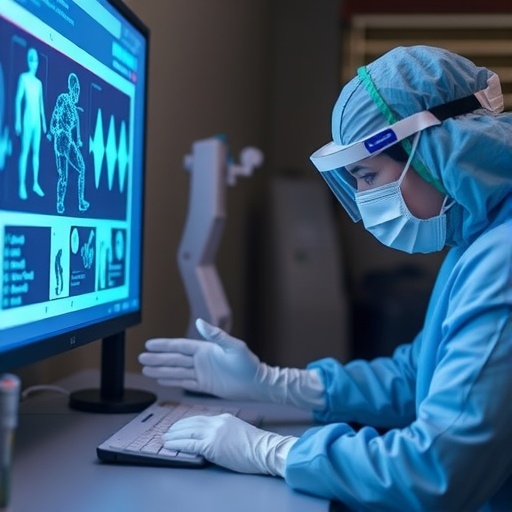
In the rapidly evolving landscape of healthcare, artificial intelligence (AI) is making waves not only in diagnostics and treatment but also in the critical domain of training healthcare professionals. A recent scoping review conducted by scholars including Lv, Y., Cai, M., and Xiang, Q., highlights how AI-assisted technologies can transform the way personal protective equipment (PPE) is taught and practiced among health professions students and healthcare workers. This innovative approach is particularly crucial in the context of contemporary challenges such as pandemics and infectious disease outbreaks, where the proper use of PPE is a matter of not just personal safety, but also public health.
The necessity of effective training in donning and doffing PPE cannot be overstated. Healthcare workers are often at the frontline of disease prevention and control, and their exposure to pathogens necessitates impeccable adherence to safety protocols. Traditional methods of training, which often involve passive learning through lectures or manual demonstrations, risk inadequate retention of critical skills. The introduction of AI into this training paradigm offers the potential for a more interactive and engaging learning experience, catering to the diverse needs of learners in a more personalized manner.
Artificial intelligence serves as a powerful enabler in simulating real-world scenarios that healthcare workers may face when interacting with infected patients or contaminated environments. For instance, AI-driven virtual simulations can provide a safe and controlled environment for trainees to practice the donning and doffing of PPE. By immersing learners in these virtual contexts, they can hone their skills without the risk of exposure to harmful pathogens. This level of engagement is not only beneficial for skill acquisition but also alleviates anxiety and enhances the preparedness of trainees for real-life situations.
The scoping review underscores the various AI technologies that can be integrated into PPE training. Machine learning algorithms can analyze a trainee’s performance in real-time, offering instant feedback and personalized recommendations for improvement. This immediate response loop is invaluable, allowing trainees to rectify mistakes and reinforce their learning on the spot. Such dynamic feedback mechanisms have the potential to reduce training time and increase proficiency compared to traditional training methods.
Gamification is another innovative aspect highlighted in the review. By incorporating game-like elements into training modules, AI can create an environment that fosters motivation and competition among learners. This approach not only makes the learning process enjoyable but also increases retention rates. Trainees are more likely to remember procedures that they have practiced in a playful manner, as opposed to those learned through monotonous tasks. By turning training into a game, AI can enhance engagement while ensuring that critical safety protocols are effectively communicated and internalized.
Moreover, the review discusses how AI can assist in developing tailored training programs that adapt to the unique learning curves of individual students. Personalized learning pathways allow educators to meet the diverse needs of their students, who may have varying levels of pre-existing knowledge and skill. By analyzing data on a trainee’s performance and learning style, AI can recommend specific training modules or additional resources that will best support their development. This level of customization in training is especially important in a diverse cohort of health professionals, where one-size-fits-all approaches often fall short.
The results of the scoping review also indicate a growing acceptance of AI-assisted training among healthcare educators and institutions. As more evidence emerges to support the effectiveness of these technologies, there is an increasing push towards incorporating them into standard training curricula. The potential for enhanced learning experiences has prompted many institutions to explore partnerships with tech companies that specialize in AI, allowing for the co-development of training tools that are contextually relevant and scientifically sound.
One of the salient concerns regarding AI in healthcare training is the need for rigorous validation and oversight. As with any technology, ensuring the accuracy and reliability of AI systems is paramount. The scoping review calls for further research into best practices and ethical considerations when integrating AI tools into training regimes. It is essential that these systems not only provide effective training but also maintain the highest standards of safety and efficacy in their designs.
As AI continues to shape the future of healthcare education, it is critical to remain vigilant about data privacy and security issues. The handling of personal data, particularly in a field as sensitive as healthcare, necessitates robust protocols to protect trainees’ information. The scoping review emphasizes the importance of transparency in how AI systems utilize data and advocates for building trust among users who may be apprehensive about adopting new technologies.
Furthermore, the review touches on the scalability of AI-assisted training programs. With many regions facing shortages of trained healthcare workers, AI offers a method to scale training beyond traditional limitations, reaching a wider audience of learners across different geographies. For instance, remote training facilitated by virtual platforms can help overcome geographical barriers, allowing healthcare workers in underserved areas to access high-quality education that they might otherwise lack.
Looking ahead, the scoping review predicts that the integration of AI will not just enhance training in PPE protocols but also extend to various competencies across the healthcare field. As institutions increasingly leverage AI to prepare professionals for a rapidly changing healthcare landscape, it is envisioned that a shift will occur towards more holistic training methodologies that encompass not just technical skills but also the critical soft skills necessary for effective patient interactions and teamwork.
In conclusion, the insights from the review published by Lv, Y., Cai, M., and Xiang, Q. paint a promising picture of the future of training healthcare professionals. The convergence of artificial intelligence with traditional education methods could herald a new era of preparedness and competence among healthcare workers, ultimately contributing to better health outcomes for communities worldwide. As research in this domain continues to evolve, the lessons learned from AI-assisted training will undoubtedly influence how the next generation of healthcare professionals is equipped to handle the complexities of modern healthcare environments.
Lv, Y., Cai, M., Xiang, Q. et al. Artificial intelligence-assisted personal protective equipment donning and doffing training for health professions students and healthcare workers: a scoping review.
BMC Med Educ (2025). https://doi.org/10.1186/s12909-025-08498-5
Cite Scienmag News
Courtney Benton. (December 24, 2025). AI Enhances PPE Training for Healthcare Workers. Scienmag. https://scienmag.com/ai-enhances-ppe-training-for-healthcare-workers/
Courtney Benton. "AI Enhances PPE Training for Healthcare Workers." Scienmag, 24 December 2025, https://scienmag.com/ai-enhances-ppe-training-for-healthcare-workers/. Accessed 3 September 2026.
Courtney Benton. "AI Enhances PPE Training for Healthcare Workers." Scienmag. December 24, 2025. https://scienmag.com/ai-enhances-ppe-training-for-healthcare-workers/


