


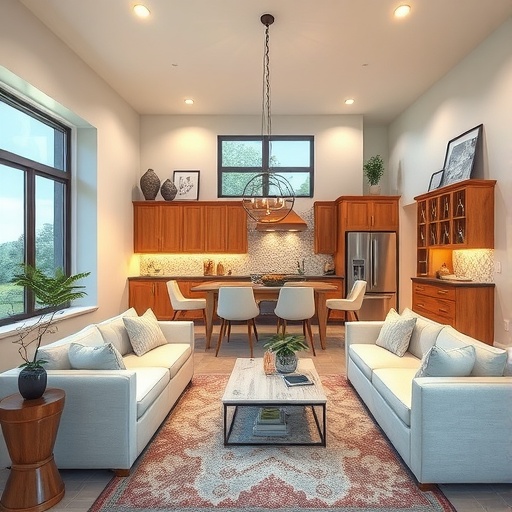
In a world increasingly shaped by technological innovation, the realms of artificial intelligence and smart home design have converged in transformative ways, particularly in catering to the aging population. A recent study conducted by researcher D. Jiang, published in Discover Artificial Intelligence, delves deep into this confluence, revealing vital insights on how AI can enhance personalized space design specifically tailored for older adults. By integrating AI-driven methodologies into the renovation processes of smart homes, Jiang emphasizes the potential of creating living environments that are not only functional but also aging-friendly.
The aging demographic poses unique challenges to home design. As older adults often face mobility issues, cognitive decline, and other health-related concerns, the need for specialized living environments has never been more pressing. Jiang articulates a visionary approach that harnesses AI to curate individualized home environments that cater to these challenges. The aspiration is clear: a home that intuitively supports the well-being and lifestyle choices of its older residents.
Central to Jiang’s research is the concept of personalized space design. This approach transcends traditional renovation paradigms, integrating an understanding of individual needs, preferences, and health profiles into the spatial design process. By employing AI technologies, designers can analyze user data to create tailored living spaces that promote safety, comfort, and independence. The research underscores the need for a shift from generic renovations to designs that truly reflect the inhabitants’ unique circumstances.
Jiang’s paper thoroughly explores the technical frameworks that enable such personalized experiences. Leveraging machine learning algorithms and data analytics, the proposed design systems can learn from user interactions, continually adapting and evolving to meet changing needs. Such systems might incorporate sensors and actuators that enable smart appliances, lighting, and climate controls to respond intelligently to the daily routines and preferences of older adults, ensuring that their living environment is empathetic and responsive.
One of the pivotal findings of Jiang’s research lies in the integration of user feedback mechanisms. By fostering continuous communication between inhabitants and the AI systems, the design can iterate in real-time, responding to immediate needs. For example, an AI system could prompt users to adjust home settings for optimal comfort or provide reminders for medication, seamlessly intertwining functionality with daily living.
Additionally, the study highlights the role of virtual reality (VR) in the design process. Implementing VR technologies allows designers and older adults to visualize and interact with potential renovations before actual implementation. This level of engagement enables users to express their preferences and desires more vividly, ensuring that the end result is not only technologically advanced but also personal and heartfelt. This innovative pre-design phase can dramatically enhance user satisfaction with the final product.
The paper also discusses various design interventions that could be augmented by AI. From ergonomic furniture that adapts to the user’s posture and movements to smart home automation systems that proactively manage energy and security needs, the implications are vast and encourage a rethinking of conventional living spaces. These innovations, micro-engineered to enhance user experience, offer a promising glimpse into the future of aging in place.
As the aging population expands across the globe, the intersection of AI and smart home renovation shines as a beacon of hope. Jiang’s exploration presents convincing evidence that personalized space design is not merely an aspiration but a reachable goal. By fostering environments that empower older adults, society can mitigate many of the challenges faced by this demographic, allowing for healthier, happier, and more independent living.
Moreover, the research urges policy makers and industry stakeholders to embrace these AI-driven solutions. The integration of personalized space design into smart home renovation projects can serve as a model for future advancements in housing and care for the elderly. By investing in technologies that prioritize personal well-being, society can pave the way toward more inclusive living environments that respect the dignity and autonomy of older adults.
In conclusion, Jiang’s exploration into artificial intelligence-driven personalized space design offers a compelling vision for the future of home renovation. The synthesis of technology and tailored living solutions not only prepares us for the demographic shifts but also champions the cause of accessibility, empowerment, and independence. As we move forward, the challenge will be to continue innovating while maintaining the human touch in our design philosophies—ensuring that technology serves as a bridge to a better quality of life for our aging population.
By fostering advancements in AI, designers, engineers, and advocates can unite to realize this vision. The research signifies a collective movement toward creating environments that not only accommodate but also cherish the older community, illustrating the profound impact that thoughtful design, underpinned by artificial intelligence, can hold in shaping the future of our homes.
Each revelation in Jiang’s work shines a light on the importance of holistic design principles, not only in terms of aesthetics but also in functionality and user experience. Innovations in artificial intelligence allow for a deeper understanding of how space can enhance quality of life, thereby marking a transformative era in the intersection of technology and elder care.
In essence, Jiang’s pioneering work lays a foundational stone for future research and development in personalized space design, prompting both reflection and action among stakeholders across sectors. By reimagining how we configure our living spaces through the lens of artificial intelligence, we open the doors to a future where every older adult can thrive in an environment that feels custom-tailored just for them.
Jiang, D. Artificial intelligence-driven personalized space design and implementation in the aging-friendly renovation of smart home.
Discov Artif Intell 5, 302 (2025). https://doi.org/10.1007/s44163-025-00556-7
Cite Scienmag News
Beatrice Stafford. (October 31, 2025). AI-Enhanced Smart Home Design for Aging-Friendly Renovations. Scienmag. https://scienmag.com/ai-enhanced-smart-home-design-for-aging-friendly-renovations/
Beatrice Stafford. "AI-Enhanced Smart Home Design for Aging-Friendly Renovations." Scienmag, 31 October 2025, https://scienmag.com/ai-enhanced-smart-home-design-for-aging-friendly-renovations/. Accessed 3 September 2026.
Beatrice Stafford. "AI-Enhanced Smart Home Design for Aging-Friendly Renovations." Scienmag. October 31, 2025. https://scienmag.com/ai-enhanced-smart-home-design-for-aging-friendly-renovations/


