


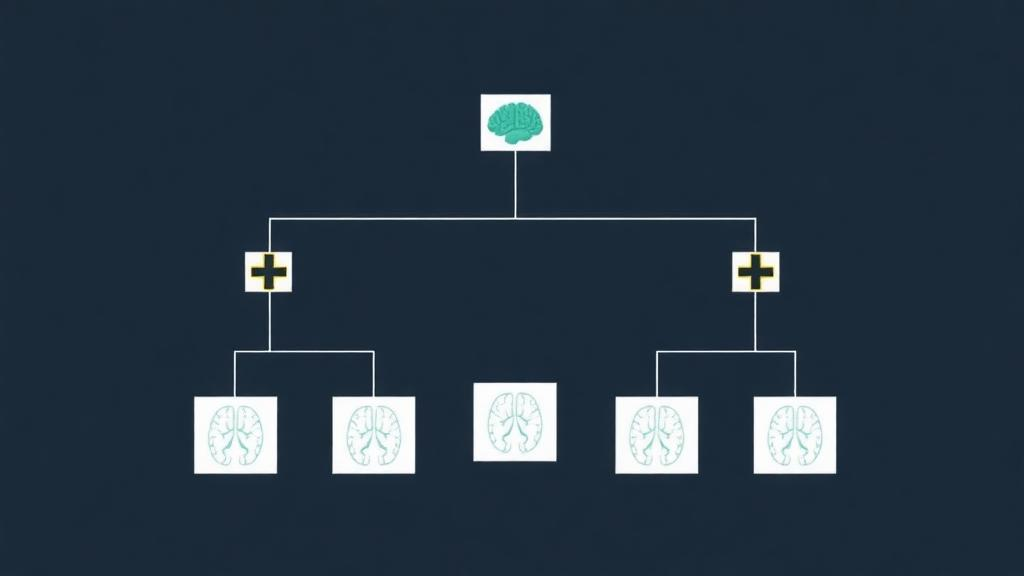
Every year, hospitals around the world absorb enormous costs and patients absorb enormous risks when they are discharged, only to reappear within weeks through the emergency department door. In neurology, where conditions range from stroke and epilepsy to brain tumors and poorly understood functional disorders, unplanned readmissions are a particularly stubborn signal that something in the chain of care has broken down. A new study from Jordan, published in PLOS One, takes a deliberately transparent approach to this problem: rather than hiding inside a black-box algorithm, it uses a classic machine learning technique called a CHAID decision tree to sort thousands of neurological admissions into visually interpretable risk groups, offering clinicians a map of who returns to the hospital and why.
The research team, led by Randa Al-Kharabsheh and Muayyad Ahmad, analyzed the electronic health records of 2,795 adult neurology admissions treated between 2022 and 2024. Each patient’s diagnosis was coded and grouped according to the International Classification of Diseases, Tenth Revision, allowing the investigators to compare readmission patterns across disease categories rather than treating every neurological admission as interchangeable. From the same records, they extracted the clinical and demographic variables that hospitals routinely collect, and then put nine different prediction models head to head to see which could best identify patients at risk of an unplanned return.
The headline numbers are sobering. Across the full cohort, 8.9 percent of neurological patients were readmitted unexpectedly after discharge. But that average conceals dramatic variation: among patients whose primary diagnosis was a neoplasm, roughly one in four, 24 percent, came back to the hospital unplanned, a rate nearly three times the overall figure. That single statistic illustrates why the researchers argue that population-level risk stratification, rather than one-size-fits-all discharge planning, could meaningfully change how neurology services allocate follow-up resources.
After comparing the nine candidate models, the team selected the Chi-square Automatic Interaction Detection algorithm, better known as CHAID. The method works by repeatedly splitting the patient population on the variable that shows the statistically strongest association with the outcome, in this case unplanned readmission, and then splitting each branch again, producing a tree whose paths can be read like a flowchart. A clinician can trace a branch and see, in plain terms, that a patient with a particular combination of comorbidity burden, age, sex, and region of residence lands in a high-risk leaf. That interpretability is precisely why the authors chose CHAID over more accurate but opaque competitors: in a hospital setting, a model that clinicians can understand and challenge is often more useful than one that performs marginally better but cannot explain itself.
The model’s raw discriminative power was modest. On a held-out test set, it achieved an area under the receiver operating characteristic curve, or AUC, of 0.671, a value the authors themselves characterize as poor to fair. In practical terms, the model distinguishes between patients who will and will not be readmitted only somewhat better than chance would allow at the individual level. For risk stratification across the full cohort, it reached a balanced accuracy of 0.63, with sensitivity of 0.52, meaning it caught about half of eventual readmissions, and specificity of 0.74, meaning it correctly cleared most patients who would not return. The researchers are candid that these numbers do not support using the tool to predict any single patient’s fate, and they frame the model instead as a screening instrument for identifying subgroups that deserve intensified attention.
What the model lacks in individual precision, it partly compensates for in the clarity of its risk profiles. The strongest single predictor was the Charlson Comorbidity Index, a weighted score that tallies a patient’s burden of chronic illnesses; patients scoring five or higher sat firmly in the high-risk branches of the tree. Age, sex, length of hospital stay, and geographic region also shaped the splits. The subgroup analyses are where the study becomes genuinely revealing. Vascular patients, such as those admitted after stroke, who also carried high comorbidity scores formed a distinctly high-risk cluster, an association so strong that it reached a p-value below .001 with a chi-square statistic of 66.368. Among younger female patients, 37.3 percent had neoplasms, a statistically significant enrichment that flags a group in whom cancer-related readmissions drive much of the risk. And patients diagnosed with functional disorders who came from northern regions emerged as a third distinct profile, a finding the authors report with a p-value of .009.
Each of these profiles tells a different operational story. High-comorbidity stroke patients may need tighter medication reconciliation, earlier outpatient follow-up, and coordinated management of diabetes, kidney disease, and cardiac conditions that neurologists alone cannot address. Young women with brain tumors may require oncology-linked discharge planning, symptom management protocols, and clearer pathways back to specialized care when complications arise. The geographic signal among functional disorder patients hints at structural inequities, possibly in access to follow-up services or in the burden of travel, that no amount of bedside clinical care can fix on its own. A decision tree cannot say which intervention will work, but by making the risk architecture visible, it tells hospital administrators where to look first.
The study carries additional weight because of where it was conducted. The authors note that this is one of the first investigations from the Middle East to demonstrate the potential of CHAID-based risk stratification for neurology readmissions. Much of the readmission-prediction literature comes from North American and European health systems with different payment structures, discharge practices, and patient populations, and models trained in those settings often transfer poorly. Building local evidence from Jordanian electronic health records is a step toward risk tools that reflect the actual epidemiology and health-service geography of the region, including the role of regional referral patterns that emerged as a predictor in this analysis.
The researchers are equally clear about the limits of their work. The analysis was retrospective and internally validated only; the risk-stratification metrics were calculated descriptively from the complete cohort, while independent validation rested on the held-out test-set AUC. Before any clinical deployment, the model must undergo external validation in different hospitals, different regions, and ideally prospective data collection. Readmission is also a notoriously messy outcome, influenced by social factors, access to primary care, and hospital discharge practices that electronic records capture imperfectly. An AUC of 0.671 is a floor, not a ceiling, and the authors position their model as a foundation for refinement rather than a finished clinical instrument.
Even so, the study lands at a moment when health systems everywhere are under pressure to reduce avoidable returns, and it makes a case that is easy to underestimate: sometimes the most valuable algorithm is not the most accurate one but the most legible. A gradient-boosted ensemble might have squeezed a few extra points of AUC out of the same data, but no clinician could read it at a glance. A CHAID tree, by contrast, hands neurology departments a structured picture of their readmission problem, anchored in variables they already measure, and points them toward the specific combinations of diagnosis, comorbidity, age, sex, and geography where intervention is most likely to matter. For the one in eleven neurological patients in this cohort who returned to the hospital unplanned, and for the one in four cancer patients among them, that kind of clarity is a practical first step toward care that anticipates, rather than reacts to, the revolving door.
Subject of Research: AI-based prediction of unplanned hospital readmissions among neurological patients
Article Title: Predicting unplanned readmissions in neurological patients: A large-scale AI-driven analysis using CHAID decision trees
Article References: Al-Kharabsheh, R., & Ahmad, M. (2026). Predicting unplanned readmissions in neurological patients: A large-scale AI-driven analysis using CHAID decision trees. PLOS One, 21(10), e0360077. https://doi.org/10.1371/journal.pone.0360077
Image Credits: AI Generated
DOI: 10.1371/journal.pone.0360077
Keywords: unplanned readmissions, neurology, CHAID decision tree, machine learning, electronic health records, risk stratification, Charlson Comorbidity Index, Jordan, PLOS One, predictive modeling, hospital discharge, health informatics
Cite Scienmag News
Cassandra Pierce. (October 10, 2026). AI Decision Tree Flags Which Neurology Patients Are Most Likely to Return to Hospital. Scienmag. https://scienmag.com/ai-decision-tree-flags-which-neurology-patients-are-most-likely-to-return-to-hospital/
Cassandra Pierce. "AI Decision Tree Flags Which Neurology Patients Are Most Likely to Return to Hospital." Scienmag, 10 October 2026, https://scienmag.com/ai-decision-tree-flags-which-neurology-patients-are-most-likely-to-return-to-hospital/. Accessed 10 October 2026.
Cassandra Pierce. "AI Decision Tree Flags Which Neurology Patients Are Most Likely to Return to Hospital." Scienmag. October 10, 2026. https://scienmag.com/ai-decision-tree-flags-which-neurology-patients-are-most-likely-to-return-to-hospital/


