


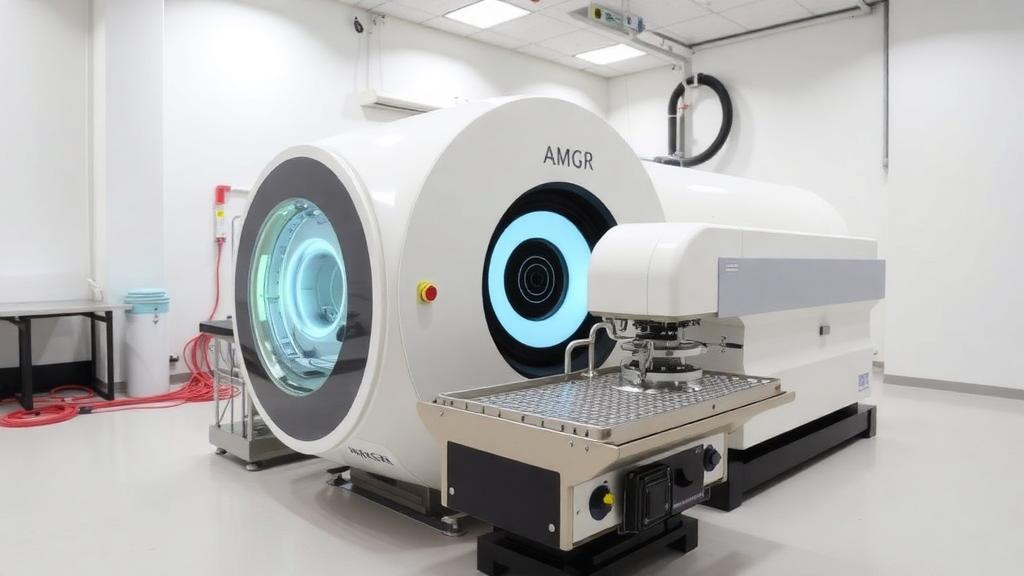
Nuclear magnetic resonance (NMR) spectroscopy has long faced an awkward trade-off. The sharpest, most information-rich spectra come from powerful superconducting magnets, where chemical shifts are spread wide and individual atoms can be told apart with ease. Yet many of the most revealing NMR experiments, from measuring how molecules tumble to generating hyperpolarized spin states, demand exactly the opposite: weak magnetic fields, sometimes down to the microtesla range, where different spin physics takes over. A team of researchers from Bruker BioSpin, the École normale supérieure in Paris, and the Magnetic Resonance Center in Florence now reports a device that promises to deliver both worlds at once, and it does so at remarkable speed.
Writing in the journal Magnetic Resonance, Jorge A. Villanueva-Garibay and colleagues introduce a new design of sample shuttle, a hybrid pneumatic–mechanical apparatus that physically transports a sealed NMR tube between the magnetic center of a high-field spectrometer and a low-field position up to roughly a meter away. The device reaches peak speeds of about 27 meters per second and accelerations up to 113.5 times gravity, completing a full round trip to a field of 36.6 millitesla in as little as 61 milliseconds on a 600 megahertz magnet, and 68 milliseconds on a 700 megahertz system. That velocity matters because every millisecond spent in transit is a millisecond during which the sample’s nuclear polarization, the precious signal-carrying resource of any NMR experiment, quietly drains away through longitudinal relaxation.
The concept of field cycling by sample shuttling is not new. Researchers have been pulling tubes out of magnets with cords, belts, racks, and puffs of compressed air for decades. Each approach carries its own compromises. Pneumatic systems can move lightweight shuttles quickly, but their hard landings risk damaging both hardware and fragile molecules, and they typically require specially designed probes that sacrifice sensitivity. Motor-driven systems offer gentle, fully controlled trajectories and work with conventional probes, but the belts and racks that couple motor to sample tend to be bulky, blocking access to the sample at the low-field position, a serious limitation for experiments in which the shuttle must pass through radiofrequency or gradient coils. Earlier designs, such as the Redfield shuttle, kept the moving parts slim but demanded laboratory ceilings of extraordinary height and could shake the entire magnet.
The new device, which the authors call the fast sample shuttle, or FSS, resolves this tension with an elegant division of labor. A cord attached to the sample container is wound onto a winch wheel driven by an 800-watt servomotor, providing precise, always-tensioned control of the trajectory on the way up. On the way down, gravity alone would be far too feeble, so the system applies a regulated overpressure of 3.5 bar from the top, pushing the container back toward the magnet with a strong, well-defined force. A second motor carrying a counter-rotating disk with the same inertia as the winch wheel spins in the opposite direction, canceling out the coherent mechanical vibrations that a single motor would otherwise transmit through the magnet’s Dewar and into the probe.
The sample container itself is deliberately slender. It is built on a standard 5-millimeter outer diameter borosilicate glass tube, extended to 9 inches in length and fitted with Vespel sleeves, a two-component seal plug confining about 650 microliters of sample, and an end cap knotted to the shuttle cord. The whole assembly measures just 6 millimeters across, narrow enough that future setups should allow near access to the sample at low fields for magnetic manipulation. Because the container places the sample at exactly the same position as a conventional 7-inch tube when it lands, the FSS works with any standard high-resolution probe head, preserving state-of-the-art sensitivity, and the amount of sample needed matches that of ordinary static NMR experiments.
Full control of the trajectory is central to the design philosophy. The position of the container is monitored indirectly but precisely through the angular variation of the servomotor, and the motion follows constant acceleration up to the midpoint of the path or a predefined maximum speed. On the 700 megahertz system in Florence, the container travels 1020 millimeters to the furthest low-field position in 68 milliseconds, dwells there for a set delay as short as 3 milliseconds, and returns in the same time. The authors calculated that pushing transfer times much below these values would demand accelerations beyond what the current design can achieve; shaving the 800-millimeter trip down to 50 milliseconds, for instance, would require roughly 150 times gravity. The acceleration scales quadratically with decreasing transfer time, so the current figures sit close to a practical physical limit.
Vibrations remain the device’s principal technical challenge. Even with the counter-rotating compensation, motor forces propagate through the structure and produce vibrational sidebands in proton spectra, appearing 7 to 60 hertz on either side of the main resonance line. The team therefore inserts a stabilization delay between the container’s landing and the first radiofrequency pulse. After just 50 milliseconds of stabilization following a maximum-distance transfer, the total sideband amplitude on the Florence system stays at or below 2.2 percent of the peak height; after 150 milliseconds it drops to about 1 percent, and the artifacts mostly vanish after half a second. Notably, the vibration levels varied between nominally identical installations, with the Paris system showing significantly higher artifacts than the one in Wissembourg, France, despite identical manufacturing tolerances, a hint that site-specific factors still influence performance.
Durability and usability received careful attention. Over more than 2.5 million shuttling cycles, run at two full cycles per second for roughly two weeks, the system components showed very little wear; the sample container and cord are disposables rated for about two million cycles each. The shuttle is fully integrated into the spectrometer’s TopSpin software, so a single interface programs the motors, triggers the pulse sequences, and records complete relaxation dispersion profiles from a simple list of target fields. A torque-based calibration, performed automatically at every cycle when the container touches the soft end stopper, keeps the high-field landing position constant over days to weeks of continuous operation, compensating for cord length changes with temperature and humidity. Standard NMR experiments remain possible without removing the setup, thanks to a crank mechanism for inserting conventional tubes.
The demonstration experiments span an impressive range of samples. Water proton relaxation rates measured in solutions of a self-aggregating gadolinium complex and of copper(II) aqua ions agreed excellently with data from a conventional fast-field-cycling relaxometer in the overlapping frequency range, while extending measurements to static fields from 1 to 16.5 tesla, far beyond the reach of any electromagnet-based relaxometer. The copper data fit the Solomon equation cleanly, yielding a single correlation time of 32 picoseconds and a copper–water proton distance of 2.7 angstroms. The method does have limits: relaxation rates faster than about 20 per second, encountered in the most concentrated copper solutions below 0.25 tesla, could not be measured accurately because the polarization nearly reaches equilibrium during the shortest delays.
Perhaps most striking for structural biologists, the team recorded high-resolution relaxometry of individual protons and of an entire protein. The H2 proton of the amino acid tryptophan, whose relaxation dispersion profile is essentially flat in free solution, showed a clear dispersion when as little as 2.5 percent equivalent of human serum albumin was added, demonstrating that the technique can detect transient binding of small molecules to macromolecular assemblies, a capability with obvious implications for studying metabolite–protein interactions. And on a 200 micromolar sample of the 42-kilodalton protein kinase p38γ, selectively labeled with carbon-13 methyl groups, a two-dimensional correlation acquired with a 3-millisecond relaxation evolution at 500 millitesla showed spectral quality identical to a conventional high-field HSQC spectrum recorded on the same instrument. With low-field relaxation rates up to 20 per second now accessible at full spectral resolution, the fast sample shuttle opens a practical route to high-resolution relaxometry and field-dependent spin dynamics on the instruments already standing in laboratories worldwide.
Subject of Research: A fast sample shuttle device for coupling high- and low-magnetic-field NMR spectroscopy and high-resolution relaxometry
Article Title: A fast sample shuttle to couple high and low magnetic fields and applications in high-resolution relaxometry
Article References: Villanueva-Garibay, J. A., Tilch, A., Aguilar Alva, A. P., Bouvignies, G., Engelke, F., Ferrage, F., Glémot, A., le Paige, U. B., Licciardi, G., Luchinat, C., Parigi, G., Pelupessy, P., Ravera, E., Ruda, A., Siemons, L., Stenström, O., & Tyburn, J.-M. (2025). A fast sample shuttle to couple high and low magnetic fields and applications in high-resolution relaxometry. Magnetic Resonance, 6(2), 229-241. https://doi.org/10.5194/mr-6-229-2025
Image Credits: AI Generated
Keywords: NMR spectroscopy, sample shuttle, field cycling, relaxometry, magnetic resonance, hyperpolarization, longitudinal relaxation, protein dynamics, paramagnetic ions, high-resolution NMR, pneumatic-mechanical design, nuclear magnetic relaxation dispersion
Cite Scienmag News
Denise Maddox. (October 10, 2026). High-speed sample shuttle brings low magnetic fields to high-resolution NMR. Scienmag. https://scienmag.com/high-speed-sample-shuttle-brings-low-magnetic-fields-to-high-resolution-nmr/
Denise Maddox. "High-speed sample shuttle brings low magnetic fields to high-resolution NMR." Scienmag, 10 October 2026, https://scienmag.com/high-speed-sample-shuttle-brings-low-magnetic-fields-to-high-resolution-nmr/. Accessed 10 October 2026.
Denise Maddox. "High-speed sample shuttle brings low magnetic fields to high-resolution NMR." Scienmag. October 10, 2026. https://scienmag.com/high-speed-sample-shuttle-brings-low-magnetic-fields-to-high-resolution-nmr/


