


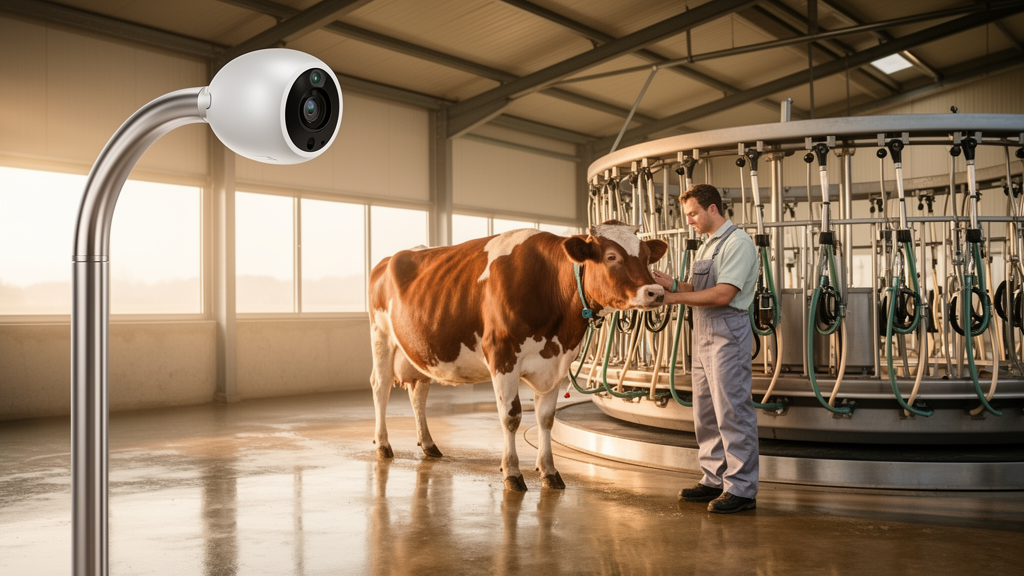
An artificial intelligence system that watches dairy farmers milk their cows has passed a rigorous test against trained human observers — and in one remarkable detail, it actually beat them. Researchers at the University of Guelph in Ontario, Canada, validated a computer-vision milking parlour monitoring system by comparing its automatically generated reports with the careful observations of two trained people watching the same video footage. The results, published in Frontiers in Animal Science, showed near-perfect agreement between machine and human on every timing metric the study assessed, while the algorithm caught six protocol violations that both human observers had missed. For an industry that has long relied on time-consuming, in-person audits of milking routines, the findings suggest that a single strategically placed camera and a neural network may soon become a routine tool for safeguarding milk quality and udder health.
The logic behind the study rests on a simple biological fact: how a cow is milked matters enormously. An effective milking routine is characterized by a low-stress environment, adequate stimulation before the milking unit is attached, and consistent pre-milking preparation and post-milking teat disinfection. When these steps are performed properly, farms see fewer intramammary infections, better milk quality, higher milk yields, and faster, more efficient milking. When they are performed sloppily — a cow cleaned with a dirty towel, forestripping skipped, a unit attached too soon after stimulation — the consequences ripple through the bulk tank. Prep-lag time, the interval between the first touch of the udder and the attachment of the milking unit, has been specifically associated with shorter milking times and lower odds of short-term teat tissue changes. Because so much depends on the consistent execution of each step, verifying that the routine is actually followed is one of the most important, and most tedious, tasks in dairy herd management.
Traditionally, that verification has meant parlour audits: a consultant or veterinarian stands in the parlour for hours, stopwatch in hand, watching an operator work through shift after shift. These audits are widely used to monitor compliance and identify deficiencies in milking procedures, but they have well-known weaknesses. Prolonged in-person observation may not always be feasible, and a single observation may not accurately represent routine performance because of the Hawthorne effect — the behavioural changes that occur when individuals know they are being watched. Audits can also miss employees on different shifts, meaning a problem worker might never be observed at all. Remote video auditing has emerged as an alternative when in-person assessments are impractical or cost-prohibitive, and such systems have already been implemented in hospitals and food preparation settings to evaluate worker performance, with evidence of improvements driven by increased task awareness and timely feedback. Computer vision, the branch of artificial intelligence concerned with the automated interpretation of images and video, promises to cut the cost of video-based assessment dramatically — but, as with any AI technology, it must first be validated.
The system put to the test, developed by Cattle Care Inc., incorporates multiple convolutional neural networks trained on video from a multi-parlour setup. Object detection is performed using YOLO — You Only Look Once, version 8.0 — alongside modified detection models to identify the key elements of the scene: humans, cows, and milking equipment. Vision-language models and convolutional neural networks then classify specific milking events. From the raw video, the software captures the key events throughout the milking process and derives performance metrics at the cow, turn, and parlour levels. It can also flag deviations from a farm’s standard milking protocol, such as lack of forestripping or teat-end cleaning, missed pre- or post-milking teat dipping, and the use of one towel on more than one cow, as well as specific operator behaviours including smoking, cellphone usage, and interactions that may compromise cow welfare. When the system flags a critical event with low confidence or identifies an unusual farm-specific event, the case is subject to human verification — though no such verification was needed for the footage in this study.
The validation took place on two commercial dairy farms in Southwestern Ontario, chosen because they offered two very different parlour configurations. Farm A milked 350 cows in a 10-by-2 herringbone parlour with an average daily production of 41 kilograms of milk per cow, while Farm B milked 110 cows in an 8-by-2 parallel parlour averaging 40 kilograms per cow. Both farms milked three times daily with a single operator per shift, and their protocols differed slightly: Farm A worked in groups of five cows with teat pre-dipping, cleaning with a cloth towel, unit attachment, and post-dipping with a dip cup, while Farm B milked groups of four and added forestripping before pre-dipping. The researchers installed a single camera at 2560-by-1920 resolution recording at 20 frames per second, positioned opposite the cows’ entrance to ensure full visibility of the milking units and the operator. Cameras remained in place for two days, and footage was stored on an SD card before being transferred to the software for processing.
The study, reported using the STARD-AI guidelines for diagnostic accuracy studies using artificial intelligence, compared four one-hour segments of uninterrupted milking shifts — two per farm, selected by the software itself — analysed independently by the system and by two trained human observers. The observers were trained on practice footage with review and feedback from a veterinarian experienced in milking routine evaluation, and their inter-observer agreement during training was excellent, with no differences in detecting protocol deviations and timing disagreements of no more than two seconds. Each observer watched the video segments blind to the other’s findings and to the software’s output. The variables of interest were prep-lag time measured per cow, average unit-on time per milking turn, turn time — the time to milk one side of the parlour from gate opening to cows exiting — and the count of events inconsistent with the milking protocol.
The statistical agreement between machine and humans was, by conventional standards, as good as agreement can get. Using Lin’s concordance correlation coefficient, where values above 0.75 are classified as excellent, the system scored 0.999 for mean unit-on time per turn across 44 turns, 0.995 for prep-lag time across 214 cows, and 0.998 for turn time across 25 turns. The human observers themselves agreed with each other at 0.998 for mean unit-on time, confirming a solid reference standard. Bland–Altman plots revealed only small, consistent biases: human observers timed milking per cow about half a second shorter than the software, prep-lag time about 3.8 seconds shorter, and turn time about 1.7 seconds longer, with limits of agreement of just a few seconds in each case. The authors note that the prep-lag discrepancy represents only 3.1 to 4.2 percent of the recommended prep-lag range of 90 to 120 seconds for cows milked three times daily, and that a correction factor would have little practical impact. One outlier in turn time — a 26-second difference — stemmed from a gate-opening delay and cows entering the parlour that the software failed to identify.
The event detection results were even more striking. Human observers flagged 51 events outside the established protocol across the four hours of footage: three instances of cellphone usage during milking, 15 manual detachments, one instance of missed forestripping on Farm B, and 32 towel errors, including multiple cows cleaned with a single towel or a cow missed entirely. The computer-vision system detected every one of those 51 events. It then went further, flagging six additional towel misuse events in which operators flipped used towels and used the clean side on the next cow — a subtle manoeuvre that both human observers had overlooked. When the researchers went back to the recordings to adjudicate, all six events were confirmed to have been correctly identified by the software. That performance yields a sensitivity of 100 percent and a positive predictive value of 100 percent, producing a perfect F-score of 1. Missed pre- or post-milking teat dipping and smoking events did not occur during the observation periods, so the system was not tested on those categories.
The authors argue that the value of this technology may not lie merely in reproducing human observations, but in complementing them. Observational assessments are inherently subject to attention, distraction, fatigue, and differences in awareness, whereas automated systems can continuously monitor predefined events without being affected by these observer-related factors. Continuous monitoring over extended periods offers clear advantages over single-point, in-person audits: consistency in the milking routine has been associated with greater milk yield, while the repetitive nature of milking work can contribute to procedural drift over time. Automated monitoring could therefore catch deviations that would otherwise go unnoticed, supporting improvements in milking consistency with potential downstream benefits for milk quality, udder health, and employee performance. Those longer-term outcomes, however, were beyond the scope of the present validation study and remain to be demonstrated.
The researchers are careful to note the limitations. The study involved only two farms, which restricts the ability to assess generalizability across the broader range of parlour configurations and milking practices, and the limited observation window cannot exclude a Hawthorne effect that may have reduced the frequency of deviations — a factor that could have inflated agreement between methods. Some aspects of milking routine assessment, such as teat-end condition, cleanliness, and post-dipping coverage, require close-up inspection that the camera’s field of view simply cannot provide, though other teams are exploring machine-learning approaches for those tasks. And while the software substantially reduces the need for manual auditing, it cannot replace the trained eye for everything. Still, under the conditions tested, the system demonstrated high agreement with human observations on every metric assessed while catching subtleties the human eye missed — a result that suggests the future of milking parlour oversight may be a quiet camera in the corner, watching every cow, every shift, without ever blinking.
Subject of Research: Validation of a computer-vision system for monitoring milking routines in dairy parlours
Article Title: Validation of a computer-vision milking parlour monitoring system
Article References: Validation of a computer-vision milking parlour monitoring system. (n.d.). https://doi.org/10.3389/fanim.2026.1959684
Image Credits: AI Generated
DOI: 10.3389/fanim.2026.1959684
Keywords: artificial intelligence, computer vision, dairy cattle, milking routine, precision livestock farming, udder health, milk quality, milking parlour, remote video auditing, validation study, protocol compliance, machine learning
Cite Scienmag News
Blake Davidson. (October 15, 2026). AI Camera Watches Dairy Milking and Outspots the Human Eye. Scienmag. https://scienmag.com/ai-camera-watches-dairy-milking-and-outspots-the-human-eye/
Blake Davidson. "AI Camera Watches Dairy Milking and Outspots the Human Eye." Scienmag, 15 October 2026, https://scienmag.com/ai-camera-watches-dairy-milking-and-outspots-the-human-eye/. Accessed 15 October 2026.
Blake Davidson. "AI Camera Watches Dairy Milking and Outspots the Human Eye." Scienmag. October 15, 2026. https://scienmag.com/ai-camera-watches-dairy-milking-and-outspots-the-human-eye/


