


Telomeres, the protective caps at the ends of chromosomes, are among the most conserved features of eukaryotic genomes, yet a new study shows that even these molecular sentinels can evolve in remarkably diverse ways. In a survey published in Comparative Cytogenetics, researchers screened whole-genome sequencing data from true water bugs, the insect infraorder Nepomorpha, and uncovered a strikingly structured pattern of telomeric repeat evolution. The canonical arthropod motif, a simple pentanucleotide repeat written as (TTAGG)n, is retained in the two most basal superfamilies of these aquatic insects, while the more derived lineages carry entirely different ten-letter repeat sequences that appear to have arisen independently within the group. The findings extend a growing body of evidence that telomeric sequences in true bugs have undergone repeated reinvention, and they demonstrate that vast archives of publicly available sequencing data can be repurposed to answer fundamental questions about genome evolution.
Telomeres solve one of biology’s most persistent problems: the fact that DNA polymerase cannot fully copy the ends of linear chromosomes. In most eukaryotes, the enzyme telomerase compensates by adding short tandem DNA repeats to chromosome termini, protecting coding sequences from erosion and preventing chromosome ends from being mistaken for broken DNA. Across arthropods, including the great majority of insects, the predominant telomeric repeat is (TTAGG)n, a motif so widespread that it is regarded as ancestral for the group. But this motif has been lost repeatedly during insect diversification, and in several lineages the replacement sequences remain unknown or incompletely characterized. Understanding when and how these switches occurred is a long-standing puzzle in comparative genomics.
True bugs of the suborder Heteroptera have emerged as a particularly instructive group for addressing this puzzle. The order Hemiptera, to which they belong, contains more than 100,000 described species, including cicadas, aphids, whiteflies, and scale insects; in the other hemipteran suborders, only the canonical (TTAGG)n motif has so far been reported. Heteroptera, by contrast, display remarkable heterogeneity. While basal infraorders retain the ancestral pentamer, derived lineages within the infraorders Pentatomomorpha, Cimicomorpha, and Gerromorpha possess non-canonical ten-base-pair repeats such as (TTAGGGATGG)n, (TTAGGGGTGG)n, (TTAGGGTGGT)n, and (TTAGAGGTGG)n. The scattered occurrence of these derived motifs across multiple infraorders has suggested that telomeric sequences have been modified independently several times within Heteroptera, but the details of this evolutionary experiment remained patchy.
Nepomorpha, commonly known as true water bugs, comprises nearly 2,400 described species, including giant water bugs, water scorpions, backswimmers, and creeping water bugs. Before the new study, telomeric sequences had been characterized in this infraorder only within the basal superfamily Nepoidea, where fluorescence in situ hybridization, or FISH, confirmed the canonical (TTAGG)n motif in several species of giant water bugs and water scorpions. For the remaining five superfamilies, no telomeric sequence data existed at all. Traditional cytogenetic approaches, while powerful, require living specimens and known or inferred candidate probe sequences, which limits how broadly they can be applied across poorly studied taxa.
To close this gap, the researchers turned to TREW, a computational tool designed for de novo identification of telomeric repeat motifs directly from short-read whole-genome sequencing data. Unlike methods that require assembled, chromosome-level genomes, TREW works with raw sequencing reads, using k-mer counting and internal consistency checks to find candidate motifs without any prior sequence knowledge. It scans each read with sliding windows of varying lengths, counts canonicalized k-mers while accounting for cyclic rotations and reverse complements, and reports only motifs meeting stringent frequency and consistency criteria. Because most Nepomorpha species have no assembled genome, only raw short-read data deposited in the NCBI Sequence Read Archive, this approach was ideally suited to mining archival datasets that would otherwise lie dormant.
The team screened 32 publicly available datasets representing 24 genera and all 13 families of Nepomorpha, retaining only datasets with sufficiently long sequencing reads to improve the reliability of repeat detection. Crucially, they first validated the method on species with known telomeres: the water scorpions Nepa cinerea and Ranatra linearis, and Lethocerus indicus, a congener of a species with previously confirmed (TTAGG)n telomeres. TREW recovered the expected motif from every control dataset, confirming that the approach reliably detects telomeric sequences in Nepomorpha short-read data. The analysis also added a new genus to the canonical list, identifying (TTAGG)n in the belostomatid Appasus japonicus for the first time.
The results beyond Nepoidea were striking. In the superfamily Corixoidea, the canonical pentamer was recovered uniformly as the best candidate from all ten datasets, spanning eight species across three families, the water boatmen of Corixidae, the Diaprepocoridae, and the minute Micronectidae. This represents the first report of telomeric composition for the entire superfamily. In sharp contrast, the four remaining superfamilies all yielded derived ten-base-pair motifs. The closely related families of Ochteroidea, the toad bugs and velvet water bugs, carried the decamers (TGGTTAGTGA)n and (TGGTTAGTGT)n, which differ by just a single nucleotide. Within Naucoroidea, which includes the creeping water bugs, the outlier families Aphelocheiridae and Potamocoridae, the dominant motif was (TGGATAGGTG)n, with a single-nucleotide variant (TGGATAGGAG)n also recovered. Most notably, the identical decamer (TGGATAGGGT)n appeared across all five datasets from Notonectoidea and Pleoidea, the backswimmers, pygmy backswimmers, and their relatives.
This last finding carries phylogenetic weight. The close relationship between Notonectoidea and Pleoidea has been consistently recovered in molecular and morphological studies, whether Pleoidea is treated as a separate superfamily or folded into an expanded Notonectoidea. The sharing of an identical derived telomeric repeat across both groups suggests the motif originated once in their common ancestor, making it a candidate synapomorphy, a shared derived character, for the clade. More broadly, the pattern maps cleanly onto current phylogenetic hypotheses: (TTAGG)n persists in the two successive basal branches, Nepoidea and Corixoidea, while decamers are restricted to the more derived superfamilies. This congruence strongly supports (TTAGG)n as the ancestral motif for Nepomorpha, with ten-base-pair motifs evolving later, after the basal lineages had split off. The finding directly addresses a gap that previous researchers had explicitly flagged, and it favors scenarios of independent evolution of decameric motifs within each heteropteran infraorder rather than a single ancient acquisition inherited from a common ancestor.
Notably, most of the Nepomorpha decamers except those of Ochteroidea share a core octamer, TGGATAGG, that is absent from the known motifs of other infraorders, where the core TTAGGG prevails instead. This difference in core sequence reinforces the interpretation that each infraorder independently doubled its ancestral pentameric template in the telomerase RNA and accumulated substitutions afterwards, a form of convergent evolution in motif length rather than sequence. The authors caution, however, that the picture in Pentatomomorpha remains complicated, because the basal family Aradidae already possesses a decameric motif, and extinct stem lineages that might have retained the ancestral pentamer are unavailable for study. The broader evolutionary history of telomeric motifs along that branch therefore remains unresolved.
Beyond its evolutionary implications, the study offers a practical assessment of TREW itself. The phylogenetic coherence of the novel results, uniform motifs across related species and single-nucleotide differences between sister families, argues strongly for their biological validity, since such patterns are difficult to explain as algorithmic artifacts. A few anomalous results, such as a low-complexity decamer from one Aphelocheirus dataset and a pentanucleotide from another species, most likely represent abundant satellite sequences misidentified as telomeric candidates, a known limitation of k-mer-based methods when applied to single datasets without replication. The authors note that FISH or chromosome-level genome assembly will still be needed to confirm the chromosomal localization of the candidate motifs. Because chromosomes of true water bugs are holokinetic, lacking localized centromeres, telomeric motifs could also serve as useful chromosomal markers in comparative karyotype analysis. Taken together, the work transforms a quiet corner of the sequencing archive into a phylogenetic dataset of its own, establishing telomeric repeat composition as a new class of molecular characters for exploring how these ancient aquatic insects diversified.
Subject of Research: Evolution and diversity of telomeric repeat sequences across the water bug infraorder Nepomorpha
Article Title: Telomeric repeat diversity across Nepomorpha ( Hemiptera , Heteroptera ) revealed by whole-genome sequencing data
Article References: Telomeric repeat diversity across Nepomorpha ( Hemiptera , Heteroptera ) revealed by whole-genome sequencing data. (n.d.). https://doi.org/10.3897/compcytogen.20.198500
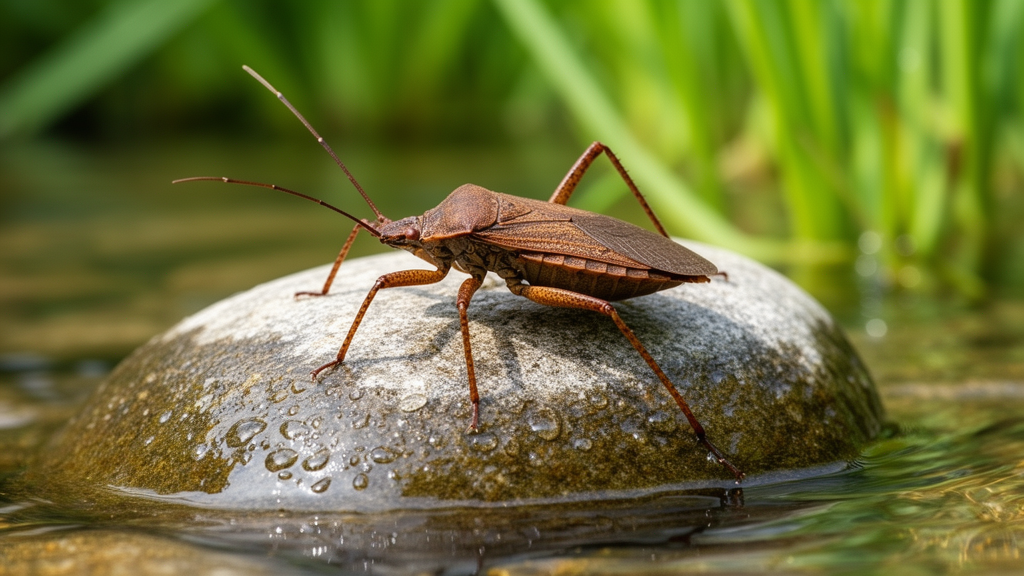
Image Credits: AI Generated
DOI: 10.3897/compcytogen.20.198500
Keywords: telomeres, Nepomorpha, Heteroptera, TTAGG, telomeric repeats, whole-genome sequencing, TREW, k-mer analysis, chromosome evolution, molecular phylogeny, hemipteran evolution, comparative cytogenetics
Cite Scienmag News
Gavin Prescott. (October 15, 2026). Water Bug Genomes Reveal Surprising Evolution of Telomere Diversity. Scienmag. https://scienmag.com/water-bug-genomes-reveal-surprising-evolution-of-telomere-diversity/
Gavin Prescott. "Water Bug Genomes Reveal Surprising Evolution of Telomere Diversity." Scienmag, 15 October 2026, https://scienmag.com/water-bug-genomes-reveal-surprising-evolution-of-telomere-diversity/. Accessed 15 October 2026.
Gavin Prescott. "Water Bug Genomes Reveal Surprising Evolution of Telomere Diversity." Scienmag. October 15, 2026. https://scienmag.com/water-bug-genomes-reveal-surprising-evolution-of-telomere-diversity/


