


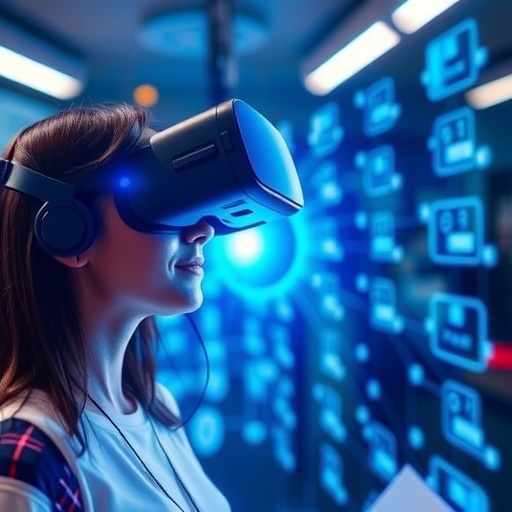
In the rapidly evolving landscape of higher education, the fusion of artificial intelligence (AI) and virtual reality (VR) is charting a transformative path. A pioneering study published in the International Journal of STEM Education unveils how this integration is revolutionizing the development of ethical decision-making skills among university learners. This groundbreaking exploration provides new insights into leveraging advanced technologies to cultivate competencies that are critical in both academic and professional realms.
Ethical decision-making, traditionally taught through case studies and theoretical frameworks, is evolving amid technological advancements. The study introduces a novel pedagogical approach that capitalizes on AI’s data-driven decision support and VR’s immersive experiential learning to foster nuanced ethical reasoning. This interface not only simulates real-world dilemmas more vividly than textbook scenarios but also dynamically adapts scenarios based on learners’ choices, creating a personalized and iterative learning process.
Central to this innovation is the AI component, which employs sophisticated algorithms to analyze learners’ decision patterns and moral reasoning in real time. This system provides immediate, context-sensitive feedback, enabling students to reflect deeply on the consequences of their choices. Moreover, AI’s capacity for pattern recognition allows educators to identify knowledge gaps and cognitive biases, fine-tuning instruction to individual needs, a feat unachievable in traditional classroom environments.
The VR environment amplifies this effect by immersing students in three-dimensional, interactive scenarios that replicate complex ethical conflicts in professional and societal contexts. The sensory immersion and contextual realism of VR engage emotional and cognitive faculties simultaneously, which is critical for ethical development. The learners not only witness but experience the ramifications of their decisions, making the educational process experiential rather than merely theoretical.
One of the study’s compelling findings is the measurable improvement in learners’ ethical competencies after interacting with these AI-enhanced VR modules. Quantitative assessments demonstrate enhanced critical thinking, moral sensitivity, and the ability to weigh competing interests and ethical principles effectively. This evidence suggests that technology-augmented learning environments can outperform traditional methods in instilling ethical judgment and reflective practices.
Furthermore, the system is designed to evolve with technological advancements and pedagogical discoveries. The modular VR scenarios can be updated or expanded to include emerging ethical challenges, such as those posed by AI implementation itself, thereby remaining relevant in a swiftly changing world. This adaptive capacity ensures that education does not lag behind technological and societal developments but progresses hand in hand with them.
The research also delves into the scalability of such AI-VR frameworks for diverse educational settings and disciplines. STEM fields, where ethical dilemmas increasingly intersect with rapid innovation and societal impact, stand to benefit significantly. This approach offers a replicable model for embedding ethical reasoning across curricula—from engineering design to biomedical research—promoting a culture of conscientious professional practice.
From a technical standpoint, integrating AI into VR environments involves intricate challenges. The researchers employed cutting-edge natural language processing and behavioral analytics to interpret learners’ inputs and simulate realistic emotional and cognitive responses from virtual agents. These intelligent agents guide scenarios dynamically, thereby creating a responsive learning environment that mimics human interactions and moral negotiations.
Data privacy and ethical considerations around deploying AI and VR in education are also critically addressed in the study. Mechanisms for securing learners’ data and ensuring transparency in AI decision-making processes are embedded within the platform. This commitment to ethical integrity within the technology itself models the very competencies the educational interventions seek to nurture.
The potential implications of this research extend beyond educational institutions. By fostering ethical decision-makers adept in AI and VR, the initiative prepares a workforce capable of navigating moral complexities in technology-driven domains. Businesses, governments, and healthcare providers grappling with ethical AI deployment and digital governance could benefit significantly from graduates trained under this paradigm.
Moreover, the immersive AI-VR methodology aligns with broader pedagogical trends emphasizing active learning and student engagement. This learner-centered approach contrasts markedly with passive instruction, harnessing the motivational power of immersive technology to sustain interest and deepen understanding. The study suggests that such engagement is pivotal for internalizing ethical principles rather than memorizing codes of conduct.
While promising, the research acknowledges challenges in widespread adoption, including the substantial resources required for developing and maintaining sophisticated AI-VR learning platforms. Accessibility remains a concern, as disparities in technological infrastructure across institutions might exacerbate educational inequalities. However, the authors advocate for collaborative efforts and open-source initiatives to democratize access and share best practices.
Future directions outlined in the study propose integrating augmented reality (AR) to complement VR experiences, enabling situational ethics training in real-world environments. The incorporation of biometric feedback to assess emotional responses during ethical simulations presents another frontier, promising more personalized and holistic learning analytics that capture both cognitive and affective dimensions.
In light of the accelerating digital transformation of education, this research marks a significant milestone. By effectively marrying AI’s analytical prowess with VR’s immersive potential, educators gain a powerful toolset for shaping not just knowledgeable but ethically conscious professionals. This innovation heralds a new era where technology and human values coalesce to nurture better decision-making capacities for the challenges of tomorrow.
This study is more than an academic exercise; it is a blueprint for reimagining ethics education at a time when society critically needs thoughtful leaders. As AI and VR continue their convergence, their responsible integration into learning promises a future where ethical competence is not an afterthought but a foundational skill embedded at the core of educational endeavors. The transformative potential captured in this work sets a precedent for harnessing technology to elevate human judgment and integrity across disciplines and professions.
Cite Scienmag News
Courtney Benton. (November 27, 2025). AI and VR Boost Ethical Skills in Higher Education. Scienmag. https://scienmag.com/ai-and-vr-boost-ethical-skills-in-higher-education/
Courtney Benton. "AI and VR Boost Ethical Skills in Higher Education." Scienmag, 27 November 2025, https://scienmag.com/ai-and-vr-boost-ethical-skills-in-higher-education/. Accessed 3 September 2026.
Courtney Benton. "AI and VR Boost Ethical Skills in Higher Education." Scienmag. November 27, 2025. https://scienmag.com/ai-and-vr-boost-ethical-skills-in-higher-education/


