


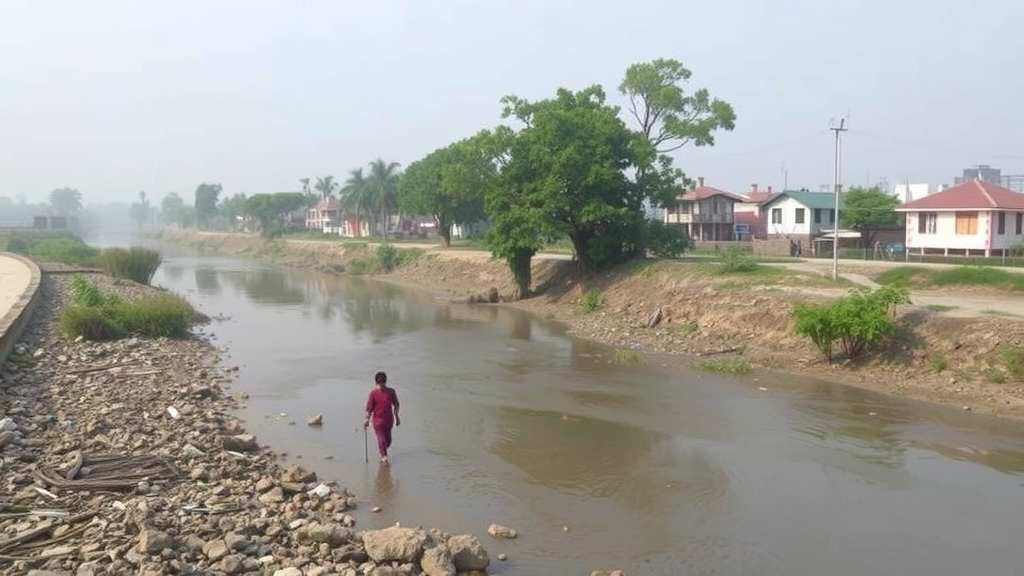
In one of the most densely populated cities on Earth, a river is quietly telling the story of what happens when urban growth outpaces environmental protection. The Turag River, which winds around the northern and western edges of Dhaka, Bangladesh, has long suffered from industrial effluent, untreated sewage, and agricultural runoff. Now, a team of researchers from the International University of Business Agriculture and Technology in Dhaka and Imam Mohammad Ibn Saud Islamic University in Riyadh has shown that modern data science can read that story with remarkable precision. By combining classical statistical analysis, machine learning, and geographic information systems, the scientists built a predictive framework capable of forecasting water quality in the Turag with accuracy above ninety percent, offering a template for pollution surveillance in fast-growing cities worldwide.
The study, published in Environmental Monitoring and Assessment, set out to answer a deceptively simple question: which of the many parameters measured in a river actually matter for determining overall water quality, and can machines learn to predict it? To find out, the researchers assembled 648 datasets from the Turag River, each containing sixteen physicochemical and environmental features ranging from temperature and dissolved oxygen to total dissolved solids, electrical conductivity, and turbidity. From these measurements they calculated the Water Quality Index, a single composite number that regulators and public health officials use to summarize whether water is safe for drinking, recreation, or aquatic life.
The first stage of the analysis relied on descriptive statistics to map the relationships among the variables. Correlation analysis revealed that the Water Quality Index moved in lockstep with three parameters in particular: total dissolved solids, electrical conductivity, and turbidity. This finding is both intuitive and significant. Dissolved solids and conductivity measure the concentration of dissolved ionic material in the water, a signature of industrial discharge and urban runoff, while turbidity reflects the cloudiness caused by suspended particles. When pollutants pour into the river, all three indicators rise together, dragging the quality index down with them.
Regression analysis quantified just how strongly these parameters govern water quality. The relationship between turbidity and the Water Quality Index proved especially powerful, with turbidity alone explaining roughly 82 percent of the variance in the index, corresponding to a coefficient of determination of 0.821. Total dissolved solids explained about 68 percent of the variance, with an R-squared value of 0.678. Analysis of variance confirmed that these relationships were statistically significant rather than artifacts of sampling noise. In practical terms, a monitoring station measuring just a handful of accessible parameters could capture most of the information needed to judge the health of the river.
Statistics, however, can only describe; the team wanted to predict. Three machine learning models were trained on the dataset to forecast the Water Quality Index and identify its most influential determinants: Random Forest, Decision Tree, and XGBoost. Random Forest builds an ensemble of decision trees, each trained on random subsets of the data and features, and averages their predictions to suppress overfitting. A single Decision Tree, by contrast, learns a transparent set of if-then rules, making its logic easy to inspect. XGBoost, an implementation of gradient boosting, constructs trees sequentially, with each new tree trained to correct the residual errors of its predecessors. All three models exceeded ninety percent predictive accuracy on the task, with Mean Squared Error and Root Mean Squared Error used to evaluate performance.
The agreement between the models is arguably as important as their accuracy. When fundamentally different algorithms, one averaging, one rule-based, and one boosting, converge on the same predictions and flag the same input variables as decisive, the result is unlikely to be a quirk of any single method. It strengthens confidence that turbidity, total dissolved solids, and electrical conductivity genuinely are the master variables controlling the Turag’s quality index, and that the models have learned a stable representation of the river’s chemistry rather than memorizing its training data.
The third pillar of the study brought the analysis into space and time. Using a Geographic Information System, the researchers mapped water quality measurements to specific locations along the Turag and tracked how conditions at each site changed month by month. This geospatial dimension exposed monthly trends and recurring pollution patterns that would be invisible in tabular data alone. Certain stretches of the river deteriorated in predictable ways, reflecting the rhythm of industrial production, seasonal rainfall, and discharge patterns in the surrounding urban landscape. Mapping those hotspots transforms monitoring from a passive record into an actionable map for regulators, showing precisely where intervention would have the greatest impact.
The stakes of this work extend well beyond one river in one city. Dhaka’s rivers receive enormous loads of untreated industrial effluent, particularly from the tanneries, dyeing operations, and textile mills that power the national economy, alongside municipal sewage from a metropolitan population that continues to swell. Contaminated water threatens both environmental sustainability and public health, contributing to the spread of waterborne disease and degrading ecosystems that once supported fisheries and agriculture. Previous research on the Turag has documented severe ecological stress, and the new study reinforces how persistent those pressures are across the calendar year.
What makes the approach genuinely powerful is its integration. Statistical analysis distilled which variables matter, machine learning converted that knowledge into a predictive engine, and GIS placed every prediction on a map and a timeline. Together they form the skeleton of an early warning system: sensors or routine sampling could feed measurements of a few key parameters into a trained model, which would flag declining water quality before it becomes a public health emergency, while the GIS layer directs attention to the exact locations where the degradation originates. Such AI-supported monitoring could sharpen pollution control, improve early warning capabilities, and ultimately protect the communities living along the riverbanks.
The study also carries a message for cities far from Dhaka. Urban rivers across South Asia, Africa, and Latin America face the same combination of rapid urbanization, underfunded sanitation infrastructure, and fragmented monitoring. A framework that achieves high predictive accuracy with a modest set of physicochemical parameters lowers the barrier to entry: cities do not need to measure everything to understand their rivers, and they do not need exhaustive laboratory capacity to forecast deterioration. As climate change intensifies both flooding and drought, the variability of urban water quality will only increase, making cheap, intelligent, data-driven surveillance less of a luxury and more of a necessity.
The researchers caution that their models were trained on data from a single river, and that transferring them to other waterways would require local calibration. Still, the demonstration stands: statistical rigor, machine learning, and geospatial mapping can be woven into a coherent monitoring system that surpasses ninety percent accuracy in predicting water quality in a real, heavily polluted urban river. For the Turag, and for the millions of people whose lives intersect with it, the river’s data now speaks with unprecedented clarity, and the tools exist to listen, predict, and act before the next pollution event becomes the next public health crisis.
Subject of Research: Machine learning and GIS-based prediction of urban river water quality in the Turag River, Dhaka
Article Title: Water quality assessment in a dense urban landscape using Statistical Analysis (SA), Artificial Intelligence (AI) and Geographic Information System (GIS)
Article References: Hasan, M., Hosna, A. U., Sheikh, M. S., Khan, T. A., Hasan, M. T., Islam, M. H., & Uddin, M. N. (2026). Water quality assessment in a dense urban landscape using Statistical Analysis (SA), Artificial Intelligence (AI) and Geographic Information System (GIS). Environmental Monitoring and Assessment, 198(10), Article 1091. https://doi.org/10.1007/s10661-026-15907-9
Image Credits: AI Generated
DOI: 10.1007/s10661-026-15907-9
Keywords: Turag River, Water Quality Index, Machine Learning, Random Forest, XGBoost, GIS, Dhaka, Water Pollution, Artificial Intelligence, Environmental Monitoring, Water, quality
Cite Scienmag News
Blake Davidson. (September 22, 2026). AI and GIS Reveal Hidden Drivers of Pollution in Dhaka’s Turag River. Scienmag. https://scienmag.com/ai-and-gis-reveal-hidden-drivers-of-pollution-in-dhakas-turag-river/
Blake Davidson. "AI and GIS Reveal Hidden Drivers of Pollution in Dhaka’s Turag River." Scienmag, 22 September 2026, https://scienmag.com/ai-and-gis-reveal-hidden-drivers-of-pollution-in-dhakas-turag-river/. Accessed 4 October 2026.
Blake Davidson. "AI and GIS Reveal Hidden Drivers of Pollution in Dhaka’s Turag River." Scienmag. September 22, 2026. https://scienmag.com/ai-and-gis-reveal-hidden-drivers-of-pollution-in-dhakas-turag-river/


