


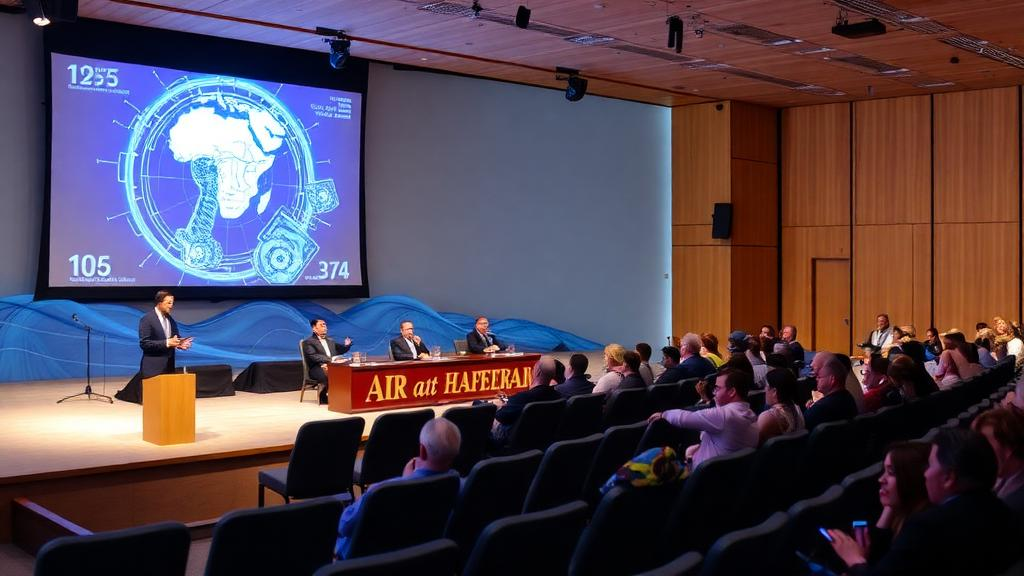
Honolulu played host this summer to one of the most consequential gatherings in modern financial research, as the 2026 MRS International Risk Conference convened from July 17 to 19 at the University of Hawaii at Manoa. Under the theme “AI in an Uncertain World,” the meeting drew more than 300 scholars and students from around the globe, who presented 199 papers across 64 parallel sessions over three intensive days. The scale and focus of the program offered a revealing snapshot of where international finance research is heading, with artificial intelligence and climate risk emerging as the twin engines of scholarly attention. More than 15 sessions were devoted to AI-related topics and 14 to climate finance and climate risk, a distribution that mirrors the questions now dominating boardrooms, central banks, and policy institutions worldwide.
The conference was hosted by the Shidler College of Business at the University of Hawaii at Manoa and co-organized by China Finance Review International (CFRI), Modern Risk Society (MRS), and the Dishui Lake Advanced Institute of Finance at Shanghai University of Finance and Economics. This transpacific partnership reflects a broader trend in academic finance: the recognition that risk, in its many modern forms, does not respect national boundaries or disciplinary silos. The collaboration brought together journal editors, database providers, and research institutes from both sides of the Pacific, creating a forum in which methodological debates could unfold against the backdrop of a rapidly changing technological and environmental landscape. For many attendees, particularly early-career researchers, the event served as both a showcase and a matchmaking opportunity for future collaborations.
The scientific program opened with a pair of special panel discussions that confronted the practical challenges of applying artificial intelligence in financial research and practice. In the “Data, AI and Applications” roundtable, scholars Rui Dai of WRDS, Jian Chen of Fudan University, Mehmet Saglam of the University of Cincinnati, and Yuehua Tang of the University of Florida debated the boundaries of AI-enabled finance under the moderation of Xuanjuan Chen of the Dishui Lake Advanced Institute of Finance at Shanghai University of Finance and Economics. The discussion ranged from intelligent customer service systems to large-scale text mining, and the panelists converged on a point that resonates far beyond the conference hall: in core risk control areas, algorithms must still defer to professional judgment. The exchange captured a tension now running through the entire discipline, as machine learning tools demonstrate remarkable pattern-recognition capabilities while regulators and risk managers grapple with questions of accountability, interpretability, and model risk.
A second panel, titled “Let’s Talk AI,” shifted the spotlight to a younger generation of researchers. Jiakai Chen of the University of Hawaii, Eileen Zhang of Rutgers University, Bochen Li of Monmouth University, and Zhao Wang of Capital University of Economics and Business demonstrated the diverse possibilities of AI tools in cutting-edge financial research. Their presentations spanned the interpretation of Federal Reserve policy communications, the analysis of news narratives, and generative information extraction, illustrating how natural language processing and related techniques are transforming the raw material of financial economics. Where researchers once relied on coarse textual classifications or manually coded event studies, they can now parse central bank statements, earnings calls, and news flows at scale, extracting measures of sentiment, uncertainty, and narrative momentum that feed directly into asset pricing and risk models. The session offered a glimpse of a methodological shift that is reshaping empirical finance from the ground up.
The intellectual centerpiece of the opening day arrived with the keynote address. Hosted by Professor Qianqiu Liu, Chair of the Finance Department at the University of Hawaii, the keynote was delivered by Professor Torben G. Andersen of Northwestern University, one of the most influential figures in the empirical study of financial volatility. His talk, “Inference for Option-Implied Risk Measures,” tackled a deceptively simple problem with deep practical consequences: how to extract reliable risk measurements from option prices when those prices are contaminated by measurement error. Option-implied measures of risk are foundational to modern risk management, informing everything from value-at-risk calculations to stress testing and derivative pricing. Yet option markets are imperfect, and the errors embedded in observed prices can propagate through downstream estimates in ways that distort inference.
Andersen’s proposed solution is a new nonparametric estimation method that improves the handling of correlations across option pricing errors. The technical significance lies in what nonparametric approaches avoid: rather than imposing a rigid functional form on the relationship between option prices and underlying risk, the method lets the data speak while explicitly accounting for the error structure that contaminates observations. By modeling the cross-correlations of pricing errors more effectively, the approach yields risk measures with more reliable statistical properties, providing practitioners with a sturdier theoretical tool for risk management. For an audience steeped in the uncertainties of AI-driven markets and climate-exposed portfolios, the message was clear: even as finance embraces new technologies, the discipline’s progress still depends on rigorous measurement and careful inference at the most fundamental level.
The conference also served as a stage for honoring sustained excellence in risk research. At an awards ceremony hosted by Professor Wei Huang of the University of Hawaii, ten distinct honors were presented, including the Pacific-Basin Finance Journal Research Excellence Award, the Global Association of Risk Professionals Research Excellence Award, the China Finance Review International Research Excellence Award, the Asia-Pacific Journal of Risk and Insurance Research Excellence Award, the Sinofin CCER Database Research Excellence Award, and the Southwestern University of Finance and Economics Research Excellence Award. Modern Risk Society conferred its own slate of recognitions, among them the Edward Kane Memorial Research Excellence Award, the Contribution Award, the Distinguished Leadership Award, and the Lifetime Achievement Award. Professor Wenfeng Wu, Editor-in-Chief of CFRI and a faculty member at the Antai College of Economics and Management, Shanghai Jiao Tong University, presented the MRS Lifetime Achievement Award and the CFRI Research Excellence Award, underscoring the journal’s role in promoting interdisciplinary research on risk and finance.
Beyond the formal sessions, the conference cultivated the informal exchanges where collaborations are often born. An evening welcome reception at the Shidler College of Business set a relaxed tone in the Aloha atmosphere of Honolulu, and the following night the gathering moved to the Imin International Conference Center for the Presidents’ Reception. Amid the garden scenery of the University of Hawaii, attendees deepened their conversations over dinner, while a lucky draw featuring exclusive tickets designed and produced by CFRI added a moment of levity to the proceedings. These social rituals, easily dismissed as peripheral, perform a genuine scientific function: they lower the barriers between senior professors and doctoral students, between journal editors and authors, and between researchers from different national traditions, enabling the candid conversations that formal presentations rarely permit.
The parallel sessions of July 18 and 19 formed the analytical heart of the meeting. Across 64 sessions, the 199 presented papers ranged from subversive challenges to long-standing assumptions in financial economics to brave explorations of entirely new research paradigms. The heavy weighting of AI and climate topics was no accident. Artificial intelligence is simultaneously a subject of study, as markets adopt algorithmic trading and machine learning-based credit scoring, and a methodological instrument, as researchers deploy it to parse text, forecast volatility, and model complex dependencies. Climate finance, meanwhile, has moved from the margins to the mainstream as physical risks and transition risks reshape asset valuations, insurance markets, and regulatory frameworks. Many attendees remarked that the conference not only refreshed their thinking but also helped them find like-minded research partners, a testament to the organizing committee’s curation of the program.
The event also carried an institutional dimension. Throughout the three days, the CFRI journal team operated a booth at the venue, introducing the journal’s features, submission process, and recent key topics to participating scholars, distributing promotional materials, and inviting high-quality manuscripts. The team also visited the Shidler College of Business for a special meeting with Professor Qianqiu Liu, exchanging in-depth views on frontier research in finance, international academic cooperation, and journal co-development. CFRI, an English-language journal hosted by Antai College of Economics and Management at Shanghai Jiao Tong University and published by Emerald Publishing Group, has grown steadily since its founding in 2011 and is now indexed in more than twenty international databases, with a 2025 Impact Factor of 10.8. As the organizing committee closed the meeting with the message “Until next time, stay curious,” the gathering in Honolulu made a persuasive case that the study of risk, whether driven by algorithms or by a changing climate, has become one of the defining scientific projects of the decade.
Subject of Research: Artificial intelligence and climate risk in international financial research
Article Title: 2026 MRS International Risk Conference successfully concludes in Hawaii
Article References: 2026 MRS International Risk Conference successfully concludes in Hawaii. (n.d.). Original publication
Image Credits: AI Generated
DOI: Not provided
Keywords: artificial intelligence, climate finance, climate risk, risk management, financial research, option-implied risk measures, machine learning, academic conference, China Finance Review International, University of Hawaii, text mining, volatility estimation
Cite Scienmag News
Blake Davidson. (October 3, 2026). AI and Climate Risk Take Center Stage as 300 Scholars Gather in Hawaii for Risk Finance Conference. Scienmag. https://scienmag.com/ai-and-climate-risk-take-center-stage-as-300-scholars-gather-in-hawaii-for-risk-finance-conference/
Blake Davidson. "AI and Climate Risk Take Center Stage as 300 Scholars Gather in Hawaii for Risk Finance Conference." Scienmag, 3 October 2026, https://scienmag.com/ai-and-climate-risk-take-center-stage-as-300-scholars-gather-in-hawaii-for-risk-finance-conference/. Accessed 4 October 2026.
Blake Davidson. "AI and Climate Risk Take Center Stage as 300 Scholars Gather in Hawaii for Risk Finance Conference." Scienmag. October 3, 2026. https://scienmag.com/ai-and-climate-risk-take-center-stage-as-300-scholars-gather-in-hawaii-for-risk-finance-conference/


