


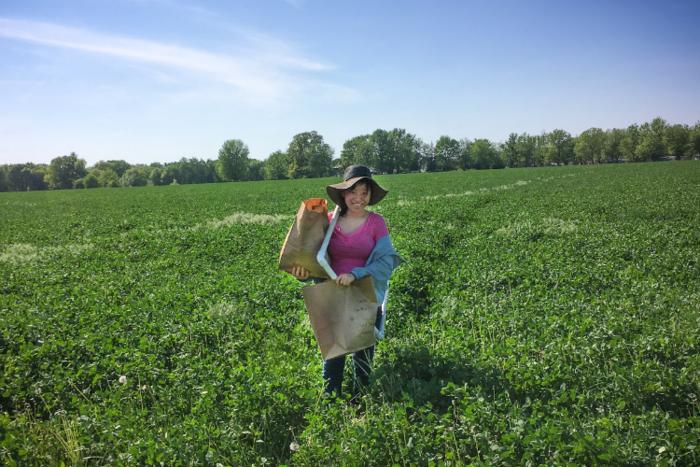
URBANA, Ill. — As greenhouse gases go, nitrous oxide (N2O) is a doozy. With a global warming potential 273 times that of carbon dioxide, mitigating N2O could make a big difference. But before mitigation can happen, it’s important to understand where the compound is coming from.

Credit: University of Illinois Urbana-Champaign
URBANA, Ill. — As greenhouse gases go, nitrous oxide (N2O) is a doozy. With a global warming potential 273 times that of carbon dioxide, mitigating N2O could make a big difference. But before mitigation can happen, it’s important to understand where the compound is coming from.
Most analyses point to agriculture as the major source of N2O globally. But there are a lot of variables within agriculture — crop and fertilizer type, soil texture, conservation practices, and more — that can affect N2O emissions. A recent University of Illinois Urbana-Champaign study provides a comprehensive accounting for these factors, finding, among other things, that long-term no-till management can effectively cut N2O emissions.
“Our analysis enables us to identify practices that work well in specific regions and encourage programs including emerging ecosystem service markets to reward effective management,” said study co-author Michelle Wander, a professor in the Department of Natural Resources and Environmental Sciences, part of the College of Agricultural, Consumer and Environmental Sciences (ACES) at Illinois.
Wander says previous N2O accounting has either been too crude, unable to pinpoint specific agricultural factors influencing emissions; or too complicated, requiring time-consuming calculations and complex algorithms. That’s why Yushu Xia, who completed her doctorate with Wander, aimed for a middle way in her analysis.
“We were motivated to fill the gap between overly simplistic (Tier-1) and overly complicated (Tier-3) approaches, so we developed Tier-2 accounting. We collected a large metadatabase, which has almost 2,000 observations from U.S. agricultural lands, to get relatively accurate estimates without complicated algorithms or the use of supercomputers,” said Xia, now a Lamont assistant research professor at Columbia University.
Xia created her metadatabase from published studies and public databases, pulling in predictors including soil properties, topography, cropping systems, fertilizer types, climate factors, and management. She looked at N2O emissions on a monthly rather than annual basis to capture seasonal differences in flux rates. The team also considered differences within U.S. regions to see whether groups like the Ecosystem Services Market Consortium should tailor programs to specific areas.
Of the management practices included in the analysis, no-till was the most significantly and consistently associated with reduced N2O emissions across time and space. But the authors are quick to point out no-till in this context refers to something very specific.
Wander explains that the label “no-till” can be misleading because rotational tillage or alternate tilling doesn’t have the same effect as true, long-term no-till. The latter leads to more complex soil structure, including stable macropores that can help reduce the production of greenhouse gases.
Wander said, “In our analysis, reduced-tillage practices varied widely in terms of N2O emissions, showing they aren’t a silver bullet. Only true no-till management consistently brought emissions down.”
Fertilizer type and soil texture were also important factors.
“Fertilizer type made a large difference,” Xia said. “For example, liquid manure caused a lot more emissions compared to solid manure, which is a slower-release product. Anhydrous ammonia had the highest emissions of the fertilizer types we evaluated, but the emissions from that source were highly variable.”
There are some things management can’t alter. For example, the analysis showed that finer-textured soils emitted more N2O than coarse-textured soils. It also identified important regional differences in how soil texture and water interact.
“Soil microbes process nitrogen in complex ways, and soil moisture and texture can make a big difference in terms of whether the end-product of microbial processing is harmless dinitrogen or the greenhouse gas nitrous oxide,” Xia said. “We need to think about the best way to manage emissions for irrigated and non-irrigated systems, but we’re not there yet.”
While the analysis pinpointed several key factors contributing to agricultural N2O emissions and identified gaps to be filled with further research, the study’s real value is in improving the older Tier-1 method without requiring the massive computational resources of Tier-3 accounting. However, the metadatabase can be used to calibrate and validate Tier-3 studies; the authors have shared it with others in the research community to do so.
“To fairly reward farmers for stewardship, we need to know where and when practices can reduce greenhouse gas emissions,” Wander said. “We show general linear modeling is a practical Tier-2 approach policymakers can rely on to make recommendations.”
The study, “Estimating soil N2O emissions induced by organic and inorganic fertilizer inputs using a Tier-2, regression-based meta-analytic approach for U.S. agricultural lands,” is published in Science of the Total Environment [DOI:10.1016/j.scitotenv.2024.171930]. Authors include Yushu Xia, Hoyoung Kwon, and Michelle Wander. The research was supported by the USDA National Institute of Food and Agriculture [grant no. 015-51106-24198 and Hatch no. 1026327].
Journal
Science of The Total Environment
Cite Scienmag News
Denise Maddox. (May 2, 2024). Agricultural management practices evaluated in new nitrous oxide accounting method. Scienmag. https://scienmag.com/agricultural-management-practices-evaluated-in-new-nitrous-oxide-accounting-method/
Denise Maddox. "Agricultural management practices evaluated in new nitrous oxide accounting method." Scienmag, 2 May 2024, https://scienmag.com/agricultural-management-practices-evaluated-in-new-nitrous-oxide-accounting-method/. Accessed 3 September 2026.
Denise Maddox. "Agricultural management practices evaluated in new nitrous oxide accounting method." Scienmag. May 2, 2024. https://scienmag.com/agricultural-management-practices-evaluated-in-new-nitrous-oxide-accounting-method/

