


MADISON — Many pancreatic tumors are like malignant fortresses, surrounded by a dense matrix of collagen and other tissue that shields them from immune cells and immunotherapies that have been effective in treating other cancers. Employing bacteria to infiltrate that cancerous fortification and deliver these drugs could aid treatment for pancreatic cancer, according to newly published findings from a team of University of Wisconsin–Madison researchers. Here’s what to know:

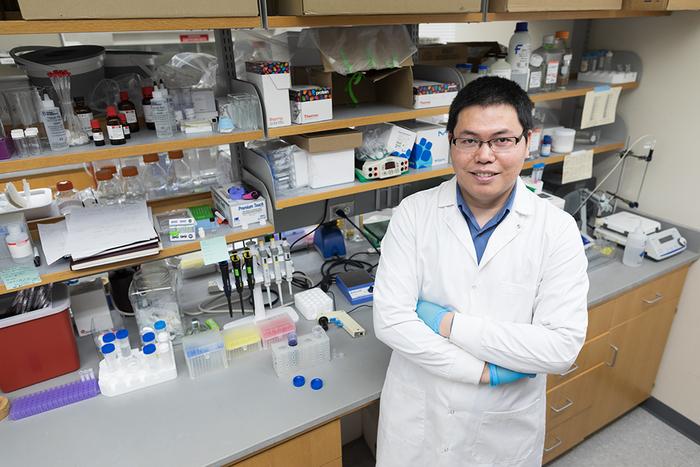
Credit: Photo by Todd Brown/UW–Madison
MADISON — Many pancreatic tumors are like malignant fortresses, surrounded by a dense matrix of collagen and other tissue that shields them from immune cells and immunotherapies that have been effective in treating other cancers. Employing bacteria to infiltrate that cancerous fortification and deliver these drugs could aid treatment for pancreatic cancer, according to newly published findings from a team of University of Wisconsin–Madison researchers. Here’s what to know:
Tumor collagen is a tough barrier: Pancreatic cancer is well known for its deadliness and has among the lowest five-year survival rates among common cancers. While there are several drivers behind the disease’s dismal prognosis, one that’s the focus of this study is the matrix surrounding many pancreatic tumors, which acts as an effective barrier against treatment.
- The barrier is a collection of collagen, connective tissue, proteins that facilitate fibrosis and other cells. Recent studies have highlighted the role of this barrier in counteracting treatment attempts with immunotherapies — treatments that work by spurring on or tamping down the patient’s immune system — such as immune checkpoint inhibitors.
- Analyzing patient tumor samples, the UW–Madison team found genetic evidence that a specific type of collagen, called oncogenic collagen, is indeed a barrier to immunotherapy-based treatments.
- “That really dense extracellular matrix, made up of immunosuppressive cells, collagens and other cells is a critical problem if we want to use immunotherapies against these pancreatic cancers,” says Quanyin Hu, an assistant professor in the UW–Madison School of Pharmacy. Hu led the study in collaboration with Sean Ronnekleiv-Kelly, a pancreatic surgeon and assistant professor in the UW–Madison Department of Surgery.
A bacteria-based infiltration: Hu is an expert in engineering cells for use as potential therapeutics or delivery vehicles for drugs. For this study, published in April in the journal Med, Hu’s lab applied a bacterium that could both penetrate through the tough collagen barrier and deliver immunotherapeutic “nano-drugs.”
- The team chose a strain of the bacterium Escherichia coli with a track record of safe use in humans and known affinity for low-oxygen environments such as tumors to serve as a drug delivery vehicle.
- Hu and his colleagues engineered “protein cages” containing a pair of drugs — one breaks down collagen and the other is an anticancer immune checkpoint inhibitor — and attached them to the E. coli.
- “E. coli has great motility, meaning it can move by itself, and it actively targets hypoxic environments like tumors,” says Hu. “And we found that it was able to penetrate deep into the tumor site to deliver drugs.”
Approach shows promise in animal models: The UW–Madison team tested its E. coli-based delivery system in mouse models of pancreatic ductal adenocarcinoma, or PDAC, the most common and lethal form of pancreatic cancer, which was the focus of the study.
- Mice treated with the therapeutic-laden bacteria experienced delayed tumor growth and significantly longer survival compared with mice that received other treatments.
- Postmortem analyses also showed that tumors treated with the nano-drug-carrying E. coli had the greatest infiltration of cancer-fighting immune cells among all treatments.
- “Right now, treatment options are very limited for PDAC, and I hope this treatment approach can eventually lead to improvements in terms of survival and prognosis,” says Hu.
While this therapeutic approach shows promise for treating pancreatic cancer and other malignancies with tough collagen barriers, Hu’s team is working on improving and simplifying it in animal models, with potential clinical trials still some time out.
This research was supported by the University of Wisconsin Carbone Cancer Center Research Collaborative and Pancreas Cancer Research Task Force, UWCCC Transdisciplinary Cancer Immunology-Immunotherapy Pilot Project, and the start-up package from the University of Wisconsin–Madison.
# # #
–Will Cushman, wcushman@wisc.edu
Journal
Med
Method of Research
Experimental study
Subject of Research
Animals
Cite Scienmag News
Nathaniel Bowman. (May 2, 2024). Pancreatic cancer is difficult to treat. Nano-drugs hitching a ride on bacteria could help. Scienmag. https://scienmag.com/pancreatic-cancer-is-difficult-to-treat-nano-drugs-hitching-a-ride-on-bacteria-could-help/
Nathaniel Bowman. "Pancreatic cancer is difficult to treat. Nano-drugs hitching a ride on bacteria could help." Scienmag, 2 May 2024, https://scienmag.com/pancreatic-cancer-is-difficult-to-treat-nano-drugs-hitching-a-ride-on-bacteria-could-help/. Accessed 5 September 2026.
Nathaniel Bowman. "Pancreatic cancer is difficult to treat. Nano-drugs hitching a ride on bacteria could help." Scienmag. May 2, 2024. https://scienmag.com/pancreatic-cancer-is-difficult-to-treat-nano-drugs-hitching-a-ride-on-bacteria-could-help/

