


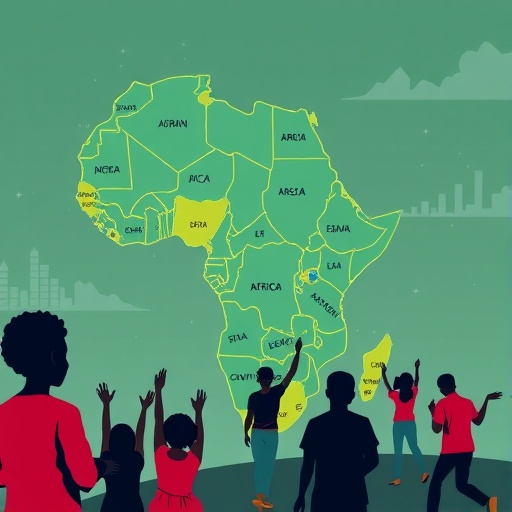
Researchers at the University of East London are advocating for a radical rethinking of global economic cooperation as a means to alleviate poverty, with a particular focus on Africa’s unique social and economic context. Their new work critiques previous economic reform strategies that have predominantly emphasized market-driven solutions, often at the expense of local communities and equitable development. These historical approaches, the researchers argue, have frequently exacerbated inequality and entrenched instability rather than fostering sustainable progress.
In a forthcoming chapter titled Poverty Alleviation through Global Economic Cooperation: The African Case and Context, Dr. Susan Akinwalere and Professor Kirk Chang critically analyze the trajectory of economic policy interventions imposed on African nations. Their study highlights that many reforms prioritized market efficiency and liberalization—a paradigm frequently dictated by external actors—over the social and economic realities faced by local populations. Such misaligned policies, they assert, have sometimes undermined institutional development, weakened governance structures, and contributed to systemic disparities.
The chapter is included in the upcoming Routledge volume Global Cooperative Economics and Movements (2026), which brings together scholarly contributions on innovative frameworks for economic collaboration. Akinwalere and Chang’s contribution stresses the necessity of departing from orthodox, top-down models towards inclusive systems that recognize the agency of African states and communities. Central to their argument is the promotion of partnership-oriented development models that empower indigenous economic actors rather than perpetuate dependency on external resources.
Dr. Akinwalere emphasizes the transformative potential of global cooperation when it is grounded in the priorities of the countries themselves. According to her, the success of poverty reduction initiatives depends on the nuanced understanding of local socioeconomic landscapes. “Policies that disregard contextual realities often worsen existing problems instead of resolving them,” she highlights, underscoring the critical role of context-sensitive frameworks in driving meaningful social change.
The demographic and resource landscape of Africa forms a vital backdrop to this discourse. With approximately 60 percent of its population under the age of 25, Africa boasts one of the world’s youngest and most rapidly expanding populations. Simultaneously, the continent is endowed with abundant deposits of critical minerals—such as cobalt, lithium, and copper—that underpin the global transition to green technologies including electric vehicles and renewable energy systems. These factors combine to position Africa as both a locus of immense economic opportunity and a crucial player in global sustainability efforts.
Despite this potential, Africa is often portrayed primarily through the lens of vulnerability and scarcity. Dr. Akinwalere challenges this reductive narrative by advocating for development paradigms that recognize and leverage the continent’s diverse assets. She posits that poverty alleviation must be reconceived as a process of establishing equitable partnerships that facilitate industrial diversification and value addition within African economies. This approach, she argues, would enable African nations to capture greater economic benefits from their natural resources and foster resilient growth trajectories.
Informed by an interdisciplinary perspective, the researchers propose that cooperative economic structures offer a viable alternative to conventional development models. Such frameworks promote collective ownership, shared decision-making, and democratic governance within economic enterprises, providing a mechanism to distribute benefits more equitably across communities. This cooperative ethos aligns with the broader call for inclusive development strategies that integrate governments, private sectors, civil societies, and academic institutions into cooperative ventures.
Professor Kirk Chang elaborates on the limitations of viewing poverty reduction solely through aggregate economic growth metrics. While growth is essential, he advocates for platforms that enable broad-based economic participation and ensure that the fruits of development are widely accessible. “Global cooperation must facilitate inclusive economic engagement rather than merely enforcing blanket prescriptions,” Chang asserts, emphasizing the importance of adaptability and responsiveness to local contexts in policy design.
The study also situates poverty within a complex web of structural issues including entrenched inequality, fragile institutional frameworks, and the enduring impacts of colonial economic legacies. These factors create systemic barriers to development and necessitate sustained, multifaceted interventions. The researchers argue that long-term investments, equitable trade partnerships, and strengthened regional integration are fundamental to dismantling these barriers and realizing inclusive growth.
Moreover, the authors underscore the importance of reimagining economic cooperation beyond narrow bilateral or multilateral aid models. Instead, they advocate for dynamic, participatory partnerships that amplify local capacity and foster endogenous development. Such partnerships would aim to transcend asymmetrical power relations and promote shared ownership of development agendas, which is critical for achieving sustainable poverty reduction.
By reconceptualizing global economic cooperation as a collaborative and contextualized process, this research contributes to a growing scholarly discourse on cooperative economics and its relevance to international development. The authors contend that this paradigm shift is imperative not only for Africa’s development but for reshaping global economic governance to be more just and effective.
The chapter thus offers a compelling vision for future economic cooperation frameworks that prioritize inclusion, equity, and local empowerment. It calls on policymakers, international organizations, and the development community to embrace innovative models reflecting the lived realities and aspirations of African societies. Only by fostering such grounded and equitable partnerships can genuine poverty alleviation be achieved in the rapidly evolving geopolitical and economic landscape.
News Publication Date: Not explicitly stated (anticipated in 2026 with the book publication)
Web References:
https://www.taylorfrancis.com/books/oa-edit/10.4324/9781003534006/global-cooperative-economics-movements-jerome-nikolai-warren-kemi-ogunyemi-asia-guerreschi-maciej-szulc
http://dx.doi.org/10.4324/9781003534006-35
References:
Akinwalere, S., & Chang, K. (2026). Poverty alleviation through global economic cooperation: The African case and context. In J. Warren, K. Ogunyemi, A. Guerreschi & M. Szulc (Eds.), Global Cooperative Economics and Movements.
Cite Scienmag News
Courtney Benton. (May 13, 2026). Africa’s youthful workforce: a catalyst for transforming global economic growth. Scienmag. https://scienmag.com/africas-youthful-workforce-a-catalyst-for-transforming-global-economic-growth/
Courtney Benton. "Africa’s youthful workforce: a catalyst for transforming global economic growth." Scienmag, 13 May 2026, https://scienmag.com/africas-youthful-workforce-a-catalyst-for-transforming-global-economic-growth/. Accessed 3 September 2026.
Courtney Benton. "Africa’s youthful workforce: a catalyst for transforming global economic growth." Scienmag. May 13, 2026. https://scienmag.com/africas-youthful-workforce-a-catalyst-for-transforming-global-economic-growth/


