


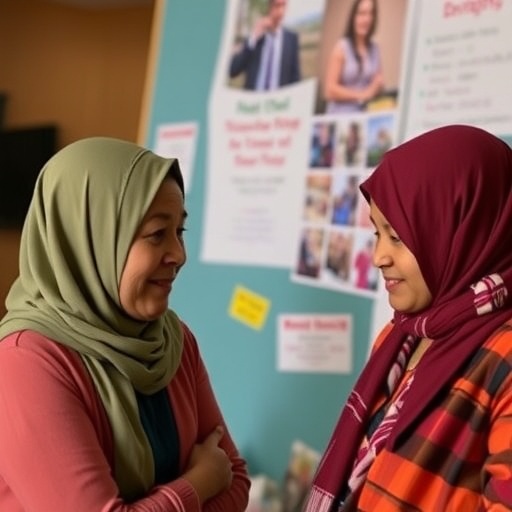
A novel study has demonstrated that a simple, guided self-help workbook combined with minimal telephone support can substantially alleviate mental health distress among displaced refugee populations. Conducted in Indonesia, this research addresses the profound psychological toll experienced by approximately 12,000 refugees residing in limbo—often for extended periods without stable rights, employment opportunities, or family reunification prospects. The findings herald a promising, scalable intervention amid the immense global refugee crisis.
The context of this study underscores the enduring challenges faced by displaced peoples. Many refugees in Indonesia endure a state of prolonged uncertainty, caught between their traumatic pasts and an unpredictable future. This precarious existence, marked by separation from loved ones and lack of socioeconomic integration, exacerbates mental health burdens. According to Professor Angela Nickerson, the clinical psychologist spearheading this research, these compounded stressors create a gap between the profound psychological needs of refugees and the insufficient mental health services currently accessible in host countries.
Highlighting this chasm, the study collaborates with local and regional organizations such as the refugee-led Refugee Learning Nest and the Indonesian legal aid group SUAKA, alongside academic institutions including UNSW Sydney and the Universities of Newcastle and Melbourne. This partnership was instrumental in adaptively tailoring the intervention for cultural and contextual relevance, ensuring responsiveness to the lived experiences and specific needs of refugee communities. Involving refugees as active facilitators not only enhanced program delivery but built community capacity for sustaining mental health support.
Globally, the scale of forced displacement has surged, with 2024 estimations identifying one in every 67 individuals as forcibly uprooted. The vast majority of these displaced populations find refuge in lower- and middle-income countries, where formal mental healthcare infrastructure is often lacking or inaccessible. The psychological toll is severe; the prevalence rates of post-traumatic stress disorder (PTSD) and depression among refugees are estimated at roughly 31.5%, reflecting the enduring impacts of war, persecution, and displacement.
The intervention evaluated was the World Health Organization’s established program “Doing What Matters in Times of Stress.” While the program is not new, this study is the first fully powered randomized controlled trial assessing its efficacy as a standalone intervention in a refugee population. The trial involved 303 Farsi-speaking Afghan refugees in Indonesia, a group extensively affected by prolonged pre-migratory trauma, perilous migration routes, and ongoing insecurity in transit settings. This intersection of trauma highlights the complexity of addressing mental health needs in such populations.
Participants were provided with an illustrated workbook in their native language and engaged in five brief facilitator calls, conducted by trained members of the refugee community. This peer-delivered model exemplifies a pragmatic, low-resource approach to mental health intervention, fostering community empowerment and circumventing barriers related to scarce professional mental health personnel. The training of facilitators was robust, co-developed in partnership with local organizations, enabling refugees to support one another through the workbook’s cognitive and emotional exercises.
The trial’s outcomes were striking. Compared to control group participants awaiting the intervention, those who completed the program experienced significantly greater reductions in psychological distress and PTSD symptoms. Additionally, improvements were observed in overall wellbeing, social functioning, and daily life activities. Notably, about half of those in the intervention condition demonstrated meaningful improvement or recovery at the one-month follow-up, contrasted with only 30% in the control group.
Underlying the therapeutic approach is acceptance and commitment therapy (ACT), which emphasizes psychological flexibility. This modality equips individuals with skills to manage uncontrollable and ongoing stressors using mindfulness, acceptance, and value-directed action rather than focusing solely on solving external problems. Such focus is crucial in contexts like refugee camps or transit countries where many external conditions remain fixed, requiring interventions that target internal coping mechanisms and adaptive emotional regulation.
The program’s efficacy also hints at the vital role of human connection and empathic listening. Interestingly, the control group exhibited some degree of symptom improvement over the course of the study, which researchers attribute to regular contact with trained assessors practicing empathic listening. This finding accentuates the importance of social support networks and emotional validation in psychological recovery, particularly in marginalized populations vulnerable to isolation and neglect.
Looking forward, the researchers aim to disseminate these findings broadly, engaging community organizations, policymakers, and service providers across Indonesia and the wider region. The ultimate goal is to promote scalable, cost-effective mental health resources accessible to displaced populations globally. This aligns with a critical need as forcible displacement reaches unprecedented levels worldwide, rendering low-cost, peer-delivered interventions an essential tool for mitigating the mental health crisis among refugees.
Complementing these efforts, Professor Nickerson has secured funding to adapt and evaluate this intervention within Australian refugee settlements. The insights gained from this research will inform enhanced settlement services and provide evidence-based frameworks for supporting refugee populations’ psychological wellbeing in resettlement contexts. This progression underscores the potential for both transit and destination countries to benefit from scalable psychological interventions rooted in community empowerment.
In sum, this study offers compelling evidence that a relatively brief, low-touch guided self-help program, bolstered by community-facilitator phone support, can meaningfully reduce the mental health burden among displaced refugees. By combining culturally sensitive content with scalable delivery methods, this model addresses critical mental health gaps in low-resource settings, fostering resilience and recovery amid entrenched adversity. Such advances represent a vital contribution to global mental health and humanitarian response strategies.
Web References:
- Article DOI: http://dx.doi.org/10.2196/89928
- WHO Program: https://www.who.int/publications/i/item/9789240003927
Cite Scienmag News
Glenn Wilkins. (June 12, 2026). Affordable Mental Health Tool Supports Refugees Facing Uncertainty. Scienmag. https://scienmag.com/affordable-mental-health-tool-supports-refugees-facing-uncertainty/
Glenn Wilkins. "Affordable Mental Health Tool Supports Refugees Facing Uncertainty." Scienmag, 12 June 2026, https://scienmag.com/affordable-mental-health-tool-supports-refugees-facing-uncertainty/. Accessed 3 September 2026.
Glenn Wilkins. "Affordable Mental Health Tool Supports Refugees Facing Uncertainty." Scienmag. June 12, 2026. https://scienmag.com/affordable-mental-health-tool-supports-refugees-facing-uncertainty/


