

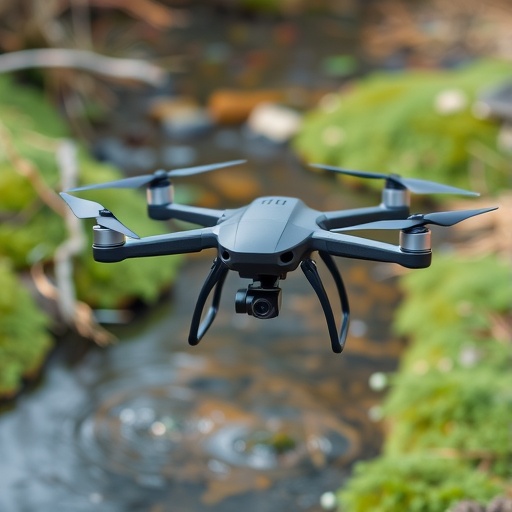
In the realm of environmental monitoring and ecological assessment, the integration of technology has revolutionized the way we approach the understanding of stream habitats and their health. A groundbreaking study led by Wang, Lu, and Wu presents an innovative, cost-effective approach utilizing drone technology to monitor and evaluate the health of stream habitats. With the increasing challenges posed by environmental change and habitat degradation, the development and application of such advanced assessment toolkits could provide significant benefits.
Drones, equipped with sophisticated sensors and imaging capabilities, have emerged as a powerful tool for researchers and environmentalists alike. Their ability to cover large areas with high-resolution imaging allows for an unprecedented capacity to gather data on various ecological parameters. The study set forth a comprehensive methodology, employing drones not just as passive data collectors, but as integral components of real-time monitoring systems that can assess habitat conditions effectively and efficiently.
The study emphasizes the importance of stream habitats as crucial ecosystems that support diverse biological communities. Streams contribute to broader environmental health and are vital for providing clean water resources, supporting wildlife, and sustaining human activities. However, these habitats are increasingly threatened by anthropogenic influences, including pollution, urbanization, and climate change. Therefore, the necessity for continuous and accurate monitoring systems cannot be overstated.
A remarkable aspect of Wang, Lu, and Wu’s research is the cost-effectiveness of the drone-based toolkits they developed. Traditional methods of habitat assessment often require extensive labor, specialized training, and significant financial resources, which can limit their accessibility, especially for smaller conservation organizations or researchers operating on tight budgets. By contrast, the methodology presented offers a scalable solution that broadens the scope of who can engage in important monitoring efforts, ultimately enhancing global conservation initiatives.
The researchers conducted extensive field trials, demonstrating the practicality of their approach in various settings. They assessed parameters such as water quality, vegetation cover, and habitat structure—all critical indicators of stream health. Additionally, the study introduced machine learning algorithms that process aerial imagery, enabling rapid analysis and interpretation of collected data, which stood to save time and reduce human error in assessments.
Another key advantage of this drone monitoring system is the potential for adaptive management practices in environmental protection. As a proactive measure, having real-time data allows stakeholders to respond swiftly to emerging issues in stream habitats, whether they be instances of pollution events or changes in biodiversity. This dynamic approach can help in implementing timely interventions, thereby safeguarding aquatic ecosystems.
Furthermore, the study explored how these drone-derived data sets could be integrated into broader environmental management frameworks. By combining information from various sources—government databases, local studies, and community input—researchers can create comprehensive ecological profiles of stream habitats that inform policy decisions and conservation strategies. Such integration is crucial for fostering collaborative efforts across different sectors, including local governments, NGOs, and academic institutions.
The potential scalability of drone monitoring technology resonates well beyond stream health monitoring. The methodologies developed in this study may be adapted for other types of ecosystems, such as wetlands, lakes, and coastal regions. With adaptations, stakeholders can utilize drones for a wide array of environmental assessments, extending the impact of this innovative toolkit into various conservation and research areas.
Moreover, community involvement in environmental monitoring is pivotal for sustainable practices. The tools created in this research may empower local communities and citizen scientists, providing them the opportunity to participate actively in monitoring initiatives. By democratizing access to high-quality equipment and training in drone operation and data analysis, communities can take ownership of their local environments, raising awareness and driving localized conservation efforts.
This novel research by Wang, Lu, and Wu signifies a fresh chapter in the relationship between technology and environmental science. As challenges mount from climate change and habitat loss, the need for efficient, effective monitoring systems becomes imperative. By pioneering cost-effective methodologies integrating drone technology into stream habitat assessment, this study paves the way for future innovations in environmental monitoring practices, bridging the gap between scientific research and practical application.
In conclusion, the development and application of cost-effective drone monitoring and evaluating toolkits present an exciting frontier for stream habitat assessment. Through technological innovation and community involvement, this research inspires hope for ecological conservation in the face of daunting environmental challenges. As the world continues to grapple with the consequences of human activity on natural ecosystems, studies like these serve as reminders of the potential synergy between science, technology, and environmental stewardship.
To encapsulate the essence of these advancements, it is critical for the scientific community to disseminate these findings widely and engage in conversations about their impacts. Leveraging social media platforms and environmental forums can amplify the reach of such captivating research, encouraging discussions that might lead to collaborative efforts in global conservation.
Only time will reveal the full impact of these cost-effective monitoring toolkits, but it is clear they represent a significant leap forward in the pursuit of sustainable environmental practices. The future of stream habitat health assessments may very well depend on harnessing this technological potential, inspiring others to follow suit in other ecological realms.
Subject of Research: Cost-effective drone monitoring toolkits for stream habitat health.
Article Title: Cost-effective drone monitoring and evaluating toolkits for stream habitat health: development and application.
Article References: Wang, W., Lu, B. & Wu, C.H. Cost-effective drone monitoring and evaluating toolkits for stream habitat health: development and application. Environ Monit Assess 198, 10 (2026). https://doi.org/10.1007/s10661-025-14814-9
Image Credits: AI Generated
DOI: https://doi.org/10.1007/s10661-025-14814-9
Keywords: drone monitoring, stream habitat health, cost-effective toolkits, environmental assessment, ecological monitoring, real-time data analysis, community involvement, machine learning integration.


