


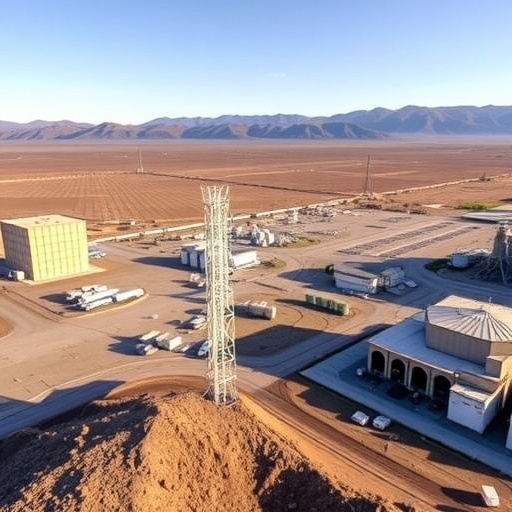
In a significant development for the global astronomy community, AES Andes, a subsidiary of the American energy corporation AES, has declared its decision to halt the INNA megaproject planned near the European Southern Observatory’s (ESO) Paranal Observatory. This announcement marks a crucial victory for the protection of one of the world’s clearest and darkest skies, essential for cutting-edge astronomical observations. ENSO anticipates that AES Andes will formally withdraw the INNA project from Chile’s Environmental Assessment Service (SEA), officially confirming its discontinuation and the preservation of the Paranal site’s pristine conditions.
The INNA project aimed to establish a large-scale industrial complex focusing on green hydrogen and green ammonia production, positioning itself as a part of renewable energy advancements. However, ESO’s comprehensive technical evaluation highlighted profound risks associated with the project’s proximity to Paranal Observatory. The observatory, situated atop the 2600-meter Cerro Paranal mountain in the Atacama Desert, benefits from approximately 300 clear nights annually—an ideal environment for astronomical observation that is jeopardized by industrial developments.
ESO Director General Xavier Barcons emphasized the gravity of the situation in his statement, expressing relief upon the project’s cancellation. Barcons underscored that the INNA facility, given its location near Paranal, would substantially degrade the observational quality through several mechanisms. These include light pollution, airborne dust, vibrations resulting from industrial machinery, and increased atmospheric turbulence—all factors that critically impair the performance of high-precision instruments like the Very Large Telescope (VLT), Very Large Telescope Interferometer (VLTI), Extrememly Large Telescope (ELT), and the Cherenkov Telescope Array Observatory South (CTAO-South).
The technical analysis conducted by ESO elucidated how the introduction of artificial lighting from the INNA complex would introduce stray light contamination, diminishing the contrast and sensitivity of optical and infrared observations. Additionally, airborne dust raised by industrial activity poses an adverse effect on the local atmosphere’s clarity, scattering incoming light and further obscuring faint celestial objects. Micro-vibrations, an often overlooked operational hazard, can disrupt the fine alignment and stability of the telescopes’ mirrors and instrumentation, degrading image quality, resolution, and data integrity.
Crucially, the project’s impact on air turbulence introduces an even more insidious threat. Atmospheric stability is paramount to high-resolution ground-based astronomical observation; turbulence causes fluctuations in the refractive index of air that distort incoming light, an effect known as “seeing.” INNA’s industrial activity would exacerbate this effect, decreasing the achievable angular resolution of even the most advanced telescopes located on site, thus impairing the ability to conduct detailed studies of distant cosmic phenomena.
ESO has long supported energy decarbonization and the transition to renewable energy systems as fundamental for a sustainable future. However, as Barcons pointed out, such initiatives must be balanced with the preservation of irreplaceable scientific infrastructure. This balance hinges on maintaining adequate separation between industrial projects and astronomical observatories to prevent detrimental interference with normal operations, underscoring the need for strategic siting of green technology complexes.
The INNA case throws into sharp relief the urgent and complex policy challenge of safeguarding astronomical sites worldwide. Northern Chile’s extraordinary natural conditions for optical astronomy are globally unparalleled. The region’s unique combination of high altitude, dry atmosphere, minimal light pollution, and stable weather patterns makes it the premier observatory location on Earth. Protecting these conditions requires clear, enforceable protection protocols and zoning regulations that prevent incompatible developments within critical buffer zones.
ESO has recommitted to partnering with Chilean authorities at all levels—from local communities to national government—to advocate for and implement enhanced preservation measures. These efforts ensure the ongoing protection and sustainable use of the region’s dark skies, which are vital not only for astronomy but also for preserving ecological systems and local cultural heritage tied to a pristine night environment.
The public response to the INNA project’s proposed location has been overwhelmingly supportive of dark-sky preservation, reflecting a broad societal recognition of the scientific and environmental value of unobstructed night skies. The global astronomy community, Chilean political leaders, environmental organizations, and countless citizens have mobilized to voice their concerns, providing an inspiring example of collaborative stewardship for natural heritage.
Going forward, ESO advises that any new industrial development proposals near observatory sites must undergo rigorous technical scrutiny regarding their environmental and operational impacts to ensure they do not threaten astronomical capabilities. The INNA case underscores how vital it is that industrial expansion and scientific research coexist through informed policies and conscientious planning rather than happenstance.
Alongside its advocacy efforts for protected observatory zones, ESO is intensifying its fight against pervasive global issues such as light pollution and satellite interference. The organization remains dedicated to preserving the quality of skies not only in Chile but throughout the world, recognizing that dark, quiet skies are essential for both advancing human understanding of the Universe and maintaining a shared cosmic heritage for future generations.
ESO’s leadership reminds the broader research and public community that maintaining the excellence of astronomical facilities like Paranal is indispensable for sustaining the rapid pace of discovery in astronomy and astrophysics. The Very Large Telescope, Extremely Large Telescope, and other cutting-edge facilities operating at Paranal provide critical insights into the origins, structure, and evolution of the Universe, enabling breakthroughs that shape fundamental physics, cosmology, and planetary science.
Looking ahead, ESO continues to leverage international collaboration among its member states and partners to promote strong protective frameworks around observatories and to foster public engagement. By integrating scientific expertise with policy advocacy and public outreach, ESO endeavors to ensure that future generations inherit the ability to observe the cosmos unhindered by human-made obstructions.
Ultimately, the cessation of the INNA project near Paranal Observatory represents a significant triumph for science, environmental preservation, and responsible development. It exemplifies how rigorous scientific assessment combined with informed, collective action can safeguard invaluable natural and scientific assets against competing pressures for industrial growth. This outcome strengthens global resolve to protect similar treasures worldwide, guaranteeing that the wonders of the Universe remain accessible through humanity’s most sophisticated earthly windows.
News Publication Date:
January 2025.
Web References:
- ESO Press Release on INNA
- AES Andes Press Release
- ESO Technical Analysis PDF
- Paranal Photos – ESO
- INNA Infographics – ESO
Cite Scienmag News
Russell Cooper. (February 2, 2026). AES Andes Cancels INNA Industrial Complex Project Near Paranal, Impacting Regional Scientific Developments. Scienmag. https://scienmag.com/aes-andes-cancels-inna-industrial-complex-project-near-paranal-impacting-regional-scientific-developments/
Russell Cooper. "AES Andes Cancels INNA Industrial Complex Project Near Paranal, Impacting Regional Scientific Developments." Scienmag, 2 February 2026, https://scienmag.com/aes-andes-cancels-inna-industrial-complex-project-near-paranal-impacting-regional-scientific-developments/. Accessed 3 September 2026.
Russell Cooper. "AES Andes Cancels INNA Industrial Complex Project Near Paranal, Impacting Regional Scientific Developments." Scienmag. February 2, 2026. https://scienmag.com/aes-andes-cancels-inna-industrial-complex-project-near-paranal-impacting-regional-scientific-developments/


