


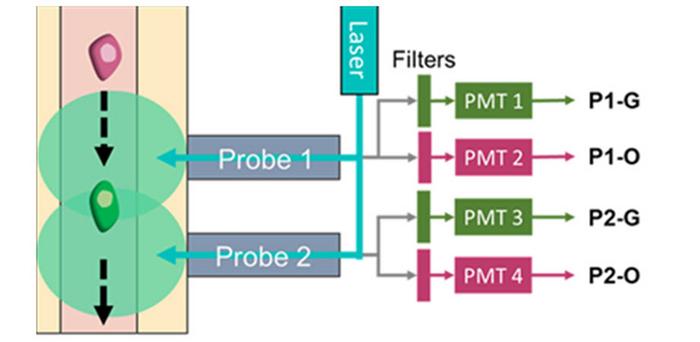
In the relentless fight against cancer, a new technology promises to shed light on how we track and understand the spread of this disease within the body. A research team from Northeastern University and Dartmouth College recently developed a remarkable tool called “diffuse in vivo flow cytometry” (DiFC), which allows for the noninvasive detection and counting of rare cancer cells circulating in the bloodstream.

Credit: Williams et al., doi 10.1117/1.JBO.29.6.065003.
In the relentless fight against cancer, a new technology promises to shed light on how we track and understand the spread of this disease within the body. A research team from Northeastern University and Dartmouth College recently developed a remarkable tool called “diffuse in vivo flow cytometry” (DiFC), which allows for the noninvasive detection and counting of rare cancer cells circulating in the bloodstream.
Monitoring cancer spread in real time
In a recent publication in the Journal of Biomedical Optics (JBO), the research team detailed their innovative two-color DiFC system, capable of simultaneously detecting two distinct populations of cancer cells in real time in small animals. This advance opens doors to a deeper understanding of cancer progression and response to treatments, as it enables researchers to study different subpopulations of cancer cells within the same animal.
Traditionally, studying circulating tumor cells (CTCs) involved invasive methods such as drawing blood samples, which often failed to capture rare CTCs or multicellular CTC clusters (CTCCs) with high metastatic potential. DiFC circumvents these limitations by using highly scattered light to probe large blood vessels, allowing for the noninvasive sampling of larger peripheral blood volumes and detection of rare cancer cells.
The team demonstrated the versatility of their two-color DiFC system through experiments involving tissue-mimicking flow phantoms and mice with multiple myeloma. By accurately differentiating between cancer cells expressing green fluorescent protein (GFP) and tdTomato, they were able to monitor the dynamics of cancer spread in real time. Notably, the majority of detected CTCCs exhibited single fluorescent proteins, providing insights into the heterogeneity of cancer cell populations.
Implications for personalized treatment
The potential implications of this technology are profound. With the ability to monitor different cancer cell subpopulations simultaneously, researchers can gain invaluable insights into tumor development and response to therapies. This helps light the way toward more targeted and personalized treatment strategies, ultimately bringing us closer to conquering cancer.
The journey towards defeating cancer is a complex one, but with advancements like DiFC, we’re equipping ourselves with powerful tools to tackle this formidable foe head-on. As this technology continues to evolve, the future holds promise for more effective cancer treatments and, ultimately, a world where cancer is no longer a life-threatening diagnosis.
For details, see the original Gold Open Access article by A. Williams et al., “Two-color diffuse in vivo flow cytometer,” J. Biomed. Opt. 29(6), 065003 (2024), doi 10.1117/1.JBO.29.6.065003.
Journal
Journal of Biomedical Optics
Article Title
Two-color diffuse in vivo flow cytometer
Article Publication Date
30-May-2024
Cite Scienmag News
Nathaniel Bowman. (June 7, 2024). Advancing cancer tracking: DiFC detects rare cells noninvasively. Scienmag. https://scienmag.com/advancing-cancer-tracking-difc-detects-rare-cells-noninvasively/
Nathaniel Bowman. "Advancing cancer tracking: DiFC detects rare cells noninvasively." Scienmag, 7 June 2024, https://scienmag.com/advancing-cancer-tracking-difc-detects-rare-cells-noninvasively/. Accessed 3 September 2026.
Nathaniel Bowman. "Advancing cancer tracking: DiFC detects rare cells noninvasively." Scienmag. June 7, 2024. https://scienmag.com/advancing-cancer-tracking-difc-detects-rare-cells-noninvasively/

