


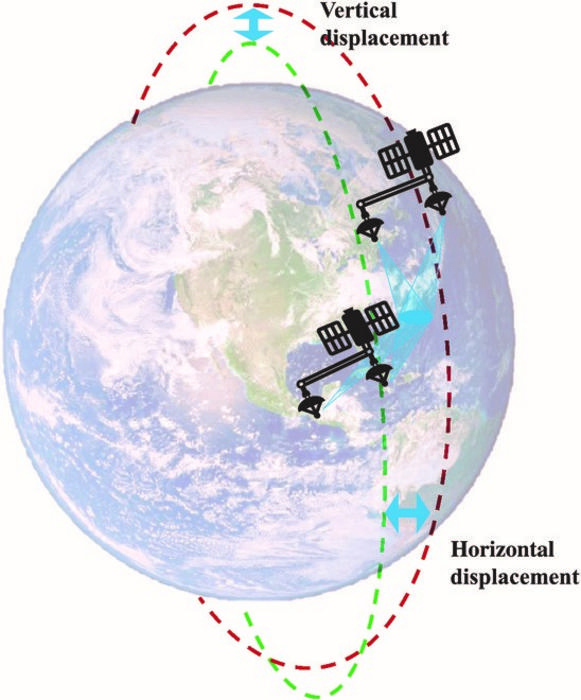
The new Tandem Dual-Antenna Spaceborne Synthetic Aperture Radar (SAR) Interferometry (TDA-InSAR) system, addresses the limitations of current spaceborne Synthetic Aperture Radar (SAR) systems by providing a more reliable and efficient method for 3D surface mapping. The system’s innovative design allows for single-pass acquisitions, significantly reducing the time required for data collection and enhancing the precision of 3D reconstructions in various terrains, including built-up areas and vegetation canopies.

Credit: Journal of Remote Sensing
The new Tandem Dual-Antenna Spaceborne Synthetic Aperture Radar (SAR) Interferometry (TDA-InSAR) system, addresses the limitations of current spaceborne Synthetic Aperture Radar (SAR) systems by providing a more reliable and efficient method for 3D surface mapping. The system’s innovative design allows for single-pass acquisitions, significantly reducing the time required for data collection and enhancing the precision of 3D reconstructions in various terrains, including built-up areas and vegetation canopies.
Synthetic Aperture Radar (SAR) interferometry (InSAR) is a powerful tool for producing high-resolution topographic maps. However, traditional InSAR techniques face challenges such as the ill-posed 2D phase unwrapping problem and the need for multiple acquisitions over time, which can introduce errors due to atmospheric and orbital changes. The TDA-InSAR system overcomes these challenges by utilizing dual-antenna and dual-satellite configurations to acquire optimal interferograms for an asymptotic 3D phase unwrapping algorithm.
Researchers from Fudan University and the Chinese Academy of Sciences have developed a novel Tandem Dual-Antenna Spaceborne SAR Interferometry (TDA-InSAR) system, designed to achieve optimal multi-baseline interferograms for fast 3D reconstruction. The study (DOI: 10.34133/remotesensing.0137), published on 6 May 2024, in the journal Journal of Remote Sensing, presents a systematic investigation into the performance of various baseline configurations and the impact of different error sources on the system’s accuracy.
The TDA-InSAR system employs a dual-antenna and dual-satellite approach to capture optimal interferograms, which are then processed through an asymptotic 3D phase unwrapping algorithm. This method allows for rapid and accurate 3D reconstruction with minimal acquisitions, overcoming the limitations of previous technologies. The study’s simulations demonstrated that the TDA-InSAR system could achieve a remarkable relative height precision of 0.3 meters in urban areas and 1.7 meters in dense vegetation, outperforming existing SAR interferometry methods. The research also explored various baseline configurations, finding that a bi-static mode with a flexible satellite baseline provided the best results.
“The TDA-InSAR system represents a significant advancement in SAR interferometry,” said Fengming Hu, the lead researcher of the study. “By tailoring the system to work with an asymptotic 3D phase unwrapping algorithm, we’ve been able to achieve a relative height precision of 0.3 meters in built-up areas and 1.7 meters in vegetation canopies, which is a substantial improvement over existing technologies.”
The TDA-InSAR system has significant implications for various applications, including terrain mapping, target recognition, and forest height inversion. Its ability to perform rapid 3D reconstruction in a single flight makes it a valuable tool for both scientific research and practical applications such as disaster response and environmental monitoring.
###
References
Original Source URL
Funding information
This work was supported in part by the National Nature Science Foundation of China under grants 61991422 and 62201158.
About Journal of Remote Sensing
The Journal of Remote Sensing, an online-only Open Access journal published in association with AIR-CAS, promotes the theory, science, and technology of remote sensing, as well as interdisciplinary research within earth and information science.
Journal
Journal of Remote Sensing
Subject of Research
Not applicable
Article Title
Conceptual Study and Performance Analysis of Tandem Multi-Antenna Spaceborne SAR Interferometry
Article Publication Date
6-May-2024
COI Statement
The authors declare that they have no competing interests.
Cite Scienmag News
Russell Cooper. (May 20, 2024). Advancing 3D mapping with tandem dual-antenna SAR interferometry. Scienmag. https://scienmag.com/advancing-3d-mapping-with-tandem-dual-antenna-sar-interferometry/
Russell Cooper. "Advancing 3D mapping with tandem dual-antenna SAR interferometry." Scienmag, 20 May 2024, https://scienmag.com/advancing-3d-mapping-with-tandem-dual-antenna-sar-interferometry/. Accessed 3 September 2026.
Russell Cooper. "Advancing 3D mapping with tandem dual-antenna SAR interferometry." Scienmag. May 20, 2024. https://scienmag.com/advancing-3d-mapping-with-tandem-dual-antenna-sar-interferometry/

