


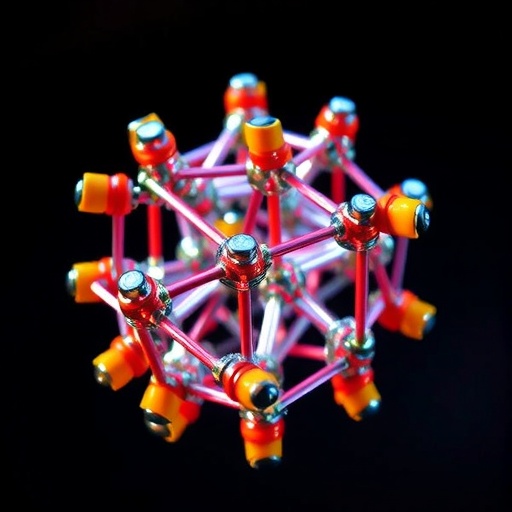
Researchers have unveiled breakthrough insights into the anion chemistry of fluorophosphate NASICON cathodes, a critical advancement for next-generation sodium-ion batteries. By conducting an in-depth comparative study of two prominent cathode materials, Na₃V₂(PO₄)₂F₃ (NVPF) and Na₃V₂O₂(PO₄)₂F (NVOPF), this work elucidates subtle structural and electrochemical nuances that dictate performance, paving the way for durable, high-voltage sodium-ion energy storage.
Sodium-ion batteries have emerged as promising contenders to lithium-ion systems, owing to sodium’s abundance and cost advantages. However, developing cathodes that deliver high voltage, fast sodium-ion transport, and long-term stability remains a formidable challenge. Traditional investigations often examined NVPF and NVOPF separately, leaving a gap in understanding how their anion chemistries influence their properties. This study bridges that divide by systematically analyzing how partial fluorine-to-oxygen substitution reshapes their crystal structure and electrochemical behavior.
Structurally, NVPF crystallizes in the P4₂/mnm space group with vanadium coordinated to oxygen and fluorine in dioctahedral units. Its strong inductive effect from fluorine elevates the vanadium redox potential to nearly 4.1 volts, but a highly ordered sodium arrangement induces phase transitions that hamper ion mobility. Conversely, NVOPF adopts an I4/mmm structure with mixed O and F coordination, resulting in a slightly lower voltage around 3.8 V but enhanced electronic conductivity. Oxygen substitution fosters π-electron delocalization, enabling solid-solution sodium storage and suppressing intermediate phase formations, which favor fast Na⁺ diffusion.
Advanced computational modeling further reveals distinct ion transport mechanisms: NVPF’s sodium migration primarily occurs via anisotropic pathways in the (002) plane, facing a 0.43 eV activation barrier. NVOPF, in contrast, features intrinsic ab-plane “ion highways” with significantly reduced barriers between 0.15 and 0.31 eV. These findings underscore how tuning anion chemistry directly modulates bulk electronic structure, ionic diffusion channels, and interfacial kinetics.
Beyond fundamental insights, the review critically assesses synthesis and doping strategies that can optimize these cathodes for practical use. Scalable mechanochemical methods permit kilogram-scale NVOPF production at ambient temperatures, while controlled hydrothermal processes yield tailored nanostructures enhancing electrochemical activity. Surface carbon coatings and elemental doping—such as Fe, Mn, Cr, and Li—significantly improve conductivity, stabilize frameworks, and extend cycle life. Notably, Li-doped NVPF achieves remarkable capacity retention after tens of thousands of cycles by disrupting ordered sodium arrangements.
The researchers also address persistent challenges in cathode-electrolyte interfaces. Operating at high voltages above conventional electrolyte stability windows, NVPF suffers oxidative electrolyte decomposition and interphase growth, whereas NVOPF is prone to hydrofluoric acid generation and vanadium dissolution. Innovative electrolyte formulations incorporating high-concentration ethers and functional additives, along with in-situ protective interphases, emerge as promising solutions to mitigate degradation and enable long-term high-voltage operation.
This comprehensive review presents a paradigm shift—demonstrating that anion chemistry is a powerful, tunable lever to regulate structure-function relationships in sodium cathodes. These insights open new avenues to engineer fast-charging, high-energy-density, and durable sodium-ion batteries, crucial for sustainable grid-scale energy storage.
Stay tuned as this collaborative team from Zhejiang University, South China Normal University, and Zhejiang University-Quzhou continue advancing the frontier of sodium-ion battery materials science.
Keywords
Sodium-ion batteries, NASICON cathodes, fluorophosphate, anion chemistry, Na₃V₂(PO₄)₂F₃, Na₃V₂O₂(PO₄)₂F, ionic diffusion, high-voltage cathodes, electrolyte stability, energy storage
Cite Scienmag News
Bethany Barker. (July 10, 2026). Advances in NASICON Cathodes: Structure, Electrochemistry, and Stability Explored. Scienmag. https://scienmag.com/advances-in-nasicon-cathodes-structure-electrochemistry-and-stability-explored/
Bethany Barker. "Advances in NASICON Cathodes: Structure, Electrochemistry, and Stability Explored." Scienmag, 10 July 2026, https://scienmag.com/advances-in-nasicon-cathodes-structure-electrochemistry-and-stability-explored/. Accessed 3 September 2026.
Bethany Barker. "Advances in NASICON Cathodes: Structure, Electrochemistry, and Stability Explored." Scienmag. July 10, 2026. https://scienmag.com/advances-in-nasicon-cathodes-structure-electrochemistry-and-stability-explored/


