


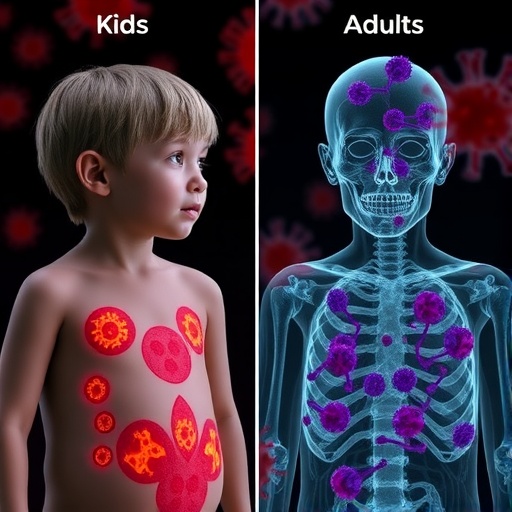
In the relentless global battle against the COVID-19 pandemic, scientists continue to unravel the complexities of immune responses elicited by SARS-CoV-2 infection. A groundbreaking study published in Pediatric Research by Nantel et al. delivers an illuminating comparative analysis of adaptive immunity to SARS-CoV-2 in infected children and adults. This detailed inquiry not only deepens our understanding of age-dependent immune dynamics but also has profound implications for vaccine design, public health strategies, and our conceptual frameworks surrounding viral immunity.
At the heart of this study lies a sophisticated examination of adaptive immunity—the tailored immune defense orchestrated by lymphocytes such as B cells and T cells. Unlike innate immunity, which offers a generalized rapid response, the adaptive arm develops specificity and memory, crucial in long-term protection. Nantel and colleagues dissected how these mechanisms operate differently in children compared to adults following natural SARS-CoV-2 infection. This dichotomy has remained a pivotal question since the earliest days of the pandemic, as children generally exhibit milder symptoms and lower fatality rates despite similar viral exposures.
Delving into the immunological factors contributing to this phenomenon, the authors employed cutting-edge immunophenotyping techniques. These methods enabled them to quantify and characterize virus-specific B and T cell subsets within peripheral blood samples, providing a granular view of cellular immunity. Beyond mere enumeration, functional assays were performed to assess the quality and potency of the immune responses. This approach extended to the evaluation of neutralizing antibody titers, which are indicative of the humoral immune system’s capacity to block viral entry and replication.
A remarkable revelation from this study was the robust and durable nature of adaptive immunity in children, which in some respects exceeded that observed in adults. Specifically, pediatric subjects displayed heightened frequencies of SARS-CoV-2-specific CD8+ cytotoxic T cells, which are critical for identifying and eradicating infected cells. This could partially explain why children clear the virus more efficiently and experience fewer severe outcomes. Additionally, memory B cell compartments in younger individuals were found to sustain neutralizing antibody production over extended periods, underscoring a foundation for longer-lasting immunity.
The implications of these findings extend far beyond academic interest. They invite reconsideration of age-specific vaccination protocols. While adult vaccination remains essential, understanding that children mount a distinct and potentially more effective natural adaptive response opens discussions about tailored booster schedules or vaccine formulations that align with these immunological profiles. Such precision vaccination strategies could optimize protection while minimizing adverse reactions.
Moreover, the study touches upon T follicular helper (Tfh) cells, a specialized subset helping B cells mature and produce high-affinity antibodies. Their increased activity in children suggests a more efficient collaboration within secondary lymphoid organs during the immune response, enhancing antibody quality. This enhanced germinal center activity might be a previously underappreciated contributor to the superior immune performance in pediatric populations.
In parallel, the authors explored the functional cytotoxic profiles of T cells via intracellular cytokine staining and degranulation markers. They found that children’s T cells were not only more abundant but also exhibited heightened functional capacity. This intricate orchestration of cellular responses may translate into effective viral clearance while simultaneously preventing the immunopathology associated with severe COVID-19 cases in adults.
Importantly, the study allows insights into how pre-existing immunity—possibly from exposures to common cold coronaviruses—intersects with SARS-CoV-2 adaptive immunity. Evidence suggested that children have a more cross-reactive immune repertoire, potentially priming their system for rapid response upon encountering novel coronavirus antigens. This cross-reactivity could modulate disease severity and also influence how vaccination outcomes unfold across age groups.
Nantel et al. further emphasized the role of circulating cytokines and chemokines, the signaling molecules that shape and regulate immune activity. Profiles in children indicated a balanced inflammatory milieu, contrasting with the often dysregulated and exacerbated cytokine responses observed in critically ill adults. This balance may contribute to protection from hyperinflammation—a hallmark of severe COVID-19—and points to intrinsic regulatory mechanisms working more efficiently in younger hosts.
Genetic and epigenetic factors were also considered in the context of immune response variance. While the study primarily focused on cellular immunity, acknowledge that genetic predispositions affecting immune receptor expression and signaling pathways could underlie the observed differences. Future integrative multi-omics analyses could extend these findings, linking adaptive immunity to host genomics for a more comprehensive picture.
In terms of methodology, the researchers adopted a longitudinal study design, tracking immune parameters from acute infection phases through convalescence. This temporal dimension afforded a dynamic perspective, illustrating not only peak immune responses but also the durability and evolution of immunity over time. Notably, children maintained stable or even increased levels of protective immune cells months post-infection, a hopeful indicator for lasting immunity that might reduce susceptibility to reinfection.
The study also brings to light the potential discrepancies in mucosal immunity, which was not extensively covered but remains an essential frontier. Given that SARS-CoV-2 primarily infects respiratory mucosa, future work should address how local immune defenses differ by age and their interplay with systemic adaptive responses. Mucosal antibodies such as secretory IgA play critical roles in frontline defense and remain to be fully elucidated in this context.
Additionally, these findings provoke deeper inquiries into vaccine-induced immunity. Since most current vaccines were evaluated predominantly in adult cohorts, this research underscores the need to validate and possibly adapt vaccination strategies for children, ensuring the elicitation of balanced, potent, and durable immunity. The immunological insights gained here could guide the rational design of pediatric vaccines or adjuvants that mimic natural infection benefits without associated risks.
This pioneering work by Nantel and colleagues represents a significant milestone in pediatric immunology amid the COVID-19 era. It reframes our understanding of how children’s immune systems interact with SARS-CoV-2, highlighting both their impressive adaptive immune capabilities and the complexities inherent to age-dependent disease outcomes. As the viral landscape continues to evolve with new variants, such nuanced immunological knowledge remains indispensable for proactive public health responses.
Ultimately, uncovering the molecular and cellular signatures distinguishing pediatric immunity offers promise not only for managing current pandemic challenges but also for designing interventions against emerging infectious diseases. With a science-driven approach embracing immunological subtleties, global health efforts can become more precise, effective, and equitable across demographic spectra.
Cite Scienmag News
Kristina Jarvis. (August 20, 2025). Adaptive Immunity to SARS-CoV-2: Kids vs. Adults. Scienmag. https://scienmag.com/adaptive-immunity-to-sars-cov-2-kids-vs-adults/
Kristina Jarvis. "Adaptive Immunity to SARS-CoV-2: Kids vs. Adults." Scienmag, 20 August 2025, https://scienmag.com/adaptive-immunity-to-sars-cov-2-kids-vs-adults/. Accessed 3 September 2026.
Kristina Jarvis. "Adaptive Immunity to SARS-CoV-2: Kids vs. Adults." Scienmag. August 20, 2025. https://scienmag.com/adaptive-immunity-to-sars-cov-2-kids-vs-adults/


