


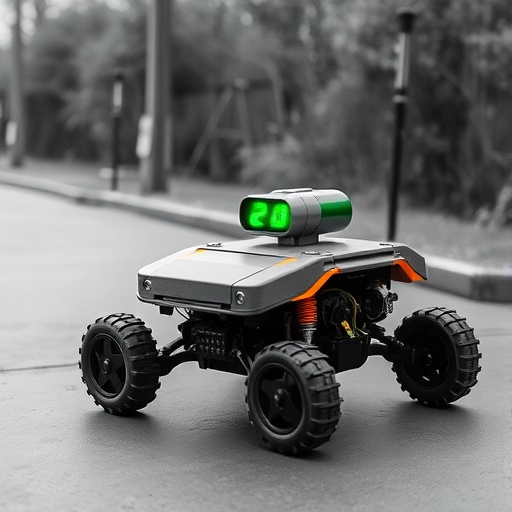
In the rapidly evolving field of autonomous guidance and robotic control systems, a pioneering advancement has been introduced by researchers Xu and Qian in a recent publication that promises to substantially enhance the performance and reliability of Automated Guided Vehicles (AGVs). Published in Scientific Reports in 2026, their study details a novel data-driven adaptive integral variable structure control method, uniquely integrated with a backpropagation (BP) neural network observer, marking a significant leap forward in trajectory tracking systems. This innovative approach offers a fresh perspective on addressing the complexities and uncertainties that traditionally challenge AGV navigation and control.
At the heart of this breakthrough lies the confluence of adaptive control theory with advanced machine learning techniques, specifically the use of a BP neural network observer. The work by Xu and Qian meticulously addresses the pressing need for AGVs to maintain precise trajectory tracking amidst external disturbances, system uncertainties, and dynamic environmental conditions. Unlike conventional control frameworks that often rely heavily on predefined models and fixed parameter tuning, their method dynamically adjusts control parameters in real time, guided by data-driven insights derived from the neural network observer.
The BP neural network observer functions as an intelligent estimator within this control scheme. By continuously learning from the trajectory data and the system’s real-time responses, it predicts state variables and system outputs more accurately than traditional observers. This capability substantially reduces the estimation errors that typically hamper the effectiveness of AGV control. The neural network’s adaptability ensures the observer’s precision is maintained even in the presence of modeling inaccuracies, sensor noise, and nonlinear system behaviors — factors that often degrade conventional control performance.
Integral variable structure control (VSC) has long been recognized for its robustness against uncertainties and disturbances. Xu and Qian’s innovation comes from embedding integral action within the VSC framework and coupling it with the neural network observer to achieve a data-driven control strategy. This hybrid control architecture exploits the chattering reduction properties of integral VSC while enhancing responsiveness through adaptive parameter tuning based on the observed data patterns. The integral action fortifies steady-state error elimination, ensuring the AGV trajectory aligns closely with desired paths.
Their methodology also tackles the notorious problem of chattering, a common drawback in sliding mode and variable structure control systems. Chattering refers to the high-frequency oscillations in control signals that can cause mechanical wear and system instability. By integrating an adaptive algorithm informed by the BP neural network’s observer data, the control method effectively modulates control efforts to attenuate chattering without compromising robustness. This delicate balance between responsiveness and stability is key for AGVs deployed in complex industrial and logistics environments where precision and smooth operation are paramount.
The trajectory tracking performance of AGVs has always been contingent on a control system’s ability to cope with real-world complexities such as payload variations, wheel slip, system parameter drifts, and external disturbances like uneven surfaces or unexpected obstacles. Xu and Qian’s control framework exhibits a high degree of resilience to such factors by continuously refining the control input through adaptive learning, a significantly advantageous feature over static control designs. This adaptivity enables the AGVs to maintain optimal performance over a broader range of operational conditions.
Computational efficiency is another hallmark of their proposed solution. Despite incorporating deep learning elements in the form of a BP neural network, the lightweight structure of the neural observer ensures that computational demands remain suitable for real-time applications. This is critical given the constrained processing resources typically available on embedded AGV controllers. The authors report that their data-driven controller can achieve rapid convergence in parameter adaptation, facilitating seamless integration with existing AGV systems without the need for extensive hardware upgrades.
The experimental validation presented in the article reflects a comprehensive assessment of the controller’s efficacy. Simulations and physical testbeds demonstrate significant improvements in trajectory precision, disturbance rejection, and control smoothness compared to traditional PID controllers and non-adaptive sliding mode controllers. The data-driven adaptive integral variable structure control approach reduces both transient and steady-state errors, underscoring the practical value of incorporating machine learning observers in control theory applications.
Moreover, the research underscores the scalability of this control strategy to various types of AGVs and potentially other autonomous robotic platforms. The modular nature of the BP neural network observer allows it to be retrained or fine-tuned with new datasets representing different operational scenarios, making the controller highly versatile. This adaptability paves the way for broader adoption in heterogeneous AGV fleets, enabling tailored control strategies that can evolve with changing operational environments and vehicle configurations.
From a theoretical standpoint, Xu and Qian’s work bridges the gap between classical control methodologies and modern computational intelligence. This synergy not only advances the state of the art in AGV control but also establishes a framework for future investigations into combining adaptive control with neural network-based state estimation. The paper outlines rigorous stability proofs and convergence analyses, lending mathematical credibility to the practical advancements, which is essential for acceptance in safety-critical applications.
Their contribution also invites reflection on the broader implications of data-driven control in autonomous systems. By moving beyond rigid model-based control designs, the research exemplifies how adaptive learning algorithms can complement human-engineered controllers to create systems capable of self-improvement and resilience in the face of uncertainty. Such advances are poised to accelerate progress in sectors like warehouse automation, smart manufacturing, and last-mile logistics, where AGVs serve as critical enablers of efficiency and productivity.
In conclusion, the data-driven adaptive integral variable structure control method incorporating a BP neural network observer heralds a transformative evolution in AGV trajectory tracking technology. Xu and Qian’s pioneering research represents a compelling blend of robustness, adaptability, and computational tractability — qualities that are indispensable for the next generation of autonomous guided vehicles. As the field moves forward, integrating AI-driven observers with robust control strategies will likely become a cornerstone of intelligent automation, reshaping how machines perceive, adapt, and interact with their environments.
Xu, J., Qian, J. Data-driven adaptive integral variable structure control method for AGV trajectory tracking system based on BP neural network observer.
Sci Rep (2026). https://doi.org/10.1038/s41598-026-57374-9
Cite Scienmag News
Cassandra Pierce. (June 15, 2026). Adaptive AGV Control via BP Neural Observer. Scienmag. https://scienmag.com/adaptive-agv-control-via-bp-neural-observer/
Cassandra Pierce. "Adaptive AGV Control via BP Neural Observer." Scienmag, 15 June 2026, https://scienmag.com/adaptive-agv-control-via-bp-neural-observer/. Accessed 3 September 2026.
Cassandra Pierce. "Adaptive AGV Control via BP Neural Observer." Scienmag. June 15, 2026. https://scienmag.com/adaptive-agv-control-via-bp-neural-observer/


