


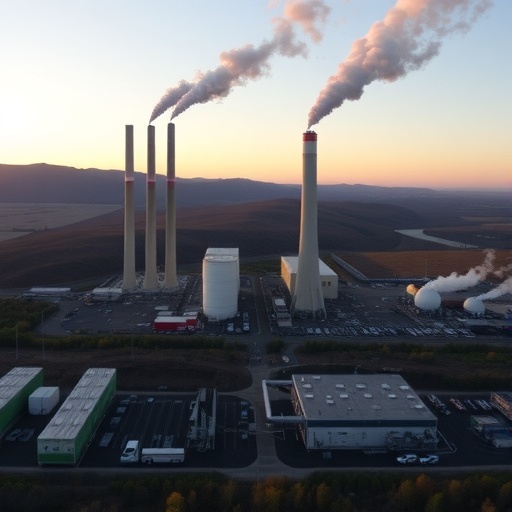
As the United States steadily moves away from coal power, a significant hurdle remains: over 100 coal-fired plants still lack concrete retirement plans. This lingering reliance on coal could jeopardize the nation’s climate commitments, particularly the goal of achieving net-zero emissions by 2035. A groundbreaking study led by researchers at the University of California, Santa Barbara (UCSB) introduces a novel, data-driven framework designed to accelerate the closure of these plants. Their approach, published in the journal Nature Energy, leverages advanced mathematical tools to untangle the complex socioeconomic and technical factors preventing a timely transition from coal.
The heart of the research lies in a sophisticated classification system that clusters the nearly 200 active U.S. coal plants into eight distinct groups based on 68 multidimensional criteria. These factors encompass technical parameters, economic viability, environmental impact, and socio-political pressures. By applying graph theory and topological data analysis—mathematical disciplines typically used in complex network and shape analysis—the team translated raw and disparate data into meaningful insights that reveal each plant’s contextual vulnerability to retirement.
Rather than solely identifying which coal plants are retiring, the UCSB study pioneers the notion of “retirement archetypes.” These archetypes encapsulate why plants within each group tend to close, addressing drivers ranging from regulatory and public health concerns to financial unprofitability and political opposition. This strategic shift from descriptive to prescriptive analytics equips policymakers and advocates with targeted intervention pathways rather than one-size-fits-all mandates.
One of the striking features of this research is the introduction of a “contextual retirement vulnerability” score. This metric quantifies the susceptibility of individual plants to early shutdown by comparing them to facilities that have already indicated closure plans. This nuanced vulnerability scoring enables smarter prioritization, allowing stakeholders to focus resources where they are most likely to yield tangible results.
The complexity of coal power retirement is underscored by the myriad forces at play. For instance, some plants operate in states heavily invested in renewable energy development and active in coal debt securitization—a financial mechanism designed to aid utilities in transitioning away from fossil fuel assets. Others face intense public health scrutiny due to their impact on local air quality and asthma rates. By bridging these multifaceted drivers, the UCSB framework disaggregates the national challenge into actionable segments.
A compelling example provided in the study is the Belews Creek plant in North Carolina. Operating for nearly five decades, this 2.49-gigawatt facility burns a mix of coal and natural gas but remains a notorious particulate polluter. Financially, it struggles with an estimated $46 million in debt and ranks among the nation’s least profitable coal plants. Despite preliminary plans for its replacement with a small modular nuclear reactor, the plant’s owner, Duke Energy, has delayed retirement, highlighting the intricacies that policymakers must navigate.
From a policy perspective, the UCSB team’s classification suggests diversified strategies to catalyze coal retirement. For plants with detrimental health impacts, environmental enforcement and public health campaigns could be decisive. Economic incentives and market-based mechanisms may be more efficacious for financially distressed facilities. Meanwhile, facilities embedded in politically anti-coal regions could be influenced through legislative and advocacy efforts sensitive to local dynamics.
Significantly, nearly 28% of coal plants lacking retirement commitments display high vulnerability, representing “quick wins” where coordinated policy and advocacy can make an immediate impact. Conversely, the framework reveals that the most resilient coal plants are dispersed across different archetypes, underscoring that a multifaceted approach is vital to dismantle entrenched fossil fuel infrastructure fully.
The implications of this work extend beyond coal. By capturing the interplay of economics, environmental health, political context, and grid reliability, the UCSB framework presents a generalizable model that can inform decarbonization strategies across the energy sector. Its open-source design further invites adaptation and customization, enabling experts to tailor its tools to diverse decarbonization challenges such as renewable integration or industrial emissions management.
Sidney Gathrid, lead author and co-founder of Krv Analytics, emphasized the framework’s utility beyond academia. The tools are built for practical application, intended to guide decision-makers in prioritizing where progress is feasible and impactful. This bridging of high-level mathematics and actionable insight exemplifies a new frontier in energy policy research, where data science and environmental studies converge to tackle urgent climate challenges.
Senior author Grace C. Wu highlighted the rarity and sophistication of this undergraduate-initiated project, noting the framework’s potential to transform energy transition planning. By embedding mathematical rigor within policy-oriented research, the study demonstrates how interdisciplinary approaches can catalyze smarter, more adaptive strategies during a historically pivotal era for energy.
As coal’s role in America’s energy landscape diminishes, the UCSB study provides both clarity and direction. Its innovative classification system, grounded in comprehensive data analysis, offers policymakers and advocates a powerful compass to navigate the intricate and fragmented landscape of coal plant retirements. Ultimately, this work shines a light on how targeted, evidence-based strategies can accelerate the crucial shift towards a sustainable, decarbonized energy future.
Cite Scienmag News
Courtney Benton. (October 24, 2025). Accelerating Smarter Solutions for Phasing Out Coal. Scienmag. https://scienmag.com/accelerating-smarter-solutions-for-phasing-out-coal/
Courtney Benton. "Accelerating Smarter Solutions for Phasing Out Coal." Scienmag, 24 October 2025, https://scienmag.com/accelerating-smarter-solutions-for-phasing-out-coal/. Accessed 3 September 2026.
Courtney Benton. "Accelerating Smarter Solutions for Phasing Out Coal." Scienmag. October 24, 2025. https://scienmag.com/accelerating-smarter-solutions-for-phasing-out-coal/


