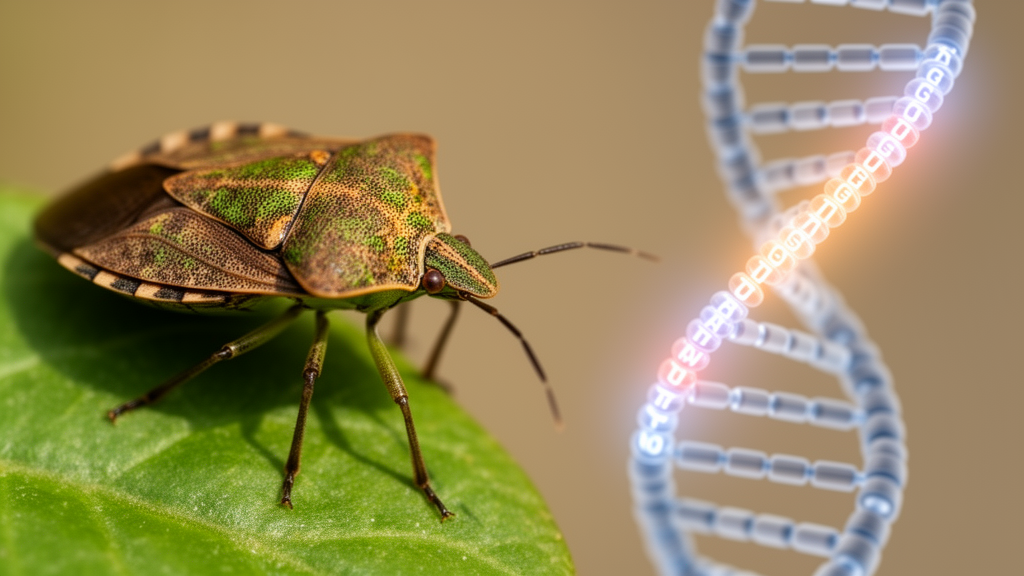
Deep inside the chromosomes of a small, predatory true bug, scientists have found a sequence of DNA that should not be there — at least not according to the standard textbook version of insect evolution. The big-eyed bug Geocoris dispar, a member of the family Geocoridae, carries telomeres built from a ten-letter motif spelled TTAGGGGTGG, a sequence that had never before been detected in its entire superfamily, Lygaeoidea. The discovery, published in the journal Comparative Cytogenetics, marks the first time anyone has peered into the telomere structure of Geocoridae, and it adds a surprising new branch to the map of how insects maintain the ends of their chromosomes.
Telomeres are the protective caps at the ends of chromosomes, and in most insects they are built from a simple five-letter repeat known as TTAGG, the so-called insect or arthropod-type motif. This sequence is considered the ancestral telomeric motif for insects and arthropods in general, having been documented across a vast range of species. Yet evolution has proven remarkably flexible when it comes to these chromosome end-caps. Throughout insect history, the canonical TTAGG motif has been repeatedly swapped out for other short motifs, long nucleotide repeats ranging from 173 to 381 base pairs, or even telomere-associated transposable elements. The result is a patchwork of telomere architectures scattered across the insect tree of life, some of which scientists are only now beginning to map with modern genomic tools.
True bugs, the suborder Heteroptera within the order Hemiptera, are a species-rich group with tens of thousands of described species. Despite this diversity, telomeric sequences have been characterized in only about 40 species — no more than 0.1 percent of all described true bugs — from 30 genera and 13 families, using fluorescence in situ hybridization (FISH) and chromosome-level genome assembly analysis. What has emerged from this limited sampling is a striking pattern of heterogeneity. The canonical TTAGG motif appears only in the Nepomorpha, an early branch of the true bug tree, and in the Reduviidae, the sister lineage to the other families of the infraorder Cimicomorpha. In contrast, every other examined species of Cimicomorpha and all species of the sister infraorder Pentatomomorpha carry ten-letter motifs instead: TTAGGGATGG, TTAGGGGTGG, or TTAGGGTGGT.
Of these three ten-letter motifs, TTAGGGATGG is by far the most prevalent, appearing in both Cimicomorpha and Pentatomomorpha and considered a candidate ancestral motif for the clade Terheteroptera, which unites these two infraorders. The other two motifs have been found exclusively in Pentatomomorpha. TTAGGGGTGG had previously been documented in the families Pentatomidae, Coreidae and Alydidae, always alongside the more common TTAGGGATGG. TTAGGGTGGT, meanwhile, was known from only a single species, the acanthosomatid bug Acanthosoma haemorrhoidale. The picture was intriguing but incomplete, with entire families of Pentatomomorpha remaining unexamined.
Geocoris dispar belongs to one of those unexamined families. The Geocoridae, commonly known as big-eyed bugs, are a worldwide family comprising five subfamilies, 37 genera and 321 species, classified within the superfamily Lygaeoidea in the infraorder Pentatomomorpha. More than three-quarters of Geocoridae species belong to the subfamily Geocorinae, and nearly half of those — 150 species — fall within the genus Geocoris itself. When researchers attempted to identify the telomeric motif in G. dispar using FISH with two standard probes, the canonical insect motif (TTAGG)n and the widespread ten-letter motif (TTAGGGATGG)n, both probes failed to hybridize with the chromosome ends. Something different was clearly at work.
To solve the puzzle, the team turned to the second most frequent telomeric sequence in Pentatomomorpha: the ten-letter motif TTAGGGGTGG. Adult males of G. dispar were collected in Voronezh Province, Russia, in August 2023, fixed in a mixture of 96 percent ethanol and glacial acetic acid, and stored at 4 degrees Celsius. Chromosome preparations were made from testes using the squash method and rendered permanent with the dry-ice technique. Standard karyotype examination employed the Schiff-Giemsa method, while the FISH procedure followed a previously published protocol. The telomeric probe was generated by PCR without a DNA template, using primers designed to amplify the (TTAGGGGTGG)n repeat, and labeled with Biotin-16-dUTP for detection.
The results were unambiguous. FISH with the (TTAGGGGTGG)n probe produced distinct hybridization signals at the ends of the chromosomes, confirming that G. dispar carries a ten-base-pair telomeric motif spelled TTAGGGGTGG. The karyotype itself matched earlier observations: males possess a chromosome number of 2n = 20, consisting of 18 autosomes plus XY sex chromosomes, with a pair of microchromosomes and a meioformula of n = 8AA + mm + X + Y. Fluorescence images were captured with a Leica DFC 345 FX camera on a Leica DM 6000B microscope equipped with a 100x objective lens, revealing bright signals at every chromosome terminus.
The significance of this finding extends well beyond a single species. Before this study, three Lygaeoidea species had been examined for telomere structure: Kleidocerys resedae and Lygaeus equestris from the family Lygaeidae, and Dimorphopterus spinolae from the family Blissidae. All three carry the motif TTAGGGATGG, the more frequent sequence in Pentatomomorpha and Cimicomorpha and the candidate ancestral motif for Terheteroptera as a whole. The discovery that G. dispar instead carries TTAGGGGTGG means this motif was previously unknown for Lygaeoidea as a whole, and it demonstrates that even within a single superfamily, telomeric sequences can differ substantially between families.
Pentatomomorpha is the second largest infraorder of true bugs, after Cimicomorpha, comprising over 14,000 species in approximately 40 families within six superfamilies: Aradoidea, Pentatomoidea, Coreoidea, Lygaeoidea, Pyrrhocoroidea and Idiostoloidea. In the three superfamilies for which telomere data are available — Pentatomoidea, Coreoidea and Lygaeoidea — no species has been found to carry the canonical five-letter insect-type motif. Instead, three variants of the ten-bp motif have been identified. All three appear in Pentatomoidea: TTAGGGATGG and TTAGGGGTGG in Pentatomidae, and TTAGGGTGGT in Acanthosomatidae. Two motifs, TTAGGGATGG and TTAGGGGTGG, are present in the sister superfamilies Coreoidea and Lygaeoidea. The first is found in the families Coreidae and Rhopalidae of Coreoidea, and in Lygaeidae and Blissidae of Lygaeoidea. The second appears in Coreidae and Alydidae of Coreoidea, and now in Geocoridae of Lygaeoidea.
Accepting the hypothesis that TTAGGGATGG is the ancestral motif for Terheteroptera, the other two ten-nucleotide motifs found in Pentatomomorpha must have emerged through the substitution of one nucleotide — in the case of TTAGGGGTGG — or two nucleotides — in the case of TTAGGGTGGT — during the evolution of this infraorder. These substitutions appear to have occurred relatively easily, producing considerable diversity of telomeric sequences across Pentatomomorpha. Notably, the TTAGGGGTGG motif seems to have arisen independently in each of the three superfamilies Pentatomoidea, Coreoidea and Lygaeoidea, a pattern of convergent evolution at the molecular level. However, the data remain limited, and the researchers emphasize that further studies are needed to fully understand how these telomeric sequences have evolved and diversified across the true bug tree of life.
Subject of Research: Discovery of a non-canonical ten-base-pair telomeric motif TTAGGGGTGG in the true bug Geocoris dispar, the first telomere data for the family Geocoridae and the superfamily Lygaeoidea.
Article Title: Non-canonical telomeric motif TTAGGGGTGG in the true bug species Geocoris dispar Waga, 1839 ( Heteroptera , Geocoridae )
Article References: Golub, N., Anokhin, B., & Kuznetsova, V. (2025). Non-canonical telomeric motif TTAGGGGTGG in the true bug species Geocoris dispar Waga, 1839 (Heteroptera, Geocoridae). Comparative Cytogenetics, 19, 117-123. https://doi.org/10.3897/compcytogen.19.156983
Image Credits: AI Generated
DOI: 10.3897/compcytogen.19.156983
Keywords: Non-canonical, telomeric, motif, TTAGGGGTGG, true, species, Geocoris, dispar, Waga, Heteroptera, Geocoridae, scientific research
Cite Scienmag News
Gavin Prescott. (October 17, 2026). A true bug rewrites the telomere rulebook with a rare DNA motif. Scienmag. https://scienmag.com/a-true-bug-rewrites-the-telomere-rulebook-with-a-rare-dna-motif/
Gavin Prescott. "A true bug rewrites the telomere rulebook with a rare DNA motif." Scienmag, 17 October 2026, https://scienmag.com/a-true-bug-rewrites-the-telomere-rulebook-with-a-rare-dna-motif/. Accessed 17 October 2026.
Gavin Prescott. "A true bug rewrites the telomere rulebook with a rare DNA motif." Scienmag. October 17, 2026. https://scienmag.com/a-true-bug-rewrites-the-telomere-rulebook-with-a-rare-dna-motif/