


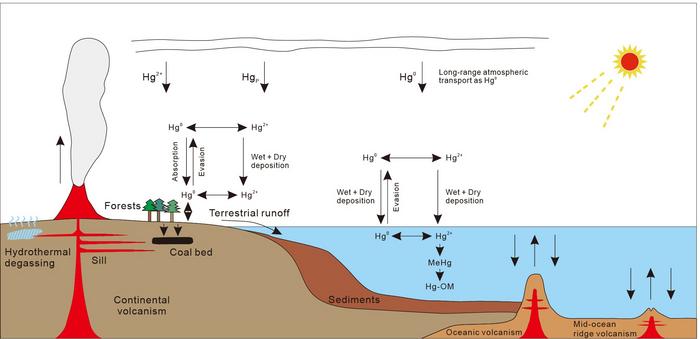
Mercury is a toxic heavy metal that can exist stably as a gas, with high volatility and global distribution in the atmosphere. Volcanoes represent a primary natural source of Hg in the atmosphere, with significant effects on Hg cycles on both global and regional scales. Mercury can undergo both mass-dependent fractionation (MDF) and mass-independent fractionation (MIF) in Earth systems. Hg-MDF is omnipresent and associated with numerous processes, while Hg-MIF can be unique signature to identify the specific pathways of Hg. Volcanic-sourced Hg exhibits near-zero ∆199Hg values. The photoreduction of Hg(II) generates negative MIF (∆199Hg < 0) in the produced Hg(0), leaving positive MIF (∆199Hg > 0) in the residual aqueous Hg(II) pool in water columns. As a result, the marine and terrestrial systems tend to have positive and negative ∆199Hg values, respectively.

Credit: ©Science China Press
Mercury is a toxic heavy metal that can exist stably as a gas, with high volatility and global distribution in the atmosphere. Volcanoes represent a primary natural source of Hg in the atmosphere, with significant effects on Hg cycles on both global and regional scales. Mercury can undergo both mass-dependent fractionation (MDF) and mass-independent fractionation (MIF) in Earth systems. Hg-MDF is omnipresent and associated with numerous processes, while Hg-MIF can be unique signature to identify the specific pathways of Hg. Volcanic-sourced Hg exhibits near-zero ∆199Hg values. The photoreduction of Hg(II) generates negative MIF (∆199Hg < 0) in the produced Hg(0), leaving positive MIF (∆199Hg > 0) in the residual aqueous Hg(II) pool in water columns. As a result, the marine and terrestrial systems tend to have positive and negative ∆199Hg values, respectively.
Utilizing Hg stable isotopes to reliably trace the origin of Hg in the geologic record have been reported in a number of researches. Mercury isotope records of Hg enrichments for volcanic origin exhibit Hg/TOC (total organic carbon) peaks with near-zero ∆199Hg values that reflect direct deposition of volcanic Hg or slight positive ∆199Hg values that reflect photoreduction of Hg(II) during atmospheric transport of volcanic Hg. The “Big Five” mass extinctions, several secondary extinctions, ocean anoxic events (OAEs) in Phanerozoic Eon, and some atmospheric redox changes in Precambrian period have all been thought to display volcanic-sourced Hg isotopes, implying that the volcanism has played an important role in these extinctions and environmental events.
Mercury isotope records of Hg enrichments for non-volcanic origins have different characteristics. Hg enrichment can be driven by ocean redox changes, and Hg input can be derived from terrestrial runoff, combustion of organic-rich sediments, asteroid impact and atmospheric Hg(0), showing varying ∆199Hg values.
There are some influence factors on sedimentary Hg enrichments and Hg isotopic variations. The differences in global or local volcanism, submarine or subaerial volcanism, the distance from volcanism, the volcanic eruptive intensity and the existence of hydrothermal activities may all have effects on Hg concentrations and Hg isotopes. The ocean redox state, such as oxic or dysoxic conditions and anoxic or euxinic environments may both primarily influence the host phases of Hg. And during and/or after diagenesis and metamorphism, Hg enrichments and Hg isotopes can also be affected.
The applications of Hg enrichments and Hg isotopes for tracing major volcanism in geologic records may significantly improve understanding of the relationship between LIP eruptions, biotic crises and environmental changes in ancient scenarios, providing strong evidences for a true cause-and-effect linkage between LIPs and geological catastrophic events. Nevertheless, there are still unresolved issues that require future work, including controversies on the LIP-trigger mechanism for certain extinctions and complicated variations in Hg isotopes. Thus, future works such as extending the scope of research, application of Hg isotope models and combining Hg with other proxies are needed to get broader insights for the volcanic event and the related environmental and biotic impacts.
See the article:
Applications of mercury stable isotopes for tracing volcanism in the geologic record
Journal
Science China Earth Sciences
Cite Scienmag News
Violet Maxwell. (May 21, 2024). A review of the applications of mercury stable isotopes for tracing volcanism in the geologic events. Scienmag. https://scienmag.com/a-review-of-the-applications-of-mercury-stable-isotopes-for-tracing-volcanism-in-the-geologic-events/
Violet Maxwell. "A review of the applications of mercury stable isotopes for tracing volcanism in the geologic events." Scienmag, 21 May 2024, https://scienmag.com/a-review-of-the-applications-of-mercury-stable-isotopes-for-tracing-volcanism-in-the-geologic-events/. Accessed 3 September 2026.
Violet Maxwell. "A review of the applications of mercury stable isotopes for tracing volcanism in the geologic events." Scienmag. May 21, 2024. https://scienmag.com/a-review-of-the-applications-of-mercury-stable-isotopes-for-tracing-volcanism-in-the-geologic-events/

