


Cigarette smoke has been studied for years, revealing a multitude of contaminants, including toxic metals. But exactly which of those metals can be traced to secondhand or thirdhand smoke? Solving this problem has been a challenge for the research community because many of the metals found in tobacco smoke could also come from industrial or naturally occurring pollutants contaminating indoor and outdoor air.

Credit: Xiaochen Tang, Berkeley Lab. Courtesy of Environmental Science & Technology Letters.
Cigarette smoke has been studied for years, revealing a multitude of contaminants, including toxic metals. But exactly which of those metals can be traced to secondhand or thirdhand smoke? Solving this problem has been a challenge for the research community because many of the metals found in tobacco smoke could also come from industrial or naturally occurring pollutants contaminating indoor and outdoor air.
Now, a recent study by scientists at Lawrence Berkeley National Laboratory (Berkeley Lab) has identified 28 trace metals in tobacco smoke. The findings reported in the journal Environmental Science & Technology Letters point to new evidence behind the long-term health effects of secondhand and thirdhand tobacco smoke. Secondhand smoke is the smoke released by a burning cigarette. Thirdhand smoke is the noxious tobacco residue that settles on indoor surfaces long after a cigarette has been put out.
“It is important to quantify the trace metals from secondhand and thirdhand smoke because some trace metals are present in other indoor and outdoor pollution sources,” said Hugo Destaillats, the principal investigator of the study, and a senior scientist in the Indoor Environment Group of Berkeley Lab’s Energy Technologies Area. “For well over a decade, our group has studied toxic organic contaminants emitted during smoking. We are now also interested in completing the picture of smoke’s persistent legacy by assessing how trace metals may contribute to tobacco’s health burden.”
During experiments in a room-size environmental chamber at Berkeley Lab, a team from the Indoor Environment Group collected samples of aerosol particles over a period of 43 hours after smoldering six cigarettes. To characterize secondhand smoke, they used Teflon-coated filters to capture freshly emitted aerosol samples immediately after smoldering. Then, they took additional samples over longer time periods to characterize thirdhand smoke.
Co-author Wenming Dong, a research scientist in Berkeley Lab’s Earth and Environmental Sciences Area (EESA), used an advanced triple quadrupole inductively coupled plasma mass spectrometry (QQQ ICP-MS) system in the EESA Aqueous Geochemistry lab to detect significant levels of 28 trace metals in secondhand and thirdhand smoke. Among these were several toxic metals such as cadmium, arsenic, chromium, beryllium, and manganese.
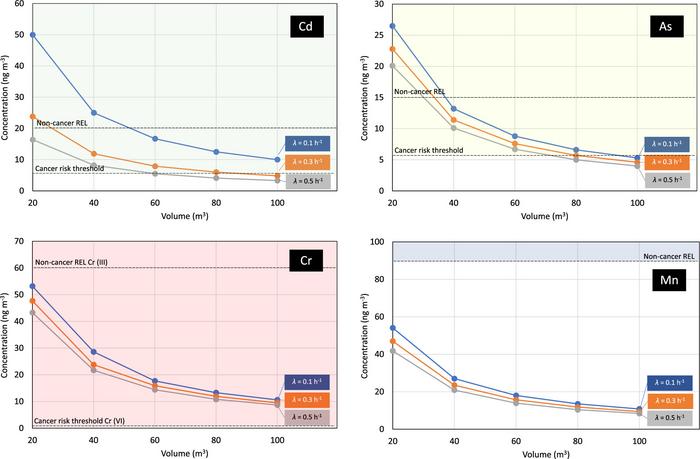
To have a better understanding of how trace metals can contribute to the chemical composition of secondhand and thirdhand smoke, the researchers then used the experimental results from the environmental chamber study to predict the concentration of trace metal contaminants in a smoker’s home, and in nonresidential scenarios such as smoking bars, under different air exchange rates. In almost all of the modeled scenarios, they found that the predicted indoor air concentration for cadmium, arsenic, and chromium exceeded the state of California’s cancer risk guidelines. They also found that some of these metals exceeded the state’s non-cancer reference levels for chronic exposure.
The Berkeley Lab researchers say that this study is a first step in understanding how tobacco smoke may contribute to our overall exposure to trace metals in the indoor environment, and that more work is needed to advance the remediation of secondhand and thirdhand smoke pollution.
“In smoking environments, these trace metals are found in indoor air and also on surfaces and in dust particles, and people can be exposed to them through pathways such as dermal uptake and ingestion,” said Xiaochen Tang, a researcher in the Energy Analysis and Environmental Impacts Division of Berkeley Lab’s Energy Technologies Area, and first author of the study. “We focused our analysis on the inhalation of airborne metal contaminants, so our results represent only part of the total exposure burden. Given the persistence of trace metals in the environment, it would be important to better understand the efficacy of ventilation, cleaning, and vacuuming as removal mechanisms for these contaminants.”
This work was supported by the University of California’s Tobacco Related Disease Research Program.
###
Lawrence Berkeley National Laboratory (Berkeley Lab) is committed to delivering solutions for humankind through research in clean energy, a healthy planet, and discovery science. Founded in 1931 on the belief that the biggest problems are best addressed by teams, Berkeley Lab and its scientists have been recognized with 16 Nobel Prizes. Researchers from around the world rely on the Lab’s world-class scientific facilities for their own pioneering research. Berkeley Lab is a multiprogram national laboratory managed by the University of California for the U.S. Department of Energy’s Office of Science.
DOE’s Office of Science is the single largest supporter of basic research in the physical sciences in the United States, and is working to address some of the most pressing challenges of our time. For more information, please visit energy.gov/science.
Journal
Environmental Science & Technology Letters
Method of Research
Experimental study
Subject of Research
Not applicable
Article Title
Inhalation of Trace Metals in Secondhand and Thirdhand Tobacco Smoke Can Result in Increased Health Risks
Article Publication Date
1-Apr-2024
Cite Scienmag News
Denise Maddox. (May 21, 2024). Tracking down toxic metals from tobacco smoke. Scienmag. https://scienmag.com/tracking-down-toxic-metals-from-tobacco-smoke/
Denise Maddox. "Tracking down toxic metals from tobacco smoke." Scienmag, 21 May 2024, https://scienmag.com/tracking-down-toxic-metals-from-tobacco-smoke/. Accessed 4 September 2026.
Denise Maddox. "Tracking down toxic metals from tobacco smoke." Scienmag. May 21, 2024. https://scienmag.com/tracking-down-toxic-metals-from-tobacco-smoke/

