


The study identified an interim series of eight divisions and 21 macrogroups, including five divisions and 16 macrogroups proposed as new for the territory. The work is intended to complement rather than replace existing mapping and vegetation-classification systems, providing a common hierarchical framework for comparing plant communities across administrative and continental boundaries. The Northern Territory covers 1.42 million square kilometres, about one-sixth of Australia’s land area, and spans a pronounced climatic and latitudinal gradient.
Its northern landscapes include monsoonal tropical forests and savannas, while the south extends into temperate dry deserts and semi-deserts. The territory supports more than 4,500 native vascular plant species, with almost 20% of its flora considered endemic. Twelve bioregions lie wholly within the Northern Territory, and another 13 are shared with neighbouring states, providing environmental units for management and planning.
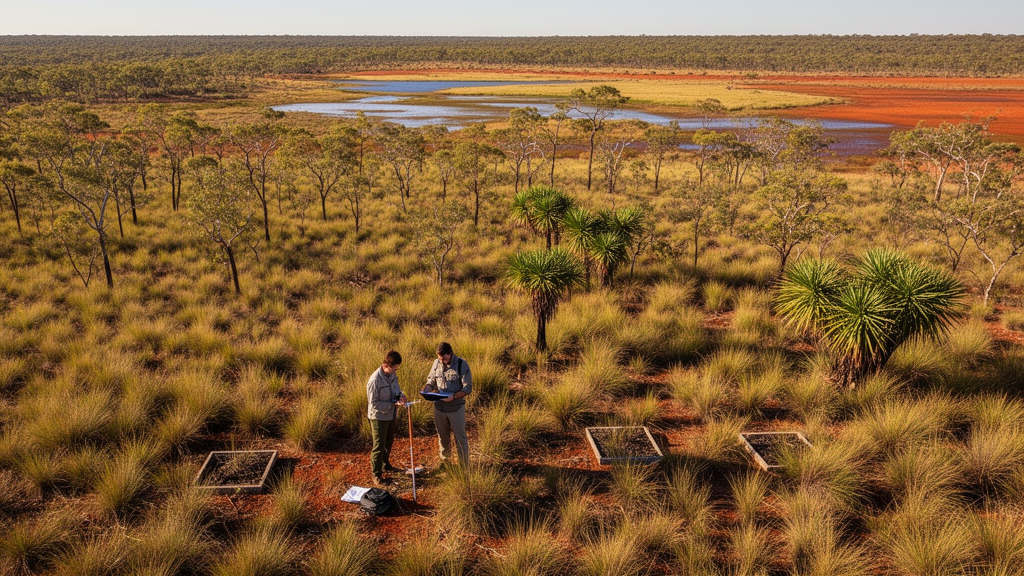
The analysis combined records from the Northern Territory Vegetation Site Database with vegetation plots from the Terrestrial Ecosystem Research Network’s Ecosystem Surveillance program. More than 77,000 NTVSD plots were initially accessed, alongside 155 TERN plots used in the analysis. Government surveys generally used quadrats of at least 20 metres by 20 metres, with larger quadrats up to 50 metres by 50 metres in sparsely vegetated arid landscapes.
TERN monitoring sites were 100 metres by 100 metres and used more rigorous methods designed for long-term ecological monitoring. Both sources recorded floristic, structural and environmental attributes. Surveys distinguished upper tree, middle shrub and ground strata, with the latter encompassing tussock grasses, hummock grasses, sedges, forbs and low shrubs.
All or dominant vascular plant species were recorded within the strata, together with cover or abundance. Canopy cover was generally used for upper strata, projective foliage cover for middle strata and percentage cover for ground strata. Height was generally measured for species taller than 2 metres and visually estimated for shorter plants exceeding 1% cover.
TERN additionally collected vegetation vouchers, genetic samples and soil physical, chemical and biological attributes. Data curation and filtering narrowed the assembled dataset. Records lacking full floristic information, plots smaller than 100 square metres or larger than 25,000 square metres, and plots with fewer than 10 taxa were excluded.
Unidentified records and those identified only above species level were also removed, while plant names were updated against the Australian Plant Census and the Northern Territory’s authoritative vascular plant checklist. Because source records mixed percentage cover with presence and absence, all abundance scores were reduced to presence and absence. The final matrix represented 45,710 plots, 4,566 taxa and 831,149 species records.
Species-by-site data were analysed with a series of kR-CLUSTER clustering analyses, considering solutions from four to 20 groups. Expert assessment was used to evaluate the statistical groupings, identify types that might require specialist input and determine how they could be placed within the IVC hierarchy. A second analysis used the 150 most frequent taxa in each macrogroup, together with their frequency among plots, to assess floristic relationships.
Agglomerative hierarchical clustering with the Bray-Curtis coefficient and square-root-transformed data assisted this comparison, while growth-form information was incorporated before final placement. The initial analysis separated the vegetation into four broad climatic zones: tropical savanna, tropical closed forest, warm-temperate vegetation and arid or semi-desert vegetation. Their distribution followed major geographic and climatic gradients, including a north-south rainfall gradient associated with changes in plant composition and structure.
Tropical savannas consist of grasslands and sclerophyll woodlands dominated by Eucalyptus and Corymbia, with patches of monsoon closed forest, sandstone woodland, shrubland and floodplain vegetation. Farther south, Acacia shrublands and woodlands and Triodia hummock grasslands dominate much of the arid zone. Following the statistical and expert review, 11 of the 21 macrogroups were placed within the Australian tropical savanna and scleromorphic woodland division of the IVC.
These include communities characterised by Darwin stringybark, Darwin box, broad-leaved bloodwood, lancewood, coolabah, bean tree, bloodwoods, spinifex and tropical grasses. Although these communities are classified within a formation containing tropical grassland, savanna and shrubland, the framework treats scleromorphic woodland as part of the savanna biome. Their placement also shows how Australian formations can differ in structure from categories developed primarily for Northern Hemisphere vegetation.
Closed forest was the only major Northern Territory group aligned with the global forest and woodland class and the tropical dry forest formation. The authors proposed a new Australasian dry forest and woodland division and assigned the territory’s closed forests to an Australasian and East Malesian dry forest macrogroup. Mangroves were associated with an existing Indo-West Pacific mangrove division and a western Pacific macrogroup, although Northern Territory specialists proposed “East Malesia” rather than “East Melanesia” as the more appropriate regional term.
A tropical grassland and sedgeland division was also proposed for communities dominated by swamp grass, water chestnut and water lily, which may be seasonally inundated by 1–2 metres or more of water. Six macrogroups represented arid and semi-arid vegetation, including desert hummock grassland, mulga woodland and shrubland, Victoria wattle with emu bush and ironwood, witchetty bush, bloodwood woodland, and rock fuchsia with witchetty bush. These were aligned with an Australian semi-desert scrub and grassland division.
All six cross the boundaries of the Northern Territory and neighbouring jurisdictions, as do many tropical types. The study therefore provides a potential bridge between state and territory classifications that have often relied on different conceptual frameworks, sampling practices and data systems. It does not establish a definitive inventory of all Northern Territory vegetation, and the researchers note that more plot data would be needed to test several proposed relationships.
The authors conclude that the IVC can be applied across a significant portion of Australia at the macrogroup level and can connect historical mapping products with modern, plot-based vegetation science. The framework could provide quantitative foundations for finer association- and alliance-level classifications, offer consistent units for studying the distribution and rarity of threatened vegetation and support cross-border ecological analysis. They also identify national applications including carbon accounting, land-condition assessment, fuel-load modelling and federal vegetation initiatives.
At the same time, the work remains preliminary: formal names for the new groups were withheld pending broader expert consultation and peer review, and specialised aquatic and wetland divisions will require further plot-based analysis.
Subject of Research: Preliminary plot-based classification of Northern Territory vegetation within the International Vegetation Classification framework
Article Title: A plot-based analysis of the vegetation of the Northern Territory, Australia: a first assessment within the International Vegetation Classification framework
Article References: Hunter, J. T., Lewis, D., Addicott, E., Luxton, S., Cowie, I., Sparrow, B., & Leitch, E. (2022). A plot-based analysis of the vegetation of the Northern Territory, Australia: a first assessment within the International Vegetation Classification framework. Vegetation Classification and Survey, 3, 161-174. https://doi.org/10.3897/vcs.83045
Image Credits: AI Generated
DOI: 10.3897/VCS.83045
Keywords: vegetation classification, Northern Territory, International Vegetation Classification, vegetation plots, Australian flora, tropical savanna, arid ecosystems, ecological typology, plant communities, biodiversity, plot-based, analysis
Cite Scienmag News
Gavin Prescott. (October 20, 2026). A plot-based analysis of the vegetation of the Northern Territory, Australia: a first assessment within the International Vegetation Classification framework. Scienmag. https://scienmag.com/a-plot-based-analysis-of-the-vegetation-of-the-northern-territory-australia-a-first-assessment-within-the-international-vegetation-classification-framework/
Gavin Prescott. "A plot-based analysis of the vegetation of the Northern Territory, Australia: a first assessment within the International Vegetation Classification framework." Scienmag, 20 October 2026, https://scienmag.com/a-plot-based-analysis-of-the-vegetation-of-the-northern-territory-australia-a-first-assessment-within-the-international-vegetation-classification-framework/. Accessed 20 October 2026.
Gavin Prescott. "A plot-based analysis of the vegetation of the Northern Territory, Australia: a first assessment within the International Vegetation Classification framework." Scienmag. October 20, 2026. https://scienmag.com/a-plot-based-analysis-of-the-vegetation-of-the-northern-territory-australia-a-first-assessment-within-the-international-vegetation-classification-framework/


