


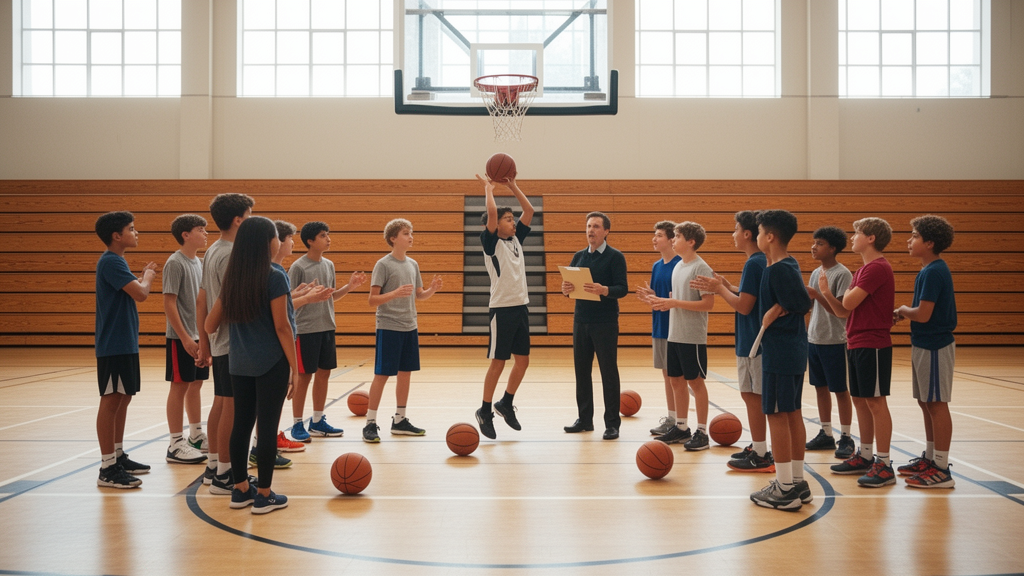
A one-semester classroom study found that college students taught basketball through an Argument-Driven Inquiry model reported greater comprehension of motor skills than students receiving traditional instruction. The research involved two intact classes of sophomores at the author’s university in Inner Mongolia, China: 40 students in the experimental class and 39 in the control class. The measured outcome was perceived comprehension, assessed with a six-dimensional questionnaire, rather than actual basketball performance.
The experimental class’s overall score rose from 3.475 to 3.751 on the five-point scale, while the control class’s score changed little, from 3.511 to 3.481. At posttest, the difference between classes was statistically significant at p < 0.001, with a reported Cohen’s d of 1.042. These findings support the study’s narrower conclusion that inquiry-centered teaching may help students understand why and how motor skills work; they do not establish that the intervention directly improved athletic execution or physical fitness.
The study was designed as a comparative teaching intervention in which the same teacher taught the same basketball course over one semester to both classes, with the principal difference being the instructional model. The experimental class used Argument-Driven Inquiry, or ADI, while the control class continued with traditional teaching. Before instruction, the researchers found no significant difference between the groups in overall motor-skill comprehension, with a pretest p value of 0.712 and Cohen’s d of 0.083.
Nor were there significant baseline differences in any of the questionnaire’s individual dimensions: explanation, interpretation, application, perspective, empathy, and self-knowledge. All corresponding confidence intervals included zero, and every baseline effect size was below 0.2. The results therefore support the researchers’ decision to regard the two classes as having comparable starting levels for the purpose of the comparison, although the use of intact classes rather than random assignment limits stronger causal attribution.
Motor-skill comprehension was operationalized through a 30-item questionnaire administered before and after the course. Its six dimensions were intended to capture more than the ability to reproduce a movement. Explanation covered concepts and methods of performing skills; interpretation concerned the functions and effects of mastering them; application addressed their use in practical situations; perspective assessed whether students could question motor skills and formulate high-quality questions; empathy concerned reflection from other learners’ perspectives; and self-knowledge evaluated students’ capacity to assess their own performance objectively.
Items used a five-point Likert scale. The investigators first surveyed 150 students to examine the instrument’s reliability and validity. Internal consistency was high: dimension-level Cronbach’s alpha coefficients ranged from 0.768 to 0.841, and the overall coefficient was 0.864.
Composite reliability values ranged from 0.845 to 0.888, while average variance extracted values ranged from 0.526 to 0.613. Sampling adequacy, discriminant-validity and multicollinearity checks also met thresholds used in the analysis. Within the experimental class, the questionnaire identified statistically significant pretest-to-posttest improvement in five of the six dimensions.
Explanation increased from 3.660 to 3.975, with p = 0.016 and Cohen’s d = 0.398. Interpretation rose from 3.645 to 3.960, with p = 0.019 and d = 0.386. Application increased from 3.530 to 3.815, with p = 0.005 and d = 0.474.
Perspective changed from 3.485 to 3.705, with p = 0.043 and d = 0.331, while empathy increased from 3.300 to 3.640, with p = 0.008 and d = 0.439. Self-knowledge was the exception, moving from 3.230 to 3.410 without statistical significance at p = 0.176. By contrast, the control class showed no statistically significant change in any dimension or in the overall score; its overall p value was 0.692.
The authors noted that self-knowledge may require longer development because it depends on substantial skill knowledge, self-regulated learning, and mastery of evaluation methods, but the study did not directly test that explanation. When the two classes were compared after the semester, the experimental group scored higher in explanation, interpretation, application and perspective. The posttest group differences were significant for explanation at p = 0.005, interpretation at p = 0.001, application at p = 0.001, and perspective at p = 0.044.
The reported effect sizes for those comparisons ranged from d = 0.462 to 0.828, with the largest corresponding to application. Empathy and self-knowledge did not differ significantly between the classes at posttest, with p values of 0.577 and 0.524, respectively. The researchers attributed those null comparisons to some improvement in the control group in the same areas, although the experimental group’s pretest-to-posttest gains were larger.
Because these are questionnaire reports, the statistical contrasts describe changes in students’ assessed understanding; they should not be read as direct measurements of technique, speed, accuracy, retention or transfer to competitive play. ADI places argumentation within structured inquiry rather than treating debate as an end in itself. The article describes an eight-stage implementation pathway adapted for physical education.
First, an instructor creates an authentic sporting problem from which students derive a question—for example, investigating why a stop-and-jump shot becomes distorted at high speed rather than simply copying a demonstration. Second, students propose hypotheses, including predictions that can initially be incorrect. Third, groups design a practice protocol, identify the variables to control, choose equipment and define how evidence will be recorded.
Fourth, they perform the inquiry and gather both quantitative observations, such as successful attempts or flight distance, and qualitative bodily feedback, such as perceived force production, balance or difficulty. Fifth, students analyze the results and build explanatory models. Sixth, they present arguments, cross-examine one another and receive biomechanical or movement-principle feedback.
Seventh, they document the inquiry and reflect on methodological limitations. Eighth, they return to practice, correct faulty actions, explain the principles behind the skill and attempt to transfer the technique to a new situation. The proposed pedagogy changes the teacher’s role during practical work.
Rather than immediately correcting a student’s movement, the instructor is expected to maintain safety, ask questions about controlled variables and prompt students to examine their own evidence. For example, when students compare a high badminton clear struck above the head with one struck at shoulder height, the task can be defined by the flight trajectory and landing position. A forearm-pass investigation might record the success rate of straight and bent arms and ask students to explain the difference mechanically.
The model also makes assumptions explicit: students write down their reasoning, classify proposed explanations, test them under planned conditions and confront competing interpretations. These examples illustrate the proposed framework across sports, but the paper explicitly states that they were not the specific activities tested in the reported intervention. Delivering all eight stages in a time-limited physical education lesson could be impractical, the author argues, because extended debate and report writing may reduce time available for movement.
The suggested compromise is to retain the full inquiry sequence while simplifying its presentation. Stages involving task definition, hypotheses, inquiry design, review, revision and skill internalization can remain central, while data collection, argumentation, reporting and reflection can be condensed into prepared forms, motor-learning journals and brief structured exchanges. The aim is to preserve the cognitive sequence without sacrificing sufficient practice.
Even so, the classroom comparison tested a basketball course as delivered by the study’s instructional design; it did not isolate which individual ADI stage, dose or classroom feature produced the observed questionnaire changes. The intervention also was not directly compared with other established inquiry-based physical education approaches. The trial has important limitations.
The design lacked random assignment, and the researchers did not report blinded assessment. The self-report instrument measured perceived understanding rather than observed movement execution, so the study cannot show that ADI improved basketball technique directly. The authors also emphasize that inquiry does not replace essential practice: students still need repeated physical activity, corrective feedback and opportunities to perform.
Future work would require larger and more diverse samples, direct performance measures and quantitative tests across other physical education courses. Subject to those constraints, the study offers a detailed classroom mechanism for moving beyond mechanical repetition: a cyclical sequence in which cognitive challenge, physical testing, argumentative reflection and revised practice are linked. Its clearest demonstrated result is an association between ADI-based basketball instruction and higher self-reported motor-skill comprehension in two small college classes.
Subject of Research: Perceived motor-skill comprehension in two college basketball classes taught with Argument-Driven Inquiry or traditional instruction
Article Title: Implementation approaches of improving college students’ comprehension level of motor skills based on argument-driven inquiry teaching model
Article References: Li, X. (2026). Implementation approaches of improving college students’ comprehension level of motor skills based on argument-driven inquiry teaching model. Frontiers in Sports and Active Living, 8, Article 1887661. https://doi.org/10.3389/fspor.2026.1887661
Image Credits: AI Generated
DOI: 10.3389/fspor.2026.1887661
Keywords: Argument-Driven Inquiry, college physical education, basketball teaching, motor-skill comprehension, classroom study, student questionnaire, inquiry-based learning, motor learning, physical education pedagogy, Implementation, approaches, improving
Cite Scienmag News
Courtney Benton. (October 20, 2026). Two-class study links inquiry-based basketball teaching to better motor-skill comprehension. Scienmag. https://scienmag.com/two-class-study-links-inquiry-based-basketball-teaching-to-better-motor-skill-comprehension/
Courtney Benton. "Two-class study links inquiry-based basketball teaching to better motor-skill comprehension." Scienmag, 20 October 2026, https://scienmag.com/two-class-study-links-inquiry-based-basketball-teaching-to-better-motor-skill-comprehension/. Accessed 20 October 2026.
Courtney Benton. "Two-class study links inquiry-based basketball teaching to better motor-skill comprehension." Scienmag. October 20, 2026. https://scienmag.com/two-class-study-links-inquiry-based-basketball-teaching-to-better-motor-skill-comprehension/


