


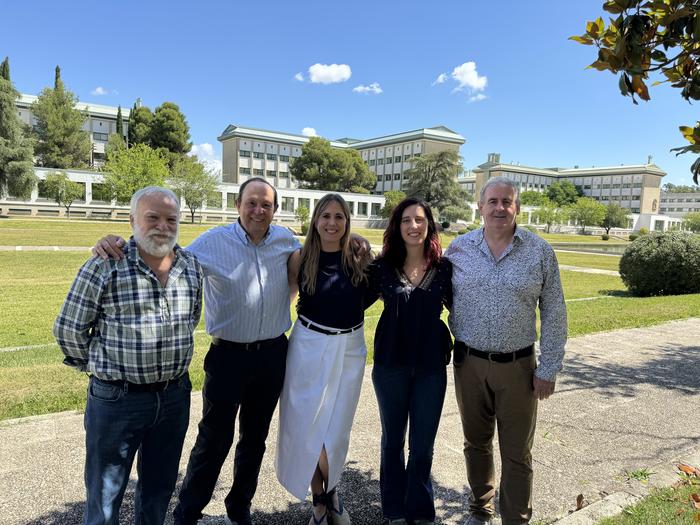
Three years ago María del Carmen Muñoz, a researcher at the University of Cordoba, was peering into an electron microscope to study the vesicles of marine cyanobacteria and found, almost accidentally, something she did not expect: structures that, although they had already been discovered years ago in other bacteria, had never been found in this type of living being, responsible for producing more than half of the oxygen on Earth. Thus began an extensive study carried out by a multidisciplinary team. Today their work comes out, its results having just been published in the journal Science Advances.

Credit: University of Córdoba
Three years ago María del Carmen Muñoz, a researcher at the University of Cordoba, was peering into an electron microscope to study the vesicles of marine cyanobacteria and found, almost accidentally, something she did not expect: structures that, although they had already been discovered years ago in other bacteria, had never been found in this type of living being, responsible for producing more than half of the oxygen on Earth. Thus began an extensive study carried out by a multidisciplinary team. Today their work comes out, its results having just been published in the journal Science Advances.
These strange structures are called membrane nanotubes, and the most relevant thing is that, according to the study, these small tubes make it possible for these living beings to transfer material by generating an exchange bridge, a kind of hose that connects with nearby cells, allowing them to transfer substances from some cyanobacteria to others. Since the discovery of these organisms, this is the first time that physical and direct contact between them has been demonstrated.
“This finding has enormous implications, and strengthens the idea that we need to change the way we think about cyanobacteria,” said researcher José Manuel García. Challenging the idea that these organisms operate in isolation, the study suggests that they could act as a kind of network in which they interact, a premise of great relevance considering that these living beings are the most abundant photosynthetic organisms on the planet, representing a veritable “lung” for the oceans, and being indispensable for the sustenance of life as we know it.
In recent years the study, led by principal investigator María del Carmen Muñoz, has mobilized a multidisciplinary group composed of, among others, the UCO’s Departments of Biochemistry, Molecular Biology, and Cell Biology; the Maimonides Institute for Biomedical Research (Cordoba), the University of Cádiz’s University Institute of Marine Research, the Institute of Plant Biochemistry and Photosynthesis (Seville), and oceanographer Sallie W. Chisholm, a member of the Massachusetts Institute of Technology and discoverer of the Prochlorococcus genus of cyanobacteria.
Key details
Since the study began, and after reviewing the literature available on these nanotubes in other bacteria, the team has launched different experiments in the laboratory, such as the use of fluorescent proteins and their monitoring by fluorescence microscopy; and the use of electron microscopy for the characterization of these structures. Through these tests they have been able to confirm that there is an exchange of material from the interior of one cell to the other.
In addition, as doctoral student and the study’s first author Elisa Angulo explained, the work has shown that this transfer of substances not only occurs in cyanobacteria of the same lineage, but also between those of different genders, something that has been verified not only at the laboratory level, but also in natural ocean samples.
New questions
As is often the case in science, these findings now open the door to new questions: is this transfer of molecules a support mechanism or a weapon to compete for survival? What other substances could be exchanged, beyond proteins? Is there any relationship between this mechanism and the amount of food available in the environment?
Elisa Angulo, a researcher at the University of Cordoba, is already trying to answer this last question, and has just concluded a voyage on the high seas in which she has been researching the behavior of these living beings in oligotrophic areas of the Pacific poor in nutrients.
We will have to wait for the next few months to continue acquiring knowledge about these marine bacteria, the living beings that invented photosynthesis and that, more than 3.5 billion years old, represent one of the oldest known forms of life. Their study, therefore, is not only of vital importance for ecosystems, but also to understand fundamental processes in the vast field of Biology.
Journal
Science Advances
Article Title
Direct interaction between marine cyanobacteria mediated by nanotubes
Article Publication Date
23-May-2024
Cite Scienmag News
Violet Maxwell. (June 6, 2024). A new study reveals that marine cyanobacteria communicate. Scienmag. https://scienmag.com/a-new-study-reveals-that-marine-cyanobacteria-communicate/
Violet Maxwell. "A new study reveals that marine cyanobacteria communicate." Scienmag, 6 June 2024, https://scienmag.com/a-new-study-reveals-that-marine-cyanobacteria-communicate/. Accessed 5 September 2026.
Violet Maxwell. "A new study reveals that marine cyanobacteria communicate." Scienmag. June 6, 2024. https://scienmag.com/a-new-study-reveals-that-marine-cyanobacteria-communicate/

