


production

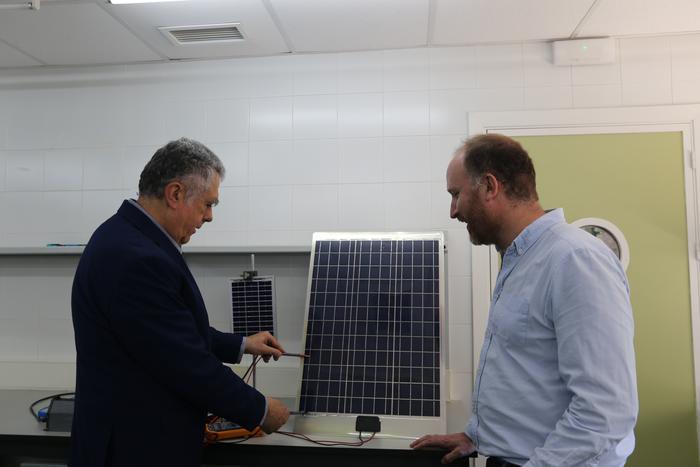
Credit: University of Cordoba
production
A team at the University of Cordoba has developed a methodology that defines the cultivable space between two-axis photovoltaic modules, with the aim of promoting the conversion of existing plants over to agrivoltaic production
In Alcarras de Carla Simón, the Solé family glimpses the end of its traditional and not-very-profitable peach plantation due to the arrival of solar panels. The conflict between land use for sustainable energy vs agricultural production is a hot topic that is reflected in cultural products, and also in research.
Agrivoltaics, which is defined as the shared use of land for agricultural and photovoltaic production, is presented as a strategy to resolve this conflict, and the TEP215 – Physics for Renewable Energies research group at the University of Cordoba seeks to promote these types of plants through its research. In one of their latest works they have developed a model that is able to gauge the cultivable space between two-axes solar collectors at existing photovoltaic plants. This type of two-axis module moves following the sun, like a kind of sunflower, to maximize its performance.
“In this work, we chose a type of photovoltaic installation that already existed to see whether we could redirect it and integrate crops for agricultural production into these existing facilities,” said Rafael López, a Professor of Applied Physics.
The methodology was developed based on a theoretical simulation of solar astronomy and the spatial geometry of a photovoltaic plant with this type of two-axis solar panel, and indicates the areas in which crops could be located without interfering with the movement of the solar panels or creating shadows; that is, without reducing photovoltaic production.
Another of the authors, a researcher at the Department of Electrical and Automatic Engineering Luis Manuel Fernández, points out that “the work also takes into account backtracking, which is a methodology developed by the group based on a process that prevents the panels from casting shadows on each other during their movement.”
Using an actual photovoltaic installation located in Cordoba, “El Molino,” with two-axis solar trackers and backtracking, the model reveals the cultivable areas between panels. The simulation at that plant revealed that 74% of the land between the panels is cultivable by crops less than 1.4 m high.
This model could be applied, refining and adjusting parameters, to other existing plants to understand the possibilities of shifting over to agrivoltaic; that is, combining photovoltaic and agricultural production, “both of which are productive and profitable,” stated Rafael López.
“This work represents an advance in the possible conversion and agrivoltaic use of existing large photovoltaic plants, improving their sustainability, contributing to the necessary deployment of agrivoltaics, and advancing the fight against climate change,” the researchers said.
This system entails a win-win relationship since the crops would also benefit from the panels’ shading, especially in extreme climates, maintaining soil moisture for longer.
The establishment of legislation on agrivoltaics and field trials with different types of crops are the next steps to be taken for this type of land use to be implemented.
Reference
Varo-Martínez, M. & Fernández-Ahumada, L.M. & Ramírez-Faz, J.C. & Ruiz-Jiménez, R. & López-Luque, R., 2024. “Methodology for the estimation of cultivable space in photovoltaic installations with dual-axis trackers for their reconversion to agrivoltaic plants,” Applied Energy, Elsevier, vol. 361(C). DOI: 10.1016/j.apenergy.2024.122952
Journal
Applied Energy
Method of Research
Experimental study
Subject of Research
Not applicable
Article Title
Methodology for the estimation of cultivable space in photovoltaic installations with dual-axis trackers for their reconversion to agrivoltaic plants
Article Publication Date
7-Mar-2024
Cite Scienmag News
Alan Morgan. (April 30, 2024). A model estimates the cultivable space at photovoltaic plants, to combine agricultural and photovoltaic production. Scienmag. https://scienmag.com/a-model-estimates-the-cultivable-space-at-photovoltaic-plants-to-combine-agricultural-and-photovoltaic-production/
Alan Morgan. "A model estimates the cultivable space at photovoltaic plants, to combine agricultural and photovoltaic production." Scienmag, 30 April 2024, https://scienmag.com/a-model-estimates-the-cultivable-space-at-photovoltaic-plants-to-combine-agricultural-and-photovoltaic-production/. Accessed 4 September 2026.
Alan Morgan. "A model estimates the cultivable space at photovoltaic plants, to combine agricultural and photovoltaic production." Scienmag. April 30, 2024. https://scienmag.com/a-model-estimates-the-cultivable-space-at-photovoltaic-plants-to-combine-agricultural-and-photovoltaic-production/

