


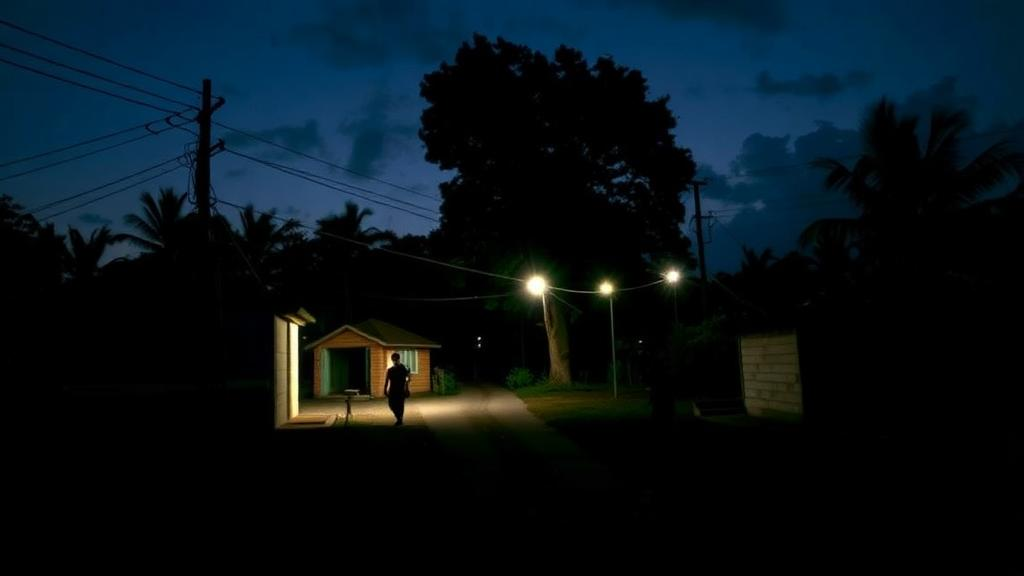
Deep in the rainforest waterways of Guyana’s Pomeroon River, the indigenous village of Wakapoa has spent decades in the dark, at least by the standards of the modern grid. Roughly 2,500 residents live scattered across small settlements that no national power line can economically reach, leaving many households dependent on costly diesel generators or small personal solar panels that flicker out after sunset. A new study published in Frontiers in Sustainable Energy Policy argues that the community’s escape from energy poverty will not come from electricity alone, but from what residents choose to do with every hour of a round-the-clock supply.
The research, led by Mahendra Kanhai of the University of Guyana with colleagues at Arizona State University, is the third installment in a three-part investigation into how remote communities can build and benefit from renewable energy systems. Earlier papers in the series examined development indicators linked to electricity access and the technical feasibility of a hybrid system combining concentrated solar power with biomass generation for the Wakapoa area. The latest work asks a deceptively simple question: once the lights stay on, what kind of social and economic value can a village actually create with them?
That question matters because the track record of rural electrification worldwide is mixed at best. Previous studies across Ethiopia, India, Nepal, and Sierra Leone found that mini-grid systems often charged tariffs far higher than national grid rates, capping consumption at the UN’s most basic Tier 1 level and attracting almost no commercial investment. In Benin, researchers found that the cost of connection fees and electricity bills could actually reduce the profitability of small firms, making electrification a poor business decision. Electricity, in other words, is a prerequisite for development, but it is not a guarantee of it.
The Wakapoa study tackles this paradox by treating electricity as raw material for enterprise. Using a quantitative research design approved by Arizona State University’s Institutional Review Board and Guyana’s Ministry of Amerindian Affairs, the team surveyed 50 randomly selected residents at a community meeting in December 2022. The sample included nurses, teachers, loggers, farmers, shop operators, village council members, and ordinary households, a size the authors note is statistically sufficient for 95 to 99 percent confidence levels in cultural consensus analysis. Responses were coded and analyzed with SPSS statistical software to map how residents planned to use a 24/7 power supply.
The results reveal a community ready to work. Respondents projected spending an average of 13.12 hours per household per day on business-oriented electricity use, far exceeding the roughly 5.56 hours they anticipated for entertainment and 4.12 hours for education. In total, 76 percent of respondents said they were willing to use electricity services for more than 12 hours a day, and 42 percent projected continuous 24-hour use, reflecting households where multiple family members would pursue income generation, online education, and study at different hours. Education in Guyana is free at all levels, and residents reported pursuing trade certifications and university courses online, which explains why some households anticipated near-constant educational use.
The economic ambitions span both traditional and entirely new ventures. Farming currently anchors the village economy at 48 percent of surveyed livelihoods, followed by shops, mining, and logging, and without cold storage, residents deliberately limit production of perishable vegetables, ground provisions, and poultry to avoid waste. With reliable power, respondents identified fruit juice processing and garment making as their leading new business ideas, followed by furniture making, baking, hair styling, large general shops, and ICT-based enterprises. Traditional activities would also scale up, including shop expansion, farm irrigation, carpentry and masonry with power tools, and poultry farming.
The projected employment figures are striking for a village of 2,500 people. The study estimates roughly 309 positions could emerge, with 12 directly tied to electricity operations and a conservatively estimated 297 generated by spin-off ventures such as agro-processing plants, furniture shops, bakeries, restaurants, guesthouses, and garment workshops. Part-time work would add further income, from cleaning solar collectors to supplying waste wood for the biomass component of the energy system. Preliminary financial modeling, built on production estimates provided by the residents themselves, projects a combined net added social value of about US$9.35 million annually across all contemplated activities, with individual ventures such as a juice-making operation estimated at roughly US$1,962 per month.
Those numbers come with important caveats. The authors frame every venture through a social value equation in which benefits must outweigh the sum of costs, burdens, and risks, and they cataloged dozens of considerations residents must weigh, from bank collateral and equipment insurance to drought, flooding, and the honesty of financial staff. To help, the team developed an added social value calculator that lets any entrepreneur, anywhere, test whether a business model reaches break-even given local costs and risks. The authors stress that the projections are preliminary estimates that require validation of production capacity and market demand, and they recommend financial consultants for larger investments.
Financing emerged as the critical bottleneck. Fully 76 percent of residents said they lacked access to funding for productive investment, yet 94 percent were willing to manage and contribute to a community financial aid fund. The proposed scheme would offer small loans, roughly US$250 to US$2,000, at low interest over three years, repaid through contributions and a share of electricity tariffs, with seed capital of about US$400,000 built into the project cost. The fund serves a dual purpose: it equips households to launch ventures while ensuring the power plant reaches the 40 to 50 percent operating load it needs from the moment generation begins. The fund could later support community-wide projects such as cold storage, ICT hubs, and scholarships.
Governance, the study concludes, is what binds the whole ecosystem together. When asked who should manage operations, 62 percent of respondents favored a bottom-up committee of village residents with equal male and female representation, structured like a corporate board of directors, while 24 percent preferred the traditional village Toshao and councilors. Hybrid options that diluted community control found little support. The community management committee would oversee the electricity system, the fund, and community projects, ensuring accountability, regular audits, and responsiveness to residents’ concerns, though forest resources would remain under the Guyana Forestry Commission’s existing authority. Training also ranked high on the community’s agenda, with 68 percent of respondents seeking small business education or broader technical skills. The authors caution that findings from Wakapoa cannot be extrapolated elsewhere, but they offer the methodology as a template: communities at the margins, given reliable power, real financing, and control over their own institutions, may finally convert electricity from a service into a livelihood.
Subject of Research: Productive electricity use and community governance to alleviate energy poverty in Wakapoa, Guyana
Article Title: Alleviating energy poverty through added social value: productive electricity use and community governance in Wakapoa, Guyana
Article References: Alleviating energy poverty through added social value: productive electricity use and community governance in Wakapoa, Guyana. (n.d.). https://doi.org/10.3389/fsuep.2026.1822478
Image Credits: AI Generated
DOI: 10.3389/fsuep.2026.1822478
Keywords: energy poverty, Wakapoa, Guyana, renewable energy, productive use of energy, community governance, rural electrification, social value, microgrid, community financial aid fund, sustainable development, Alleviating
Cite Scienmag News
Denise Maddox. (October 15, 2026). A Guyanese Village Shows How 24/7 Power Could Lift Communities From Energy Poverty. Scienmag. https://scienmag.com/a-guyanese-village-shows-how-24-7-power-could-lift-communities-from-energy-poverty/
Denise Maddox. "A Guyanese Village Shows How 24/7 Power Could Lift Communities From Energy Poverty." Scienmag, 15 October 2026, https://scienmag.com/a-guyanese-village-shows-how-24-7-power-could-lift-communities-from-energy-poverty/. Accessed 15 October 2026.
Denise Maddox. "A Guyanese Village Shows How 24/7 Power Could Lift Communities From Energy Poverty." Scienmag. October 15, 2026. https://scienmag.com/a-guyanese-village-shows-how-24-7-power-could-lift-communities-from-energy-poverty/


