

Sunday, May 31, 2026
Science
No Result
View All Result
  • Login
  • HOME
  • SCIENCE NEWS
  • CONTACT US
  • HOME
  • SCIENCE NEWS
  • CONTACT US
No Result
View All Result
Scienmag
No Result
View All Result
Home Science News Earth Science

A garnet-rich lunar mantle?

July 5, 2024
in Earth Science
Reading Time: 3 mins read
0
A deep garnet-rich layer in the lunar mantle
67
SHARES
606
VIEWS
Share on FacebookShare on Twitter
ADVERTISEMENT

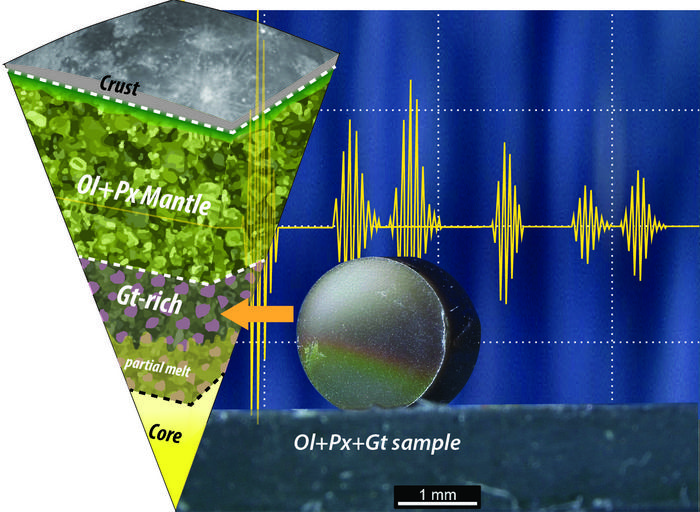
Our present-day Moon has an interior structure containing a central metallic core, overlain by a mantle comprised of minerals such as olivine and pyroxene (e.g. Ol+Px mantle) underneath a shell of crust (e.g. Wieczorek et al. 2006).  Such a picture of the Moon’s interior has been formed from analyses of returning lunar samples and records of deep seismic events collected during missions to the Moon (e.g. Weber et al., 2011). Despite the wealth of literature, there is still a longstanding debate as to the existence of garnet (Gt) within the deeper part of the lunar mantle. Reflecting upon the existence of garnet, the pivotal question first posited fifty years ago (e.g. Anderson, 1975) has remained unanswered: are laboratory measured sound velocities in realistic lunar aggregates containing garnet compatible with the seismic profiles of the deep lunar interior? 

A deep garnet-rich layer in the lunar mantle

Credit: Geodynamics Research Center, Ehime University

Our present-day Moon has an interior structure containing a central metallic core, overlain by a mantle comprised of minerals such as olivine and pyroxene (e.g. Ol+Px mantle) underneath a shell of crust (e.g. Wieczorek et al. 2006).  Such a picture of the Moon’s interior has been formed from analyses of returning lunar samples and records of deep seismic events collected during missions to the Moon (e.g. Weber et al., 2011). Despite the wealth of literature, there is still a longstanding debate as to the existence of garnet (Gt) within the deeper part of the lunar mantle. Reflecting upon the existence of garnet, the pivotal question first posited fifty years ago (e.g. Anderson, 1975) has remained unanswered: are laboratory measured sound velocities in realistic lunar aggregates containing garnet compatible with the seismic profiles of the deep lunar interior? 

To provide answers to this question Ehime’s researchers first synthesized garnet-rich lunar rock assemblages (Ol+Px+Gt sample) at high pressures and high temperatures using the multi-anvil press apparatus “ORANGE-2000” at the Geodynamics Research Center. These samples were then transported to SPring-8, the Large-scale Synchrotron Radiation Facility, located in Hyogo Prefecture, where experiments were carried out at the High Pressure and High Temperature beamline BL04B1.  Here the researchers subjected the lunar rock assemblage to pressure and temperature conditions similar to those of the Moon’s deep interior while they measured the propagation speed of sound waves in the lunar rock assemblage.  Combining the results of their experiment with a modelling component, the researchers concluded that the sound velocities in lunar assemblages containing large amounts of garnet were compatible with the seismic and density profiles of the Moon’s deep interior, between depths of 740-1260 km. Furthermore, they found that rock assemblages containing little to no garnet are unlikely to explain the observed seismic velocities and densities of the lunar mantle at those depths. 

These intriguing results have significant implications for the Moon and its interior dynamics, including its composition and formation (e.g. Jing et al., 2022), the interior temperature, as well as implications for the lunar core and the now defunct lunar dynamo.


Journal

Earth and Planetary Science Letters

DOI

10.1016/j.epsl.2024.118792

Share27Tweet17
Previous Post

Ionic liquids: “Don’t shake it”

Next Post

Migrating starlings are no copycats

Related Posts

Optimized Planning Cools Cities, Cuts Pollution — Earth Science
Earth Science

Optimized Planning Cools Cities, Cuts Pollution

May 30, 2026
Northern Permafrost Limits Future Agricultural Expansion North — Earth Science
Earth Science

Northern Permafrost Limits Future Agricultural Expansion North

May 30, 2026
Soil Scientist Receives $1.6 Million NSF Grant to Investigate the ‘Living Skin’ of Arid Ecosystems — Earth Science
Earth Science

Soil Scientist Receives $1.6 Million NSF Grant to Investigate the ‘Living Skin’ of Arid Ecosystems

May 29, 2026
Not All Biochar Is Created Equal: New Insights Demand Clearer Carbon Removal and Soil Health Claims — Earth Science
Earth Science

Not All Biochar Is Created Equal: New Insights Demand Clearer Carbon Removal and Soil Health Claims

May 29, 2026
Massive Permafrost Carbon, Nitrogen Found in Arctic Deltas — Earth Science
Earth Science

Massive Permafrost Carbon, Nitrogen Found in Arctic Deltas

May 29, 2026
Satellite Insights into Radiative Forcing of Halogen Gases — Earth Science
Earth Science

Satellite Insights into Radiative Forcing of Halogen Gases

May 29, 2026
Next Post
Where did the starlings go?

Migrating starlings are no copycats

  • Mothers who receive childcare support from maternal grandparents show more parental warmth, finds NTU Singapore study

    Mothers who receive childcare support from maternal grandparents show more parental warmth, finds NTU Singapore study

    27650 shares
    Share 11056 Tweet 6910
  • University of Seville Breaks 120-Year-Old Mystery, Revises a Key Einstein Concept

    1054 shares
    Share 422 Tweet 264
  • Bee body mass, pathogens and local climate influence heat tolerance

    680 shares
    Share 272 Tweet 170
  • Researchers record first-ever images and data of a shark experiencing a boat strike

    544 shares
    Share 218 Tweet 136
  • Groundbreaking Clinical Trial Reveals Lubiprostone Enhances Kidney Function

    529 shares
    Share 212 Tweet 132
Science

Embark on a thrilling journey of discovery with Scienmag.com—your ultimate source for cutting-edge breakthroughs. Immerse yourself in a world where curiosity knows no limits and tomorrow’s possibilities become today’s reality!

RECENT NEWS

  • Impact of Immigration Restrictions on the US Healthcare Workforce
  • Innovative AI Technique Predicts Radiation Dosage Prior to Treatment in Advanced Prostate Cancer
  • Study Reveals Cancer Diagnostic Delays Linked to Population-Based Screening Using Cell-Free DNA Multicancer Early Detection Test
  • NMDA Antagonists’ Impact Predicts Depression Treatment Success

Categories

  • Agriculture
  • Anthropology
  • Archaeology
  • Athmospheric
  • Biology
  • Biotechnology
  • Blog
  • Bussines
  • Cancer
  • Chemistry
  • Climate
  • Earth Science
  • Editorial Policy
  • Marine
  • Mathematics
  • Medicine
  • Pediatry
  • Policy
  • Psychology & Psychiatry
  • Science Education
  • Social Science
  • Space
  • Technology and Engineering

Subscribe to Blog via Email

Success! An email was just sent to confirm your subscription. Please find the email now and click 'Confirm Follow' to start subscribing.

Join 5,146 other subscribers

© 2025 Scienmag - Science Magazine

Welcome Back!

Login to your account below

Forgotten Password?

Retrieve your password

Please enter your username or email address to reset your password.

Log In
No Result
View All Result
  • HOME
  • SCIENCE NEWS
  • CONTACT US

© 2025 Scienmag - Science Magazine
