


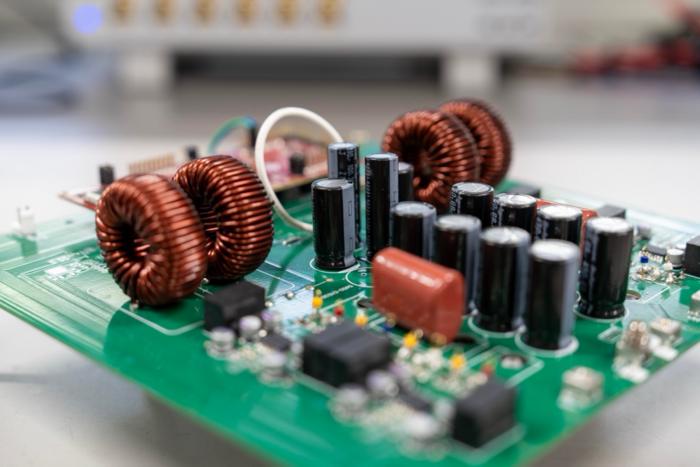
A new DC-DC power converter is superior to previous designs and paves the way for more efficient, reliable and sustainable energy storage and conversion solutions. The Kobe University development can efficiently interface with a wide range of energy sources while enhancing system stability and simplicity at an unprecedented efficiency.

Credit: MISHIMA Tomokazu
A new DC-DC power converter is superior to previous designs and paves the way for more efficient, reliable and sustainable energy storage and conversion solutions. The Kobe University development can efficiently interface with a wide range of energy sources while enhancing system stability and simplicity at an unprecedented efficiency.
Electric power comes in two kinds, AC (alternating current) and DC (direct current). Famously, the question over which kind should be used for national power grids, the “Current War” of the late 19th century, got settled in favor of AC and most power plants today produce this kind. However, solar power, batteries and in particular those in electric vehicles, and computers all depend on DC, making lossy AC-to-DC conversion necessary. An alternative to this is the establishment of DC microgrids that integrate various renewable DC energy sources and storage devices and deliver energy directly to data centers and other DC appliances. This eliminates the need for AC-to-DC conversion, but it requires a device that can convert different voltages flexibly, as each DC device typically needs a different voltage and batteries provide different voltages depending on their charge and capacity. This also needs to be done bidirectionally, since batteries are used both as energy sources and sinks.
The power electronics researchers MISHIMA Tomokazu from Kobe University (Japan) and National Chung Hsing University (Taiwan) teamed up in a project for the “development of elemental technologies for high power density power distribution systems contributing to low-carbon data centers” and now achieved a significant breakthrough. “Our diverse team with expertise spanning across relevant disciplines allowed us to approach the problem from multiple perspectives, and our access to cutting-edge facilities and resources enabled us to conduct thorough experiments, simulations and analyses. Additionally, our group has a track record of successful collaborations with industry partners and other research institutions, providing valuable insights and support for our endeavors,” explains Kobe University student team member LIU Shiqiang.
They published the design principles, characteristics, and prototype evaluation in the journal IEEE Transactions on Power Electronics. Liu, who is the first author of the study, explains its main advantages over previous designs: “Its superior voltage ratio means it can efficiently interface with a wide range of energy sources, while the self-balancing of inductor currents enhances system stability and simplicity. Moreover, the asymmetrical duty limit control offers enhanced performance especially for electric vehicle-connected DC microgrids.”
The evaluation of their prototype showed an impressive efficiency of up to 98.3 percent. “This highlights the practical feasibility and scalability of the proposed topology for real-world applications, paving the way for future advancements in bidirectional DC-DC conversion technology,” comments Liu.
The team has filed for a patent for the design in Japan and is now preparing for its commercialization with UPE-Japan, a Kobe University startup. Naturally, they also want to keep improving their design, including for higher power densities and a wider variety of applications. Liu says, “Ultimately, our long-term objective is to contribute to the transition towards more efficient, reliable and sustainable energy storage and conversion solutions, particularly in the context of electric vehicles and renewable energy integration.”
This research was conducted in collaboration with researchers from the National Chung Hsing University.
Kobe University is a national university with roots dating back to the Kobe Commercial School founded in 1902. It is now one of Japan’s leading comprehensive research universities with nearly 16,000 students and nearly 1,700 faculty in 10 faculties and schools and 15 graduate schools. Combining the social and natural sciences to cultivate leaders with an interdisciplinary perspective, Kobe University creates knowledge and fosters innovation to address society’s challenges.
Journal
IEEE Transactions on Power Electronics
Method of Research
Experimental study
Subject of Research
Not applicable
Article Title
Over 98% Efficiency SiC-MOSFET based Four-Phase Interleaved Bidirectional DC-DC Converter Featuring Wide-Range Voltage Ratio
Article Publication Date
17-Apr-2024
Cite Scienmag News
Courtney Benton. (April 19, 2024). A flexible and efficient DC power converter for sustainable-energy microgrids. Scienmag. https://scienmag.com/a-flexible-and-efficient-dc-power-converter-for-sustainable-energy-microgrids/
Courtney Benton. "A flexible and efficient DC power converter for sustainable-energy microgrids." Scienmag, 19 April 2024, https://scienmag.com/a-flexible-and-efficient-dc-power-converter-for-sustainable-energy-microgrids/. Accessed 3 September 2026.
Courtney Benton. "A flexible and efficient DC power converter for sustainable-energy microgrids." Scienmag. April 19, 2024. https://scienmag.com/a-flexible-and-efficient-dc-power-converter-for-sustainable-energy-microgrids/

