


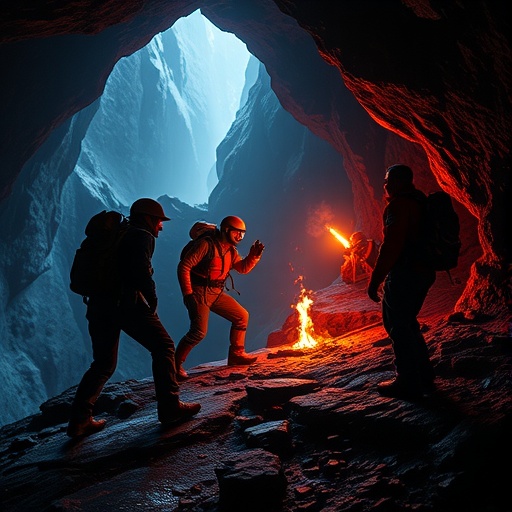
A groundbreaking paper from a team of scientists at the Southern University of Science and Technology is making waves in the scientific community by emphasizing the critical importance of human exploration across the realms of deep space, deep sea, and deep Earth. Published in the prestigious journal Ocean-Land-Atmosphere Research in September 2025, this work underscores the intrinsic interconnectedness of these three frontiers and advocates for a unified approach toward advancing scientific understanding and technological innovation.
The research emerges from the vibrant discussions held during the Southern Youth Earth Science Forum and Symposium on Deep Space, Deep Sea, and Deep Earth, convened in Shenzhen, China, earlier in 2025. Drawing participants from nearly one hundred institutions worldwide, the symposium served as a catalyst for the formation of a collaborative spirit that transcends disciplinary and geographical barriers. Scientists agreed on the urgency of tackling grand scientific challenges through a multidisciplinary lens, reinforcing the perception that deep space, oceanic depths, and Earth’s interior are fundamentally linked in ways that traditional compartmentalized research methods cannot address.
To solidify this vision, attendees at the symposium issued a defining “Letter of Call for Actions,” highlighting the necessity for establishing the Deep Space-Deep Sea-Deep Earth Southern Collaborative Research Alliance. This ambitious initiative aims to propel cutting-edge cooperation, leveraging data sharing and integrating diverse expertise to create a powerful nexus of knowledge. The alliance is envisioned as a fertile ground where innovative AI-driven methodologies meet the complex dynamics of these three profound natural domains, fostering breakthroughs that can fundamentally alter humanity’s grasp of its surroundings.
The alliance’s core objectives extend beyond scientific exploration. It emphasizes nurturing a new generation of scientists equipped with interdisciplinary expertise, leadership acumen, and a forward-looking mindset that embraces cross-sector collaborations. By pooling resources from academic bodies and industry players, the alliance plans to catalyze technological innovation and translate research advances into impactful applications, particularly through the integration of artificial intelligence to optimize data analysis, resource allocation, and predictive modeling in Earth and space sciences.
Leading this charge, Professor Jian Lin of Southern University of Science and Technology elaborated on the profound synergy between the three deeps. “Human exploration within deep space, deep sea, and deep Earth is not just an interdisciplinary effort—it is a pivotal moment in redefining the boundaries of human knowledge and our relationship with the cosmos and our planet,” Lin said. This perspective highlights that progress in one domain often inspires technological and conceptual advances in the others, making combined explorations indispensable in the era of big data and AI.
Deep space research has entered a renaissance, bolstered by extraordinary technological advancements in telescopes, robotic probes, and astronautic missions. These innovations enable unprecedented examinations of the solar system and beyond, shedding light on planetary formation, cosmic phenomena, and the potential for extraterrestrial life. Study of seismic activity on celestial bodies such as the Moon and Mars relies heavily on Earth-based geophysical technologies adapted for space, illustrating the reciprocal benefits of cross-domain scientific methods.
Meanwhile, deep sea exploration confronts the daunting challenges of the ocean’s abyssal zones that extend beyond 200 meters into pitch darkness, down to the hadal depths surpassing 6,000 meters. These regions harbor extreme conditions that demand resilient and sophisticated submersible technology. Human-crewed vehicles such as the Trieste, Deepsea Challenger, and China’s Fendouzhe have achieved historic descents into the Mariana Trench, unveiling intricate geological structures and unique ecosystems previously unknown to science.
On a parallel track, deep Earth research delves into the planet’s hidden interior by applying advanced geophysical techniques such as seismic tomography, gravity field measurements, and electromagnetic surveying. Such research not only enriches our understanding of planetary processes like tectonic plate dynamics, mantle convection, and the geomagnetic field but also informs resource exploration and natural hazard prediction, providing critical insights for societal safety and sustainability.
China’s exceptional strides exemplify the momentum in the three deeps exploration landscape. For instance, the Chang’e-6 lunar probe successfully returned nearly two kilograms of lunar material from the far side of the Moon, while the Fendouzhe submersible’s record-breaking dive of over 10,900 meters demonstrated unmatched deep-sea operational capabilities. Concurrently, the deployment of the Mengxiang drilling vessel with an 11-kilometer ocean drilling capacity marks a leap forward in sampling Earth’s crust and deciphering its geodynamic behavior under extreme conditions.
The study’s authors emphasize that the technological breakthroughs achieved in each domain have fueled innovations across others. Lunar and Martian seismometers derive from terrestrial Earthquake monitoring technologies, while remote sensing methods refined in space exploration enhance Earth observation satellites. Similarly, oceanic and continental drilling technologies serve as prototypes for extracting subsurface samples from extraterrestrial bodies, exemplifying a virtuous cycle of technology transfer among the three exploration realms.
Projecting forward, the research team underscores the strategic importance of promoting technological synergy, combining AI, large-scale scientific instruments, classical techniques, and emergent innovation. Central to their vision is the cultivation of a vibrant community of young scientists who can navigate the complex interface of multidisciplinary research, drive innovation, and foster international partnerships. These efforts collectively aim to accelerate progress in understanding the three deeps while positioning humanity to address grand challenges encompassing planetary health and cosmic discovery.
In the age of exponential data growth and transformative AI capabilities, the integration of deep space, deep sea, and deep Earth exploration offers an unprecedented opportunity to revolutionize Earth and planetary sciences. The researchers assert that building a global community with shared goals will illuminate previously inaccessible dimensions of nature and the universe, advancing human knowledge and securing a brighter, more informed future.
This pioneering research initiative is supported by significant funding from the National Key Research and Development Program of China, the National Natural Science Foundation of China, and the Guangdong Natural Science Foundation. The consortium’s collaborative and cross-disciplinary ethos exemplifies a new era of scientific enterprise—one that aligns technological innovation with the collective quest to explore the deepest frontiers of space, ocean, and Earth.
Cite Scienmag News
Eleanor Cresswell. (October 14, 2025). Team Emphasizes the Vital Role of Human Exploration in the Three Deeps. Scienmag. https://scienmag.com/team-emphasizes-the-vital-role-of-human-exploration-in-the-three-deeps/
Eleanor Cresswell. "Team Emphasizes the Vital Role of Human Exploration in the Three Deeps." Scienmag, 14 October 2025, https://scienmag.com/team-emphasizes-the-vital-role-of-human-exploration-in-the-three-deeps/. Accessed 30 August 2026.
Eleanor Cresswell. "Team Emphasizes the Vital Role of Human Exploration in the Three Deeps." Scienmag. October 14, 2025. https://scienmag.com/team-emphasizes-the-vital-role-of-human-exploration-in-the-three-deeps/


