


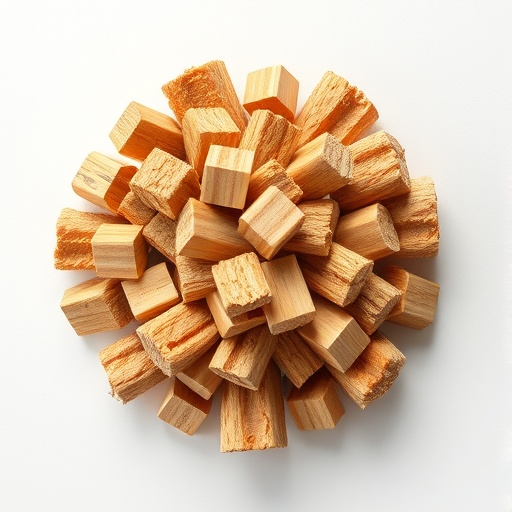
In the furniture workshops of Dhaka, teak wood is sawn into planks, leaving behind drifts of fine sawdust that are typically burned or thrown away. Chemists at the Bangladesh Council of Scientific and Industrial Research, working with the University of Dhaka, have now transformed that waste into a high-performance ingredient for one of the world’s most familiar plastics. In a study published in Results in Chemistry, Shahin Sultana and colleagues extracted cellulose microfibers from teak (Tectona grandis) sawdust and used them to reinforce poly(methyl methacrylate), the transparent acrylic known commercially as plexiglass. The best-performing composite, loaded with just 2.5 percent cellulose by weight, proved roughly two and a half times stronger in tension than unmodified PMMA and about a third stronger than the chemically toughened polymer matrix on its own. Because both the polymer and its reinforcing fibers were produced in nontoxic aqueous ethanol rather than petroleum-derived solvents, the work offers a practical recipe for acrylic composites that are cheaper, safer, and considerably kinder to the environment.
PMMA occupies a curious position in modern materials science. It is by some counts the most important member of the acrylic family, a mainstay of the plastics industry, and an amorphous thermoplastic made by free-radical polymerization of methyl methacrylate. Its exceptional optical transparency, weatherability, light weight, chemical resistance and strong electrical properties explain its presence in aircraft windshields, bulletproof screens, aquarium walls, automotive glazing, smartphone and LCD displays, optical devices, coatings, dental prostheses and surgical supplies. Yet the polymer carries a persistent weakness: it is brittle. Thin sheets crack readily, and pure PMMA cannot reliably be deployed as a thin film. Researchers have therefore spent decades modifying the acrylic through cross-linking, blending, and nanofillers ranging from metal oxides to cellulose nanocrystals. What distinguishes the new study is that it tackles both halves of the problem at once, greening the synthesis itself while upgrading the mechanical performance with a filler recovered from woodworking waste.
The synthesis at the heart of the work is deceptively simple. Conventional PMMA production frequently depends on volatile organic solvents such as toluene, whose toxicity poses risks to workers and ecosystems alike. Sultana’s team instead refluxed 24 grams of methyl methacrylate with 1.4 grams of benzoyl peroxide, a free-radical initiator, in 30 grams of 96 percent aqueous ethanol for two hours on an oil bath, then cast the viscous product onto glass dishes, where it dried into transparent sheets. Viscometry in tetrahydrofuran, interpreted through the Mark-Houwink relation, gave a molecular weight of 56,200 grams per mole, within one percent of a published benchmark, while the polymer measured 1.38 grams per milliliter in density at 30 degrees Celsius, softened or decomposed between 175 and 180 degrees Celsius, and was completely insoluble in water. Notably, the raw materials were used exactly as supplied, stabilizers and all, without additional purification, yet high polymer yields were still achieved.
Spectroscopy confirmed the transformation. In attenuated total reflectance Fourier-transform infrared spectra, the ester carbonyl stretching band appeared at 1726 cm⁻¹, and the carbon-carbon double bond of the monomer, visible at 1638 cm⁻¹, vanished entirely from the polymer, the classic fingerprint of successful chain growth. Proton nuclear magnetic resonance in deuterated chloroform at 600 megahertz showed the expected trio of PMMA signals: methyl protons at 0.8 to 0.9 parts per million, methylene protons at 1.7 to 2.1, and methoxy protons at 3.5 to 3.7. The vinyl signals of unreacted monomer near 5.90 and 5.40 parts per million were absent, while aromatic resonances between 7.4 and 8.0 parts per million betrayed benzoyl end groups inherited from the peroxide initiator, further evidence that the synthesized acrylic was pure.
Because virgin PMMA is brittle, the researchers next modified it within the same green medium, adding 0.15 grams of ethylene glycol dimethacrylate, a cross-linking agent that forges covalent bridges between growing chains, together with 1.43 grams of starch, a cheap biodegradable polysaccharide that toughens the network. The resulting material, dubbed MPMMA, proved markedly stronger. Tensile testing under the ASTM D3039 standard at a crosshead speed of 5 millimeters per minute lifted the strength from 5.39 megapascals for plain PMMA to 10.15 megapascals for the modified resin, while elongation at break, stiffness and ductility all improved as well. Scanning electron microscopy helped explain why: where pure PMMA showed a homogeneous, glassy-smooth surface, the modified polymer displayed a wavelike roughness, a morphological signature of the EGDMA and starch working their way into the growing chains.
The reinforcement began at a Dhaka sawmill. Teak sawdust was washed, dried, and stripped of waxes in a benzene-ethanol mixture, then de-pectinized over three days in warm 0.5 percent ammonium oxalate. Delignification followed with 0.7 percent sodium chlorite at 90 to 95 degrees Celsius in an acetate-buffered bath, and a four-hour soak in 24 percent potassium hydroxide yielded purified alpha-cellulose. Fifteen hours of high-energy milling at 45 hertz in a planetary ball mill, using yttria-stabilized zirconia balls in alumina jars, broke the cellulose down into microfibers averaging 1.84 micrometers in diameter with a moisture content of just 3.9 percent. The extraction chemistry was visible in the infrared spectra: the hydroxyl band softened from 3339 to 3322 cm⁻¹ and the lignin-associated peak at 1508 cm⁻¹ disappeared, confirming that lignin and hemicellulose had been scrubbed away.
Composites were then produced by dispersing the cellulose microfibers into the MPMMA reaction mixture at 1, 2.5, 5, and 7.5 weight percent relative to the monomer, refluxing for forty minutes at 75 degrees Celsius, and casting sheets that were cut into standardized test bars. Strength peaked at 2.5 percent loading, reaching 13.55 megapascals, a figure that almost matches PMMA heavily reinforced with bismuth and iron oxide ceramics for radiation-shielding applications, but achieved here with a renewable fiber. Beyond that optimum, performance declined as excess fibers clustered together; hydrogen bonding and van der Waals attraction between cellulose surfaces promote agglomeration, which creates stress-concentrating defects rather than load-bearing bridges. Elongation at break fell steadily as fiber content rose, the familiar trade-off in which stiffness is purchased at the expense of stretch, and the reinforced formulations were the most rigid of the entire series.
Thermal and structural probes rounded out the picture. Simultaneous thermogravimetric and calorimetric analysis from 35 to 850 degrees Celsius showed the 2.5 percent composite beginning to degrade at 150 degrees Celsius and losing half its mass at 370, marginally earlier than unmodified PMMA at 160 and 380 degrees, a slight sacrifice in thermal stability that mirrors earlier cellulose-PMMA nanocomposites. X-ray diffraction revealed that the extracted cellulose retained the disordered native Cellulose I architecture, a single broad asymmetric scattering hill between 10 and 30 degrees two-theta with merged reflections near 15.8 degrees and a suppressed (200) shoulder at 22.6 degrees; the intense milling had amorphized the crystals, driving the crystallinity index down to roughly 15 percent as calculated by peak-area deconvolution. In the composite, a dominant amorphous halo near 15.7 degrees together with faint higher-order scattering at 29.9 and 40.9 degrees confirmed that the acrylic phase governs the structure, with cellulose dispersed throughout the matrix without forming any new crystalline phase.
The most conceptually striking part of the study is computational. To see what polymerization does to the molecule itself, the team ran density functional theory calculations on methyl methacrylate and a three-unit trimer at the B3LYP/6-31+G(d,p) level, scaling harmonic frequencies by the standard factor of 0.9640. Natural bond orbital analysis quantified the electronic upheaval: when the alkene carbons flip from sp2 to sp3 hybridization, the negative charge on backbone carbon C1 swells from minus 0.372 in the monomer to minus 0.676 in the trimer, an 82 percent increase in electron density, while the ester carbonyl carbon grows more positive, from plus 0.792 to plus 0.838, and its oxygen more negative. Electrons drain into the sigma-bonded backbone as pi-conjugation is lost, leaving a more polarized, more strongly bonded chain. The optimized trimer also revealed weak but meaningful C–H···O contacts, with oxygen-to-hydrogen distances of 2.50 and 2.54 angstroms, hydrogen-bonding interactions that help stabilize and pack the polymer, and the ester groups lined up on the same side of the chain, echoing the isotactic geometry reported in earlier computational work. Calculated infrared bands tracked the experiment closely, with the calculated C=C frequency matching measurement exactly; the slightly high calculated carbonyl value reflects an isolated molecule freed from the carbonyl-carbonyl dipole contacts that restrain real polymer chains.
The authors are careful to note that a trimer models only local electronic behavior, not the entanglements of a real 56,000-gram-per-mole chain. Even so, the convergence of experiment and theory is persuasive, and its implications reach well beyond one laboratory in Dhaka. Sawmills across the tropics generate teak dust by the ton; converting it into reinforcement for a commodity acrylic simultaneously disposes of a waste stream, displaces petroleum-derived additives and mined ceramics, and avoids the toxic solvents that conventional acrylic manufacture normally demands. The team concludes that the ethanol-based solution polymerization route, together with EGDMA and starch modification and cellulose reinforcement, can be used to manufacture new plastic and composite materials, and the numbers bear them out: a 2.5 percent handful of sawdust cellulose more than doubled the strength of plexiglass. As industries scramble to decarbonize and detoxify polymer production, the humble contents of a sawmill floor have suddenly become a serious candidate for the plastics of the future.
Cite Scienmag News
Bethany Barker. (August 29, 2026). Teak sawdust cellulose reinforced PMMA composites and DFT study of MMA trimer. Scienmag. https://scienmag.com/teak-sawdust-cellulose-reinforced-pmma-composites-and-dft-study-of-mma-trimer/
Bethany Barker. "Teak sawdust cellulose reinforced PMMA composites and DFT study of MMA trimer." Scienmag, 29 August 2026, https://scienmag.com/teak-sawdust-cellulose-reinforced-pmma-composites-and-dft-study-of-mma-trimer/. Accessed 3 September 2026.
Bethany Barker. "Teak sawdust cellulose reinforced PMMA composites and DFT study of MMA trimer." Scienmag. August 29, 2026. https://scienmag.com/teak-sawdust-cellulose-reinforced-pmma-composites-and-dft-study-of-mma-trimer/


