


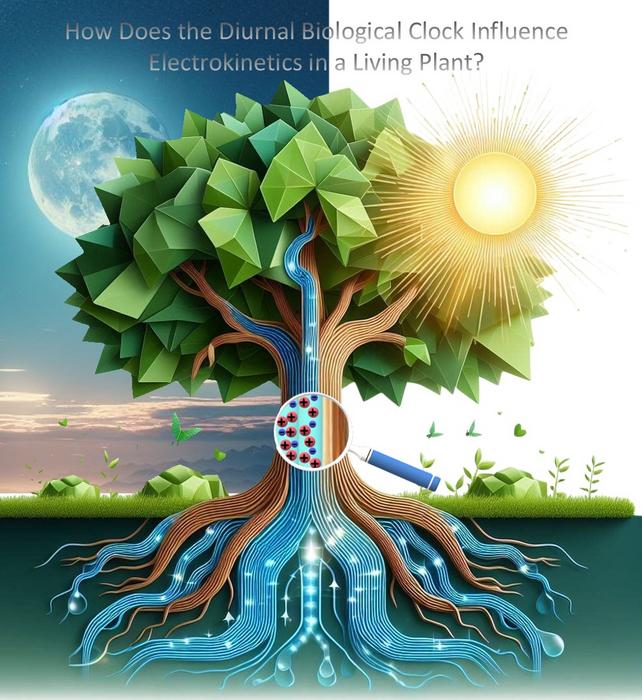
WASHINGTON, May 28, 2024 —When plants draw water from their roots to nourish their stems and leaves, they produce an electric potential that could be harnessed as a renewable energy source. However, like all living things, plants are subject to a circadian rhythm — the biological clock that runs through day and night cycles and influences biological processes. In plants, this daily cycle includes capturing light energy for photosynthesis and absorbing water and nutrients from the soil during the day and slowing its growth processes at night.

Credit: Aniruddha Guha
WASHINGTON, May 28, 2024 —When plants draw water from their roots to nourish their stems and leaves, they produce an electric potential that could be harnessed as a renewable energy source. However, like all living things, plants are subject to a circadian rhythm — the biological clock that runs through day and night cycles and influences biological processes. In plants, this daily cycle includes capturing light energy for photosynthesis and absorbing water and nutrients from the soil during the day and slowing its growth processes at night.
In a study published this week in Physics of Fluids, by AIP Publishing, the researchers from the Indian Institute of Technology Kharagpur detailed how biological processes produce voltage in plants and the impact of the cyclic day and night changes on this voltage.
“This streaming potential, essentially a consequence of the natural energy gathered in the plant, offers a renewable energy source that is continuous and can be sustainable over long periods,” author Suman Chakraborty said. “The question we wanted to answer was how much potential it can produce, and how is electric potential influenced by the plant’s biological clock?”
To find out, the authors inserted electrodes into the stems of water hyacinths and attached reservoirs with electrodes to pieces of lucky bamboo to closely examine how electrical potential changes depending on types of ions, ion concentration, and the pH of the fluid flowing through the plants.
“Our eureka moment was when our first experiments showed it is possible to produce electricity in a cyclic rhythm and the precise linkage between this and the plant’s inherent daily rhythm,” Chakraborty said. “We could exactly pinpoint how this is related to water transpiration and the ions the plant carries via the ascent of sap.”
The study quantified the voltage response originating from the movement of ions through the plant’s pathways that align uniquely with the plant’s daily rhythms. The authors discovered plants can actively moderate the flow of fluid or sap in sync with the day and night cycles. They also found the electric streaming potential increases with decreased concentration of ions or increased pH in the fluid.
“We not only rediscovered the plant’s electrical rhythm, articulating it in terms of voltages and currents, but we also provided insight into potentially tapping electrical power output from plants in a sustainable manner with no environmental impact and no disruption to the ecosystem,” Chakraborty said. “The findings could help develop biomimetic, nature-inspired systems that can address the global energy crisis with an eco-friendly, sustainable solution in which planting a tree not only relieves the crises of climate change and declining environmental quality, but also provides a way to harness electricity from it.”
###
The article “How does the diurnal biological clock influence electrokinetics in a living plant?” is authored by Aniruddha Guha, Saumyadwip Bandyopadhyay, Chirodeep Bakli, and Suman Chakraborty. It will appear in Physics of Fluids on May 28, 2024 (DOI: 10.1063/5.0195088). After that date, it can be accessed at https://www.doi.org/10.1063/5.0195088.
ABOUT THE JOURNAL
Physics of Fluids is devoted to the publication of original theoretical, computational, and experimental contributions to the dynamics of gases, liquids, and complex fluids. See https://aip.scitation.org/journal/phf.
###
Journal
Physics of Fluids
Article Title
How does the diurnal biological clock influence electrokinetics in a living plant?
Article Publication Date
28-May-2024
Cite Scienmag News
Bethany Barker. (May 28, 2024). Harnessing green energy from plants depends on their circadian rhythms. Scienmag. https://scienmag.com/harnessing-green-energy-from-plants-depends-on-their-circadian-rhythms/
Bethany Barker. "Harnessing green energy from plants depends on their circadian rhythms." Scienmag, 28 May 2024, https://scienmag.com/harnessing-green-energy-from-plants-depends-on-their-circadian-rhythms/. Accessed 4 September 2026.
Bethany Barker. "Harnessing green energy from plants depends on their circadian rhythms." Scienmag. May 28, 2024. https://scienmag.com/harnessing-green-energy-from-plants-depends-on-their-circadian-rhythms/

