


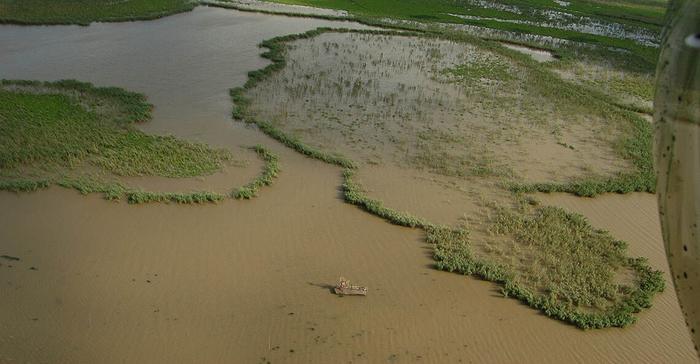
In 2016, observers in the wetlands of Louisiana’s Bird’s Foot Delta began to note dying stands of Phragmites australis, locally known as Roseau Cane. By 2021, nothing but mud flats remained in some areas where the reeds once stood.

Credit: Photo courtesy of Louisiana Department of Wildlife and Fisheries
In 2016, observers in the wetlands of Louisiana’s Bird’s Foot Delta began to note dying stands of Phragmites australis, locally known as Roseau Cane. By 2021, nothing but mud flats remained in some areas where the reeds once stood.
Initial theories pointed to a non-native scale insect as the culprit, but further investigations indicated a more complex mix of environmental factors. Tracy Quirk, an associate professor in the Department of Oceanography & Coastal Sciences, set out to determine if abiotic, or non-living, factors could have played a role in the troubling phenomenon.
She and her fellow researchers recently published their findings in Nature Communications.
Quirk’s team pinned the decline of Phragmites-dominated stands on the complex interplay of chronic and acute stressors the marsh experienced – long term stress of relative sea level rise, compounded by short term, weather-related shocks, such as drought and hurricanes.
Relative sea level rise means “the Birds Foot Delta marshes are flooded more- inundated to a greater depth a greater percentage of the time,” Quirk said. More water causes lower oxygen concentrations in the soil creating stressful conditions for marsh plants.
She continued, “that makes them inherently more susceptible to acute disturbances, such as a drought – which allows salt water to move in closer to the coast. Unlike the short pulse of a hurricane, salt water can remain inland for longer a longer duration.”
Hurricanes can compound this situation by bringing a pulse of extreme salt water flooding.
Quirk noted the data demonstrated that Phragmites marshes which had been inundated not only died-back at a greater rate but struggled to recover from the initial dieback event.
The study drew its conclusions by examining data from Louisiana Coastal Monitoring Stations from the years 2007 to 2021. Quirk and her team looked at annual vegetation cover, marsh elevation, water level, salinity, and surface elevation changes at marshes across the Louisiana coast.
In the years covered by the study, Quirk and her team found that the marshes suffering from the greatest amount of dieback had gone from being flooded 43 percent of the time to 75 percent of the time. Marshes in low-lying areas suffered the most impact from the salinity intrusion.
Overall, elevation plays a significant role in the plants’ ability to withstand increased flooding and higher salinities brought on by relative sea level rise. “Phragmites are better at tolerating high salinities when they’re not flooded as much. It’s the dual stressor,” said Quirk.
The perfect storm of conditions causing the diebacks noted in 2016 actually began in 2012, the study says. That year, an early severe drought brought saltwater further into the marshes, which were further shocked by the impacts of Tropical Storm Debby and Hurricane Isaac.
The study suggests the resilience of these marshes could be improved by elevating marsh beds – by harnessing and redistributing river sediment or directly adding sediment to low elevation marshes. “In order to be more resilient, you have to deal with the flood stress and the only way to do that is to add sediment to these deteriorating marshes,” said Quirk. “We’ve seen in other parts of the coast. Phragmites marshes are high, and get impacted by high salinities are very resilient.”
Journal
Nature Communications
Article Title
Vegetation dieback in the Mississippi River Delta triggered by acute drought and chronic relative sea-level rise
Article Publication Date
25-Apr-2024
Cite Scienmag News
Thomas Green. (May 22, 2024). LSU study finds sea-level rise and weather-related shocks caused marsh die-back. Scienmag. https://scienmag.com/lsu-study-finds-sea-level-rise-and-weather-related-shocks-caused-marsh-die-back/
Thomas Green. "LSU study finds sea-level rise and weather-related shocks caused marsh die-back." Scienmag, 22 May 2024, https://scienmag.com/lsu-study-finds-sea-level-rise-and-weather-related-shocks-caused-marsh-die-back/. Accessed 4 September 2026.
Thomas Green. "LSU study finds sea-level rise and weather-related shocks caused marsh die-back." Scienmag. May 22, 2024. https://scienmag.com/lsu-study-finds-sea-level-rise-and-weather-related-shocks-caused-marsh-die-back/

