


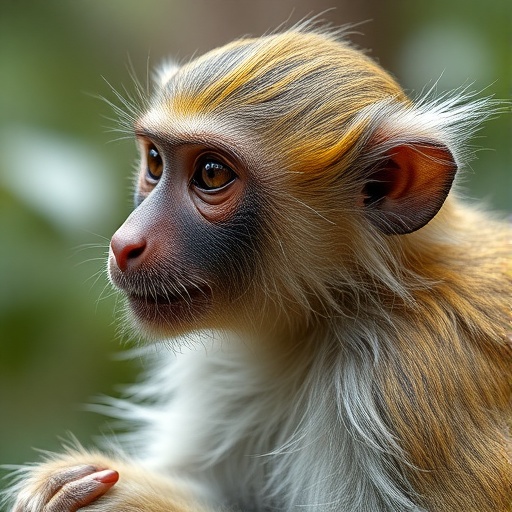
In the complex panorama of vocal learning, human infants hold a distinctive place, pioneering a language acquisition process deeply intertwined with social interaction and neural development. Recent research led by neuroscientists at Princeton University casts surprising light on this phenomenon by drawing parallels between human infants and a small, arboreal primate known as the common marmoset. While humans have long been celebrated for their unique capacity to learn language through social exchanges, this new study reveals that this capacity may not be as exclusive as once thought — instead, it could be deeply rooted in shared biological and developmental processes shaped by evolutionary history.
At the heart of this discovery lies a remarkable behavioral similarity: both human babies and marmoset infants engage in a babbling phase characterized by repetitive, seemingly purposeless vocalizations. In humans, this babbling stage is fundamental to language development, providing a scaffold on which more structured speech is built. The Princeton team observed analogous babbling in marmosets, a finding that challenges prevailing assumptions that such vocal learning strategies are uniquely human or confined to few avian species. What makes this even more fascinating is that these marmoset infants rely on feedback from their caregivers, much like human babies, to refine their vocal emissions toward adult-like calls.
This vocal learning process unfolds against a backdrop of rapid brain growth following birth, a pattern shared between humans and marmosets but markedly different from other primates. The developmental window during which these vocal exchanges occur coincides with a distinctive neural growth spurt. Unlike chimpanzees and rhesus macaques, whose significant brain maturation predominantly transpires prenatally, both human and marmoset brains expand remarkably postnatally. This timing places the infant’s social environment at the forefront of shaping neural circuits responsible for vocal learning. The study highlights how the brain’s enhanced plasticity during this critical period allows external auditory, social, and emotional inputs to influence and refine emerging communication skills.
This linkage between brain development and social vocal learning presents a compelling evolutionary question: how did two primate species so distantly related — humans and marmosets diverging over 40 million years ago — converge on a similar strategy for acquiring vocal skills? Chimpanzees, our closest genetic relatives, do not exhibit this reliance on interactive vocal feedback during infancy, indicating that vocal learning through caregiver-infant exchange is not a shared ancestral trait but rather an instance of convergent evolution. Researchers speculate that the demanding social structure and cooperative breeding systems present in marmosets may have fostered the evolution of this vocal flexibility, mirroring the intricately social human parenting context.
The intricacies of this vocal exchange in marmosets were elucidated through longitudinal observational studies complemented by quantitative analysis. As marmoset infants transitioned from rudimentary, sputtering vocalizations to mature, whistle-like calls, those receiving frequent adult responses accelerated their learning trajectory. These findings provide the first compelling experimental evidence demonstrating that, unlike the stereotyped vocalizations of most nonhuman primates, marmosets actively rely on social reinforcement to shape their communicative repertoire. This plastic developmental period represents a critical phase wherein auditory feedback is integrated with neural growth to refine vocal output, an insight that long eluded ethologists and neurobiologists alike.
Princeton’s research team, led by Ph.D. candidate Renata Biazzi under the mentorship of Professor Asif Ghazanfar, further examined comprehensive datasets encompassing the neurodevelopmental timelines of four primate species: humans, marmosets, chimpanzees, and rhesus macaques. Employing comparative neuroanatomical and developmental analyses, they pinpointed a distinct postnatal brain growth trajectory uniquely shared by humans and marmosets. This growth pattern likely underpins the capacity for infant vocal learning, lending credence to theories linking altriciality — the state of being born in an undeveloped condition — with enhanced neural plasticity and learning potential.
A striking aspect of marmoset parenting that emerged from the study is the cooperative care system, which shares parallels with human alloparenting. Multiple caregivers attend and respond to the infant’s vocalizations, thereby amplifying social feedback and enabling a rich communicative environment. This contrasts starkly with the more solitary caregiving observed in many primates and may be a pivotal factor underpinning the evolution of vocal learning in marmosets. The social dynamics surrounding vocal exchanges provide a natural laboratory to investigate how neurodevelopment and environmental factors jointly influence communication skills.
Through a sophisticated mathematical model, the researchers demonstrated how the interplay between rapid brain growth and responsive caregiving accelerates vocal development. This model simulates the amplification effect of timely social feedback during periods of heightened neural receptivity, offering a mechanistic explanation for the observed learning rates in marmoset infants. It illustrates anatomical and behavioral coupling — whereby neural plasticity positions the brain for learning and social interaction furnishes the necessary stimuli — together forging the trajectory of vocal competence.
Looking forward, the Princeton team aims to delve deeper into the qualitative features of vocal interactions between adult marmosets and their offspring. Intriguingly, they hypothesize that, much like human adults use infant-directed speech — characterized by exaggerated intonation and slower tempo — adult marmosets may employ specialized calls or modulations when communicating with babies. Discovering such “marmoset baby talk” would provide further evidence of convergent communicative strategies and could illuminate fundamental principles of social feedback mechanisms essential for vocal learning.
The implications of this research extend beyond primatology and evolutionary biology into the realms of developmental neuroscience and linguistics. By studying an animal model that combines early postnatal brain plasticity with social vocal feedback, scientists can better understand the neurobiological substrates that support human language acquisition. Moreover, elucidating how interaction shapes neural development during sensitive periods offers promising insights for addressing communication disorders and optimizing early childhood learning environments.
Importantly, this research delineates the boundaries of vocal learning capabilities in primates. While many species can alter vocalizations in adulthood, the sensitive infancy period, marked by rapid brain maturation and intensive social feedback, appears uniquely conducive to ingraining foundational vocal skills. This emphasizes the criticality of early social environments in shaping neural trajectories and communication proficiencies, a principle that resonates with prevailing human developmental theories.
In sum, the study reveals that the extraordinary capacity for vocal learning shared by human infants and common marmosets stems from a convergence of neural developmental timing and rich social interactivity. These findings rewrite aspects of the evolutionary narrative, suggesting that infant vocal learning’s roots may extend further into the primate lineage than previously assumed, shaped as much by brain physiology as by the social fabric enveloping the newborn. As research progresses, the common marmoset stands as a pivotal species for unraveling the complex interplay between brain development, social feedback, and the emergence of language-like communication.
News Publication Date: 19-Aug-2025
Web References: http://dx.doi.org/10.1073/pnas.2421095122
References:
- Biazzi, R. B., Takahashi, D. Y., & Ghazanfar, A. A. (2025). Altricial brains and the evolution of infant vocal learning. Proceedings of the National Academy of Sciences, August 19, 2025. https://doi.org/10.1073/pnas.2421095122
Cite Scienmag News
Cassandra Pierce. (September 4, 2025). Rapid Brain Growth Could Unlock How Humans and Marmosets Learn to Talk. Scienmag. https://scienmag.com/rapid-brain-growth-could-unlock-how-humans-and-marmosets-learn-to-talk/
Cassandra Pierce. "Rapid Brain Growth Could Unlock How Humans and Marmosets Learn to Talk." Scienmag, 4 September 2025, https://scienmag.com/rapid-brain-growth-could-unlock-how-humans-and-marmosets-learn-to-talk/. Accessed 31 August 2026.
Cassandra Pierce. "Rapid Brain Growth Could Unlock How Humans and Marmosets Learn to Talk." Scienmag. September 4, 2025. https://scienmag.com/rapid-brain-growth-could-unlock-how-humans-and-marmosets-learn-to-talk/


