


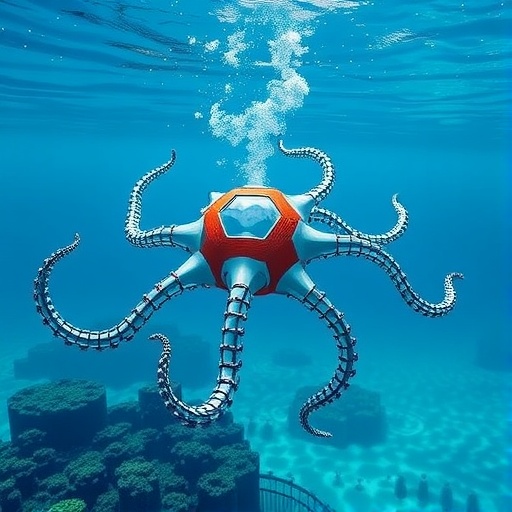
University of Iowa engineers have taken a bold step forward in underwater vehicle technology, unveiling a novel approach inspired by one of the ocean’s most fascinating creatures: the octopus. Their groundbreaking research centers on the development of a new type of active flow control system utilizing bioinspired twisted spiral artificial muscles mimicking the distinctive papillae muscles found on an octopus’s skin. This innovative technology has demonstrated significant improvements in maneuverability and efficiency for underwater vessels, representing a potential paradigm shift in marine robotics.
The research team’s central innovation lies in the adaptation of the octopus’s ability to dynamically adjust its skin texture through tiny, coiled muscles known as papillae. These muscles can instantaneously expand or retract, enabling the octopus to camouflage itself seamlessly or adjust its movement patterns to navigate complex underwater currents. Taking inspiration, the engineers designed a series of coiled spires—termed twisted spiral artificial muscles—that replicate this natural function for the purpose of optimizing underwater vehicle performance.
The heart of this system is the integration of these twisted spiral artificial muscles onto the hydrofoil wings of an underwater craft. These muscles are mechanically activated by miniature electric motors, called actuators, which control the unspooling and recoiling of the coils. As water flows over the modified hydrofoil, these bioinspired appendages dynamically alter their shape to reduce drag and increase lift, generating up to 30% more lift and reducing drag by as much as 10% under certain conditions. The practical effect is an underwater vehicle that can more efficiently slice through water with less energy expenditure.
Such improved hydrodynamics are crucial for unmanned underwater vehicles (UUVs), which require high maneuverability and energy efficiency to perform prolonged missions under challenging oceanic conditions. Traditional UUVs often struggle with balancing lift and drag, especially in turbulent currents or complex underwater topographies. By embedding adaptive, muscle-like structures on the hydrofoil surfaces, the craft achieve dynamic flow control, enabling unprecedented control over their movement and positioning.
The underlying principle of this technology is complex vortex manipulation, where the artificial muscles generate active vortex generators along the hydrofoil surfaces. Vortex generation is a well-known fluid dynamic technique to delay flow separation and improve lift in aerodynamics and marine applications. However, the active and programmable nature of these twisted spiral muscles allows for a responsive system that adjusts to real-time flow conditions, optimizing performance in a way static vortex generators cannot.
Engineering this system required the convergence of biomechanics, materials science, and electromechanical design. The synthetic muscles are fabricated from spiral coils designed to emulate the contractile and extensile behavior of biological muscles. Using two rows of four coils on each hydrofoil wing, each coil’s movement is precisely controlled through electric signals to the actuators, allowing the vehicle to modulate its surface contour dynamically. This complex coordination mirrors the octopus’s exquisite muscular dexterity and responsiveness.
Testing involved rigorous experimental trials in controlled flow environments with varying current speeds and flow angles. Data showed that the active control system significantly enhanced lift generation when the vehicle was angled steeply against the oncoming water flow, a maneuver typically associated with increased drag and instability. These improvements imply that the design not only reduces energy consumption but also enhances safety and control during complex underwater operations.
Beyond enhancing performance metrics, the modular nature of these artificial muscles promises broad adaptability across different vehicle designs and mission profiles. For example, UUVs tasked with pipeline inspection could leverage the ability of these muscles to conform to narrow or irregular spaces, while deep-water exploration robots might use the technology to navigate strong and variable currents with greater ease.
This breakthrough was led by Caterina Lamuta, Associate Professor in Mechanical Engineering at the University of Iowa, whose lab specializes in bioinspired robotic systems. The research team includes doctoral students Rabiu Mamman and Thilina Weerakkody, who contributed extensively to the experimental design and analysis. Their collaborative efforts demonstrate the power of integrating biology-inspired principles to solve engineering challenges in underwater vehicle dynamics.
The research, funded by the U.S. Office of Naval Research, marks the first demonstration of an underwater flow control mechanism powered by active twisted artificial muscles. It offers a scalable, low-cost solution with potential defense, scientific, and commercial oceanographic applications. By mimicking natural systems honed over millions of years, the team’s work heralds a new era of efficient, autonomous underwater exploration.
Published recently in the journal Robotics Reports, the study titled “Bioinspired Active Vortex Generators for Underwater Flow Control” lays out the theoretical framework, engineering design, and experimental validation of this technology. The article provides a technical deep dive into the mechanics of these twisted spiral muscles, their actuator control systems, and performance outcomes under a range of hydrodynamic conditions.
Future research directions are focused on optimizing the materials used for the artificial muscles to improve durability and response speed, integrating sensor feedback for autonomous control, and scaling this technology for larger underwater vehicles. The long-term vision includes deploying fleets of bioinspired UUVs capable of complex undersea missions, with improved energy efficiency and adaptability surpassing current state-of-the-art designs.
In summation, the University of Iowa’s engineering team has brought octopus-inspired muscular mechanics to the forefront of underwater robotics, offering a transformative technology that enhances lift, reduces drag, and increases maneuverability through active flow control. As ocean exploration and underwater operations intensify, such innovations will be pivotal in extending our reach into the depths with greater efficiency and environmental compatibility.
Cite Scienmag News
Denise Maddox. (September 4, 2025). Octopus-Inspired Design Enhances Underwater Vehicle Maneuverability, Researchers Find. Scienmag. https://scienmag.com/octopus-inspired-design-enhances-underwater-vehicle-maneuverability-researchers-find/
Denise Maddox. "Octopus-Inspired Design Enhances Underwater Vehicle Maneuverability, Researchers Find." Scienmag, 4 September 2025, https://scienmag.com/octopus-inspired-design-enhances-underwater-vehicle-maneuverability-researchers-find/. Accessed 6 September 2026.
Denise Maddox. "Octopus-Inspired Design Enhances Underwater Vehicle Maneuverability, Researchers Find." Scienmag. September 4, 2025. https://scienmag.com/octopus-inspired-design-enhances-underwater-vehicle-maneuverability-researchers-find/


