


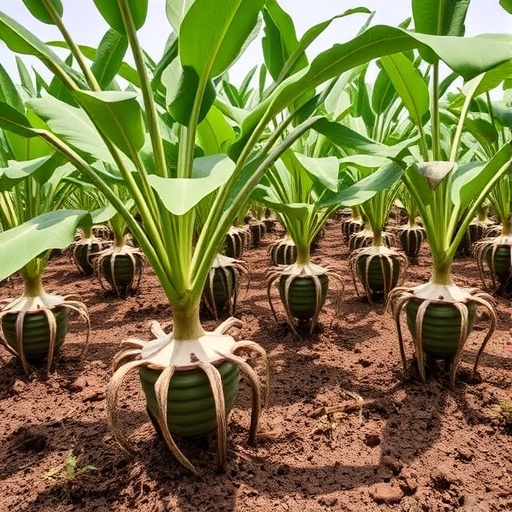
In the quest for sustainable agriculture, the role of arbuscular mycorrhizal fungi (AMF) has emerged as a critical focal point. Research highlights their potential to enhance soil health and plant growth, particularly in crops such as cassava. The groundbreaking study conducted in Thailand by Ketjarun et al. explores the indigenous AMF present in organic cassava fields and their potential applications in sustainable cassava cultivation practices. This innovative approach not only promises to address the challenges faced by traditional farming methods but also seeks to redefine agricultural productivity through ecological practices.
AMF form a symbiotic relationship with the roots of many plants, including cassava, facilitating improved nutrient uptake and water absorption. This association is particularly vital in regions where soil quality is suboptimal or eroded due to extensive farming. The study conducted by Ketjarun and colleagues reveals that using indigenous AMF can significantly increase the growth rates of cassava plants. As cassava holds economic importance in many tropical regions, understanding how these fungi influence its growth offers a dual benefit: enhancing food security and fostering environmental sustainability.
One of the key advantages of utilizing indigenous AMF lies in their adaptability to local soil conditions and climates. Unlike commercial microbial inoculants, which may not always thrive in varying environments, the study affirms that local AMF strains can effectively boost plant resilience against abiotic stress. This is particularly significant in the context of climate change, where crops face increasing threats from droughts, floods, and temperature extremes. By inoculating cassava plants with indigenous AMF, farmers can enhance their yields while simultaneously reducing dependency on chemical fertilizers and pesticides.
Furthermore, the effects of these indigenous fungi extend beyond individual plants to positively impact entire ecosystems. Ketjarun et al. emphasize the role of AMF in promoting soil structure and fertility. The extensive underground hyphal networks formed by these fungi improve soil aggregation, allowing for better aeration and water infiltration. As a result, soils rich in AMF activity not only support stronger cassava plants but also promote healthier and more sustainable farming systems, ultimately benefiting biodiversity and reducing soil degradation.
The economic implications of this research are vast. Efficient cassava cultivation, supported by indigenous AMF, could lead to significant cost savings for farmers who traditionally rely on synthetic fertilizers and herbicides. By decreasing input costs and increasing yields, farmers can achieve higher profitability while minimizing their environmental footprint. In regions where cassava serves as a dietary staple, this can also have a profound impact on food prices and availability, directly influencing local communities’ well-being.
There is a deep-seated urgency to transition toward more sustainable agricultural practices. The findings of this research underscore the importance of indigenous knowledge in agriculture. By embracing local AMF, farmers can enhance their crops utilizing their natural biodiversity rather than imposing artificial practices that often lead to long-term soil depletion. The relationship between local farmers and their environment can thus be strengthened, ushering in an era of farming that is both ecologically sound and economically viable.
Moreover, policy implications should not be overlooked. Governments and agricultural bodies must recognize the value of indigenous AMF when designing agricultural support systems. Investments in education and training for farmers about the benefits of AMF could facilitate a widespread adoption of these practices, creating a ripple effect through agricultural communities worldwide. This research serves as a call to action, urging stakeholders to reconsider how they approach sustainable agriculture while leveraging natural symbiotic relationships.
In addition, the study discusses the various methods for the efficient extraction and application of indigenous AMF from organic cassava fields. Research indicates that specific methods can maximize the viability of live spores and hyphae when introducing them into new soil. These techniques, which preserve the delicate fungi while ensuring they are actively contributing to root systems, will be vital in spreading the use of AMF in larger agricultural settings.
The challenge remains in scaling these findings from small farms to larger agricultural operations. Translating the positive impacts observed in controlled environments to various agricultural scales will require outreach and collaboration between scientists, farmers, and policymakers. Building networks focused on sustainable practices can bridge the gap between academic research and field application, ultimately fostering a more resilient agricultural framework.
This groundbreaking work lays a foundation for future studies aimed at understanding the full range of benefits provided by AMF in various crops and settings. Researchers are encouraged to explore beyond cassava, investigating the potential of indigenous fungi in other economically significant crops and their interactions with local microbial communities. The implications of such research could pave the way for a new generation of agricultural practices that honor ecological balance while catering to the increasing global demand for food.
As the agricultural sector faces unprecedented challenges, the application of indigenous AMF offers a beacon of hope. Ketjarun et al.’s research has spotlighted the underappreciated potential of these organisms not only for cassava cultivation in Thailand but also for the transformation of farming practices globally. As farmers, researchers, and policymakers collaborate to harness these insights, the future of sustainable agriculture begins to take shape—one rooted in the rich biodiversity of our ecosystems.
The global agricultural landscape is on the brink of change, and the introduction of indigenous AMF can help steer it towards a sustainable future. With continued research and collaboration, the marriage between traditional farming techniques and modern science may yield an agricultural renaissance that fosters food security, supports livelihoods, and preserves our planet’s precious ecosystems.
Cite Scienmag News
Alan Morgan. (September 4, 2025). Indigenous AMF Boosts Sustainable Cassava Farming in Thailand. Scienmag. https://scienmag.com/indigenous-amf-boosts-sustainable-cassava-farming-in-thailand/
Alan Morgan. "Indigenous AMF Boosts Sustainable Cassava Farming in Thailand." Scienmag, 4 September 2025, https://scienmag.com/indigenous-amf-boosts-sustainable-cassava-farming-in-thailand/. Accessed 3 September 2026.
Alan Morgan. "Indigenous AMF Boosts Sustainable Cassava Farming in Thailand." Scienmag. September 4, 2025. https://scienmag.com/indigenous-amf-boosts-sustainable-cassava-farming-in-thailand/


