


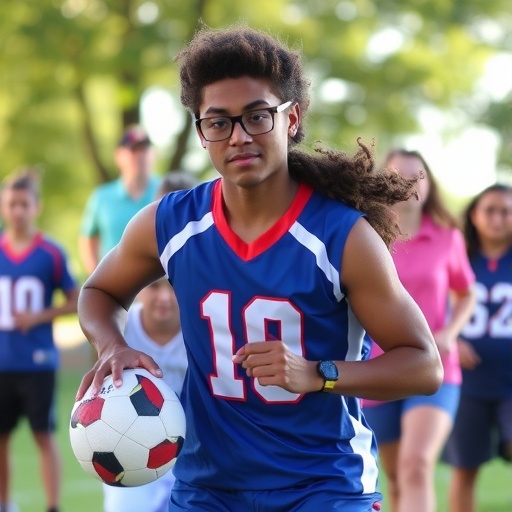
In the dynamic ecosystem of college life, where social interactions and personal development intertwine, a new comprehensive study sheds illuminating light on how peer influence shapes the sporting behaviors of university students. Presented in the latest issue of BMC Psychology, the research conducted by Liu, Yang, Liu, and colleagues dissects the complex mechanisms through which peer effects govern normative intentions toward sports participation among young adults. This article unpacks the moderated mediation model proposed by the authors, offering a technical yet accessible deep dive into one of the pivotal determinants of health-related behavior in tertiary education settings.
At the core of this investigation lies the concept of normative behavior intention—essentially, the psychological readiness and motivation of college students to engage in sports activities, guided not only by personal preferences but significantly swayed by their social milieu. The study uniquely integrates peer influence as a multidimensional construct, involving not only direct encouragement or discouragement but also the nuanced perceptions that students hold about their peer groups’ attitudes and behaviors related to sports. By examining these pathways, the researchers illuminate how social contexts create ripple effects that can either propel or inhibit physical activity in academic environments.
This endeavor undertook a quantitative approach, gathering data from a diverse cohort of college students across different universities. Using rigorous statistical techniques, including moderated mediation analysis, the authors parsed out the direct and indirect effects of peer influence while considering key moderating variables such as gender, self-efficacy, and personal attitudes toward sports. These factors serve as crucial buffers or enhancers in the chain of influence, reflecting the interplay between individual psychological traits and social environmental cues.
One of the paramount technical contributions of the study is the conceptualization and operationalization of peer effects. Rather than a simplistic measure of peer pressure, the researchers defined peer effects through multiple dimensions including descriptive norms (what peers commonly do), injunctive norms (what peers approve or disapprove), and identification with peer groups. Such granularity allows for a far richer understanding of behavioral intention modulation, recognizing that students may internalize peer influences differently based on which norm or group they reference.
Furthermore, the moderated mediation model offered robust insight into how these peer effects influence sports normative behavior intention through mediating psychological processes such as attitude formation and perceived behavioral control. The mediation pathway suggests that exposure to peer norms alters individual attitudes toward sports, which in turn shapes their intention to participate. The model also posits that moderators like individual confidence in sports ability (self-efficacy) can alter the strength or direction of these pathways, disentangling the complexity of these social-cognitive interactions in a collegiate context.
Expanding on the methodological rigor, the study employed validated psychometric scales adapted for cross-cultural sensitivity and relevance to the sports domain. Advanced techniques including confirmatory factor analysis and structural equation modeling underpinned the robustness of their findings, enabling a high degree of confidence in the causal inferences drawn. This meticulous approach addresses common critiques in social behavioral research regarding measurement reliability and validity, setting new standards for future studies in this arena.
Importantly, the findings highlight significant gender differences in the magnitude and pathways of peer influence. Male and female students demonstrated distinct patterns with respect to which normative cues were most salient and how their self-beliefs moderated these influences. Such insights carry profound implications for designing gender-responsive interventions aimed at promoting physical activity within university populations, suggesting that a one-size-fits-all approach is inadequate.
The research also intersects with broader theoretical frameworks in health psychology and social cognition, such as the Theory of Planned Behavior and Social Identity Theory. By integrating these established models into a single moderated mediation framework, the authors enrich the explanatory power regarding how individual and social factors jointly shape behavior intentions. This theoretically grounded but empirically tested approach bridges the gap between abstract psychological theories and concrete health behaviors among emerging adults.
Beyond the academic sphere, the implications of this study are far-reaching. Universities face ongoing challenges in encouraging student participation in health-promoting activities amidst academic pressures, lifestyle distractions, and the digital saturation of social life. Insights from Liu and colleagues illuminate actionable levers within peer group dynamics that campus health promoters and policy makers can harness. For example, fostering strong, positive peer networks that endorse sports participation could catalyze broader cultural shifts towards healthier lifestyles.
Moreover, the moderated mediation model underscores that interventions cannot merely target individual motivation. Instead, they must strategically manipulate social environments and reinforce supportive peer norms while simultaneously boosting individual self-efficacy. This dual approach offers a promising paradigm for behavior change programs that seek to sustain long-term engagement rather than transient spikes in activity.
Intriguingly, this research prompts future inquiries into how digital social networks and virtual peer communities influence normative behavior intentions—domains that were only peripherally considered here. Given the pervasive role of online platforms in shaping young adults’ social worlds, subsequent investigations could extend this model to incorporate virtual influences, adding contemporary relevance to the foundational findings.
To sum up, the work of Liu et al. advances our understanding of the peer effect mechanism by meticulously disentangling the social-cognitive processes that drive sports participation intentions in college settings. Their moderated mediation model not only provides a sophisticated analytical lens but also charts a framework for future explorations and practical applications. As health promotion increasingly emphasizes social determinants, such contributions become indispensable in sculpting healthier generations through evidence-based strategies grounded in peer dynamics.
In an era where sedentary lifestyles and mental health challenges among youth are rising global concerns, this research arrives as a vital beacon—highlighting how the social fabric of student life can be leveraged to foster normative, health-enhancing behaviors. The study’s methodological innovations and nuanced analyses mark a significant stride in sports psychology and social behavioral research, compelling stakeholders to reconsider the centrality of peer influence in public health initiatives aimed at young adults.
Ultimately, Liu and colleagues’ findings compel universities, educators, and health promoters to adopt holistic approaches that intertwine social environment reform with individual empowerment. By embracing these complex interdependencies, we unlock pathways to more vibrant, active, and mentally resilient college communities—transforming peer effects from passive background noise into a dynamic force for positive change.
Cite Scienmag News
Glenn Wilkins. (September 2, 2025). How Peers Shape College Students’ Sports Intentions. Scienmag. https://scienmag.com/how-peers-shape-college-students-sports-intentions/
Glenn Wilkins. "How Peers Shape College Students’ Sports Intentions." Scienmag, 2 September 2025, https://scienmag.com/how-peers-shape-college-students-sports-intentions/. Accessed 1 September 2026.
Glenn Wilkins. "How Peers Shape College Students’ Sports Intentions." Scienmag. September 2, 2025. https://scienmag.com/how-peers-shape-college-students-sports-intentions/


