


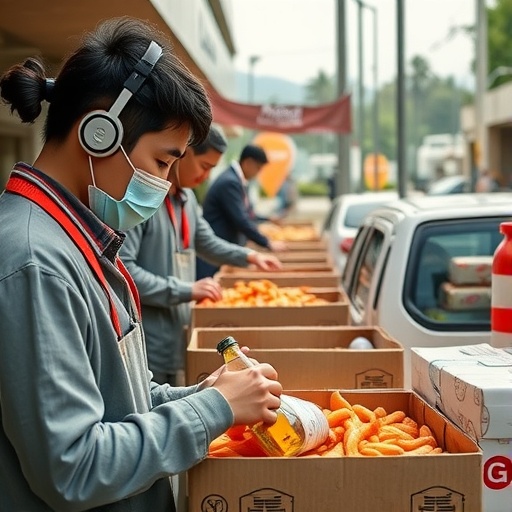
In the wake of escalating natural disasters and their profound impact on vulnerable populations, researchers at the University of Houston (UH) are pioneering an innovative approach to alleviate food insecurity through the integration of artificial intelligence (AI) with disaster response coordination. This groundbreaking initiative leverages cutting-edge computational techniques to optimize the distribution of food resources via an intelligently designed online platform, explicitly addressing the challenges faced by food pantries during crises.
Food insecurity is a pressing concern significantly exacerbated by the aftermath of natural disasters such as hurricanes, floods, and wildfires. These catastrophic events disrupt supply chains, displace populations, and hinder access to vital resources. The UH research team, building upon prior experiences with Hurricane Harvey in 2017, is channeling their expertise into creating an AI-driven system that not only streamlines communication among stakeholders but also prioritizes aid distribution efficiently based on real-time data inputs.
Harnessing a substantial grant nearing $1.2 million from the U.S. Department of Agriculture’s National Institute of Food and Agriculture, UH and three other institutions are spearheading the development of this AI-enabled tool. UH’s portion of the funding, approximately $300,000, focuses on creating an adaptive dashboard tailored for Florida food pantries affected by the aftermath of Hurricanes Helene and Milton. This dashboard promises enhanced situational awareness, allowing for dynamic prioritization of aid based on evolving needs communicated through short message service (SMS) texts.
The system is being conceptualized to process large volumes of status reports submitted by food pantry leaders in disaster zones. Employing advanced natural language processing algorithms, the AI interprets incoming requests, categorizing and ranking needs by severity and immediacy. This rapid data synthesis reduces latency in emergency response, enabling coordinators to allocate limited resources in a manner that maximizes impact and minimizes delays—a crucial asset when demand surges unpredictably.
Beyond mere allocation, the design prioritizes scalability and flexibility, making the AI platform capable of adapting to an array of disaster scenarios. Whether the region faces flooding, wildfires, or infrastructural damage from tornados, the system’s underlying machine learning models are being trained to recognize diverse emergency contexts, dynamically recalibrating priorities. This versatility ensures the tool remains relevant across varying environmental crises and geographic regions, including an eventual rollout in Houston.
Marcus Sammer, an application developer at UH’s Computational Biomedicine Lab, plays a pivotal role in architecting the AI’s operational framework. The project uniquely combines principles from computational biology, data science, and computer engineering to create an interface that is both robust and user-friendly. This intersection of disciplines facilitates sophisticated data analysis while maintaining accessibility for end-users under emergency conditions.
Understanding the broader implications, the team situates their work within the escalating national concern around food insecurity. Data from the USDA indicates a troubling rise in food insecurity rates, with 13.5% of American households affected at least once in 2023. Disasters exacerbate these conditions dramatically, severing supply routes and overwhelming community aid systems. By preemptively addressing communication bottlenecks and streamlining resource logistics, the AI tool aims to mitigate these compounding vulnerabilities.
The project at UH is not an isolated venture but is grounded in a continuum of funding and research excellence. Professor Ioannis Kakadiaris, the project’s principal investigator, has secured over $2.2 million from the National Science Foundation since 2021 for related AI endeavors targeting food security. This sustained support underlines the technological and societal significance of harnessing AI for humanitarian applications, particularly in times of crisis.
Throughout the year-long study period, researchers will methodically engage with stakeholders ranging from food pantry coordinators to emergency management professionals. These interactions are essential to refine system requirements and ensure the final product addresses real-world operational challenges. Initial pilot testing slated for September in Florida will provide iterative feedback, allowing the team to calibrate the AI models and user interface for peak performance.
The innovation does not stop at immediate disaster relief. The AI-powered dashboard embodies a paradigm shift toward proactive disaster management and resilience building. By centralizing data streams and automating response recommendations, emergency coordinators gain unprecedented analytical capabilities. This intelligence fosters anticipatory actions, potentially reducing the duration and severity of food insecurity episodes following disasters.
In a landscape where rapid information processing and decisive action are paramount, the integration of AI mechanisms into disaster response infrastructure marks a transformative advance. The UH initiative exemplifies how sophisticated computational methods can be mobilized to solve entrenched social problems, bridging technology with empathy. As climate change accelerates the frequency and intensity of natural disasters globally, such intelligent systems will be indispensable in safeguarding vulnerable communities.
This project also hints at future expansions, wherein similar AI frameworks could be adapted for broader emergency services beyond food aid—encompassing medical supplies, shelter coordination, and long-term recovery logistics. The modularity engineered into the UH tool ensures that these extensions can be seamlessly integrated, heralding a new era of disaster response enhanced by artificial intelligence.
Ultimately, the University of Houston’s AI-powered disaster response platform promises not only technological innovation but also a compassionate reimagining of how society marshals its resources during times of greatest need. By leveraging data-driven insights and fostering collaborative networks, this tool exemplifies the potential of interdisciplinary research to create tangible, life-saving solutions.
News Publication Date: June 18, 2024.
Web References: http://www.uh.edu/cbl
Cite Scienmag News
Violet Maxwell. (August 14, 2025). UH researchers harness AI to revolutionize emergency food distribution. Scienmag. https://scienmag.com/uh-researchers-harness-ai-to-revolutionize-emergency-food-distribution/
Violet Maxwell. "UH researchers harness AI to revolutionize emergency food distribution." Scienmag, 14 August 2025, https://scienmag.com/uh-researchers-harness-ai-to-revolutionize-emergency-food-distribution/. Accessed 4 September 2026.
Violet Maxwell. "UH researchers harness AI to revolutionize emergency food distribution." Scienmag. August 14, 2025. https://scienmag.com/uh-researchers-harness-ai-to-revolutionize-emergency-food-distribution/


