


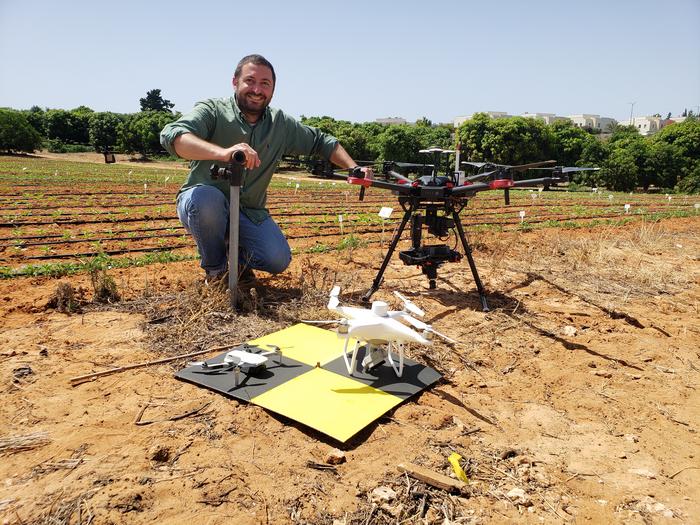
A groundbreaking study emerging from The Hebrew University of Jerusalem introduces a revolutionary drone-based system designed to transform how crop health monitoring is conducted, particularly for sesame cultivation. For the first time, researchers have ingeniously combined hyperspectral, thermal, and RGB imagery with state-of-the-art artificial intelligence algorithms to simultaneously detect nitrogen and water deficiencies in sesame plants grown in field environments. This pioneering approach ushers in a new era in precision agriculture, enabling more accurate, efficient, and sustainable crop management under increasingly challenging climatic conditions.
The innovative system leverages the synergy of multiple data modalities captured by unmanned aerial vehicles (UAVs), commonly known as drones, equipped with advanced multispectral sensors. Hyperspectral imaging provides detailed spectral information for each pixel, revealing subtle physiological changes in plants that reflect nutrient content and water status. Thermal cameras complement this by mapping temperature variations across the crop canopy, directly correlating with plant water stress. Meanwhile, conventional RGB images supply high-resolution visual context, critical for spatial identification and morphological analysis. Together, these datasets empower deep learning models to extract complex features that singular sensing methods typically miss.
Addressing a significant hurdle in remote crop stress detection, the research team, led by Dr. Ittai Herrmann, focused on the simultaneous identification of combined nitrogen and water deficiencies—two of the most critical limiting factors for sesame productivity. Traditionally, detecting multiple co-occurring stresses has posed immense challenges due to overlapping symptoms and confounding environmental variables. Conventional remote sensing techniques often falter in differentiating whether observed physiological changes stem from nutrient shortages, water scarcity, or their interaction. This study breaks new ground by deploying an ensemble of deep learning classifiers trained on multimodal UAV data, drastically improving diagnostic precision.
The experimental trials took place at the Robert H. Smith Faculty of Agriculture’s Experimental Farm in Rehovot, Israel. Under controlled irrigation and nitrogen regimes, sesame plants were cultivated and continuously monitored. This meticulous setup allowed researchers to create a comprehensive dataset linking variations in leaf physiology, spectral signatures, and external environmental parameters. MSc student Rom Tarshish spearheaded the fieldwork phase, gathering extensive plant trait data and spectral readings at the leaf level, which served as vital ground truth for model validation.
Meta-analyses and machine learning pipelines conducted by Dr. Maitreya Mohan Sahoo utilized UAV-derived imagery to generate spatially explicit maps of critical physiological traits, including leaf nitrogen content and water status. These maps unveiled early stress markers invisible to the naked eye or standard field inspections. The deployment of such high-fidelity spectral and thermal datasets integrated with deep neural networks substantially decreased the ambiguity often encountered when decoding complex plant stress patterns.
One remarkable outcome of this multimodal ensemble approach was its dramatic improvement in classification accuracy. Where conventional methods achieved only 40–55% accuracy in distinguishing combined nutrient and water stress, the new AI-driven system escalated this to a robust 65–90%. This leap forward not only enhances diagnostic reliability but also provides actionable insights to farmers for timely intervention, curbing yield losses and resource wastage.
Sesame, an indeterminate oilseed crop valued for its resilience and nutritional qualities, stands to gain significantly from such advanced monitoring techniques. Its expanding global demand invites adaptation to diverse agroecosystems, often with limited water and fertilizer availability. By facilitating precise detection of stressors, this novel UAV-based system enables optimized input management, reducing excessive fertilizer and irrigation applications, thereby promoting environmentally friendly and economically viable cultivation practices.
The implications of this research extend far beyond sesame farming. The demonstrated methodology lays a blueprint for crop health monitoring across various species, especially those grown in heterogeneous or resource-limited landscapes. The integration of high-resolution UAV remote sensing with AI-powered analytics offers unprecedented scalability, speed, and granularity in agricultural surveillance, critical for meeting the food security demands of a growing population amid climate change.
Moreover, the study reflects a convergence of disciplines—agriculture, remote sensing, computer vision, and environmental science—highlighting the transformative potential of interdisciplinary collaboration. Institutions including Virginia State University, University of Tokyo, and the Volcani Institute actively contributed, illustrating a global commitment to advancing sustainable agriculture through technology.
By enabling early and accurate identification of combined water and nutrient stress, farmers and agronomists can implement precision interventions tailored not only to individual plant needs but also to localized environmental conditions. Such smart farming practices are indispensable for enhancing yield stability, conserving vital resources, and mitigating the environmental footprint of intensive agriculture.
In the broader context of climate resilience, this research provides vital tools for adapting traditional farming systems to the volatile and unpredictable weather patterns expected in the coming decades. Continuous monitoring powered by drones and AI creates feedback loops essential for adaptive management, ensuring crop systems remain productive and sustainable amidst pressure from droughts, heat, and soil nutrient depletion.
Published in the ISPRS Journal of Photogrammetry and Remote Sensing in February 2025, this study underscores the rising importance of UAV-based remote sensing and artificial intelligence in modern agriculture. It establishes a benchmark for future research seeking to unravel the complex interplay between multiple stress factors and crop physiology, ultimately aiding the transition to smarter, greener food production systems worldwide.
By innovatively integrating hyperspectral, thermal, and RGB imaging capabilities with sophisticated deep learning frameworks, this pioneering approach redefines the boundaries of non-destructive crop health assessment. As researchers and stakeholders embrace these technological advancements, the prospects for sustainable sesame cultivation—and crop science at large—look more promising than ever.
News Publication Date: 20-Feb-2025
Web References: http://dx.doi.org/10.1016/j.isprsjprs.2025.02.011
Cite Scienmag News
Alan Morgan. (June 30, 2025). Smart Skies: Triple-Camera Drone Identifies Crop Stress to Boost Sesame Farming Efficiency. Scienmag. https://scienmag.com/smart-skies-triple-camera-drone-identifies-crop-stress-to-boost-sesame-farming-efficiency/
Alan Morgan. "Smart Skies: Triple-Camera Drone Identifies Crop Stress to Boost Sesame Farming Efficiency." Scienmag, 30 June 2025, https://scienmag.com/smart-skies-triple-camera-drone-identifies-crop-stress-to-boost-sesame-farming-efficiency/. Accessed 4 September 2026.
Alan Morgan. "Smart Skies: Triple-Camera Drone Identifies Crop Stress to Boost Sesame Farming Efficiency." Scienmag. June 30, 2025. https://scienmag.com/smart-skies-triple-camera-drone-identifies-crop-stress-to-boost-sesame-farming-efficiency/


