


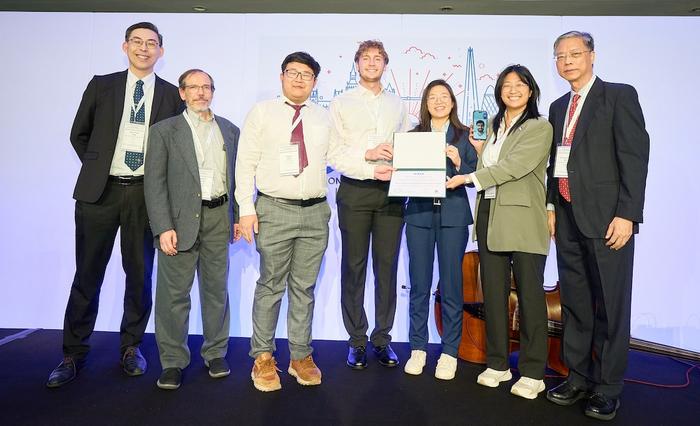
Rice University has made headlines in the engineering world following the remarkable achievement of its student team, known as WRIST, which recently took first place in the prestigious IEEE Circuits and Systems Society (CASS) Student Design Competition held in London. The competition showcased innovative solutions from students around the globe, and Rice’s entry stood out for its originality and potential in revolutionizing the way humans interact with virtual environments. This wearable haptic wristband device promises to enhance user experiences in virtual reality (VR) and human-computer interaction by delivering a new level of tactile feedback previously unseen in consumer technology.
As technology continues to advance, the demand for immersive user experiences becomes ever more pronounced. The WRIST device, short for Wearable Radial Interface for Sensory Haptic feedback, emerges as a solution that strives to meet this need. This innovative wristband is designed to deliver a combination of radial squeeze and precise vibrotactile feedback in a lightweight and user-friendly form. By replacing traditional bulky devices with a sleek and modular design, the team has opened new possibilities for accessibility and functionality in both entertainment and educational technologies.
Equipped with an array of cutting-edge components, the WRIST device boasts a powerful DC motor that connects to a sophisticated radial spooling mechanism. This mechanism enables the soft, flexible band to deliver dynamic squeezes around the wrist, providing users with an authentic sense of pressure that aligns with their interactions in a virtual space. In addition to radial feedback, the device features five strategically placed linear resonant actuators that generate finely controlled vibrations. This combination creates a multi-layered sensory experience, allowing users to feel taps, pulses, and other dynamic cues as they navigate virtual environments.
One of the key features of the WRIST wristband is its impressive speed and responsiveness. The motor is capable of generating a force of up to 10 newtons in just a tenth of a second, escalating to 15 newtons in merely 0.3 seconds. Such rapid responsiveness is essential for simulated haptic interactions where users expect real-time feedback proportional to their actions. This responsiveness not only enhances the authenticity of virtual experiences but also broadens the scope for applications in training and educational tools, making the device a promising asset for various fields.
The development of WRIST involved meticulous engineering efforts, particularly in optimizing the motor and gearbox for high performance without inflating production costs. Team member Brendan Hlibok highlighted their innovative approach, which included utilizing a custom DC motor paired with a planetary gearbox, supported by encoder-based feedback control. This engineered solution allows for significant torque, quick response times, and reliable actuation, which are crucial for creating immersive VR experiences that are both enjoyable and practical.
Unlike many commercial haptic devices that often rely on external components and are limited in their feedback options, the WRIST device is designed to be entirely self-contained. All critical electronics, including the custom-printed circuit board, motor controller, and communication interfaces, are neatly integrated within the bracelet. This not only enhances the portability of the device but also simplifies its use in various settings. Controlled via a single USB-C cable connected to a laptop, WRIST is set to revolutionize interactions by allowing seamless integration into numerous applications, whether as part of gaming setups, educational tools, or even occupational training modules.
Furthermore, the wristband’s design focuses on comfort and adaptability. Made from a biocompatible thermoplastic polyurethane, the band can easily adjust to accommodate different wrist sizes, enabling long-lasting wear without discomfort. The embedded electrical connections have been engineered to flex safely along with the band, ensuring durability while maintaining a consistent functionality that does not interfere with user experience.
The modular nature of the WRIST device further enhances its appeal, particularly in educational institutions and research settings. Team members emphasized the significance of a design that can be easily replicated or repaired using common lab tools or 3D printing technologies. This accessibility is crucial as it allows aspiring engineers and researchers to experiment with advanced haptic feedback technologies without the financial burdens typically associated with high-end commercial equipment. In this way, WRIST becomes not only a tool for entertainment but a platform for innovation in educational environments.
To illustrate the potential applications of the WRIST technology, the team developed interactive environments using Unity, a popular game engine for VR development. These immersive simulations include scenarios where users can experience physical feedback as they engage with virtual elements—like feeling the sensation of a squeeze when pressing virtual buttons or experiencing increasing pressure while simulating the draw of a bowstring in archery. Such immersive experiences provide valuable insights into how haptic feedback can enhance user interactions in various contexts, from gaming to professional training.
As the competition drew to a close, the team garnered attention not just for their technical prowess but for their ability to communicate their design and ideas effectively, a testament to their preparation and mentorship from Rice University faculty. Joseph Cavallaro, a professor and chair of the IEEE CASS Houston chapter, noted the team’s ingenuity and the significant challenges they addressed in the development of haptic technology—particularly concerning cost, form factor, and multimodality.
The WRIST project exemplifies the innovative spirit at Rice University, showcasing what undergraduate engineering students can achieve when equipped with vision, support, and mentorship. Their success at the IEEE CASS Student Design Competition reflects not just technical excellence but also the significance of collaborative learning and persistence. With the team’s aspirations to make haptic feedback technology accessible and functional, WRIST stands as a beacon of future possibilities in engineering, user experience design, and beyond.
This remarkable achievement is just the beginning for the WRIST team. The potential applications of their technology range broadly across industries and fields. As users seek more immersive experiences in gaming, education, and even therapy, WRIST’s advancement represents a critical step forward in transcending the limitations of current haptic feedback systems. With ongoing developments and potential future enhancements, the WRIST team is poised to redefine user interaction with digital environments, setting the stage for exciting new possibilities in the evolving intersection of engineering and user experience.
Ultimately, WRIST encapsulates a significant stride towards future innovations in wearable technology. By fostering greater accessibility and improving tactile feedback in virtual environments, the project addresses crucial gaps presently faced in the VR landscape. As virtual reality continues to gain relevance, devices like WRIST promise to enhance the way we interact with both games and professional training, making tactile engagement more realistic and intuitive. As this team continues their groundbreaking work, they are surely shaping the future of haptic technology to be more user-centric and versatile than ever before.
Keywords
Wearable devices, Haptic feedback technology, Virtual reality, User interaction, Robotic engineering, Electrical engineering, Mechanical engineering, Immersive experiences.
Cite Scienmag News
Alan Morgan. (June 10, 2025). Rice University Students Secure Top Honors in Global Design Competition with Innovative Haptic Wristband. Scienmag. https://scienmag.com/rice-university-students-secure-top-honors-in-global-design-competition-with-innovative-haptic-wristband/
Alan Morgan. "Rice University Students Secure Top Honors in Global Design Competition with Innovative Haptic Wristband." Scienmag, 10 June 2025, https://scienmag.com/rice-university-students-secure-top-honors-in-global-design-competition-with-innovative-haptic-wristband/. Accessed 1 September 2026.
Alan Morgan. "Rice University Students Secure Top Honors in Global Design Competition with Innovative Haptic Wristband." Scienmag. June 10, 2025. https://scienmag.com/rice-university-students-secure-top-honors-in-global-design-competition-with-innovative-haptic-wristband/


