


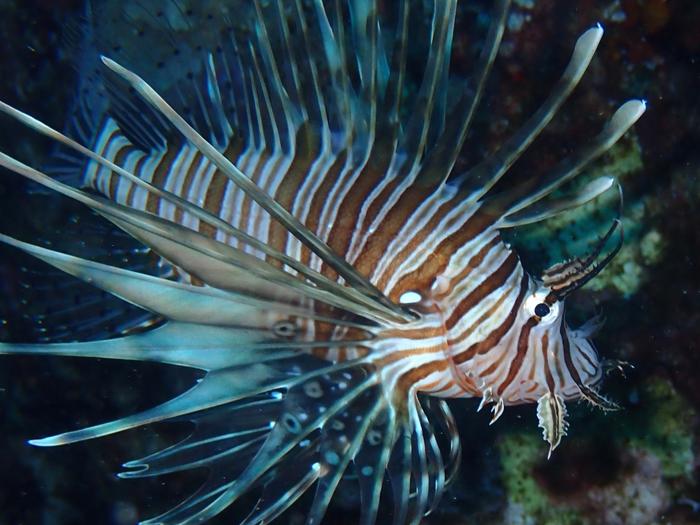
Researchers from Wageningen University and Research, the Netherlands, have published a comprehensive study on the invasion of lionfish in the Mediterranean Sea, highlighting a rapid spread and the potential ecological impacts.

Credit: Pierre mkrs via Wikimedia commons
Researchers from Wageningen University and Research, the Netherlands, have published a comprehensive study on the invasion of lionfish in the Mediterranean Sea, highlighting a rapid spread and the potential ecological impacts.
Published in the open-access journal NeoBiota, the research shows the lionfish species Pterois miles has significantly expanded its territory in the Mediterranean since the invasion began around ten years ago. The invasive species has established presence in the eastern Mediterranean, with observations now extending to colder waters previously thought to be unsuitable for the species.
Originating from the Indo-Pacific region, the lionfish species Pterois miles and Pterois volitans are regarded as the most successful invasive fishes in marine ecosystems, with the capacity to drastically affect local fish communities and biodiversity in invaded areas.
Lionfish are generalist predators and impact ecosystems by preying extensively on local fishes, including endemics of high conservation value. As they are unaccustomed to lionfish, native prey species usually do not flee from this new predator.
“After years studying these predators, I find it amazing how they can easily adjust to so many different environments and be successful in areas that are so different from the ones where they evolve,” says lead author Davide Bottacini.
“It is always impressive to see how such a flamboyant and–to us–conspicuous predator can approach its prey without being noticed,” he continues.
As the largest enclosed sea on earth, the Mediterranean is a unique ecosystem. It is a highly biodiverse basin home to more than 11,000 animal species, some of which are found nowhere else in the world. Genetic studies revealed that lionfish found in the Mediterranean originate from the Red Sea and likely entered through the Suez Canal.
Through a detailed review of existing scientific data, the researchers identified gaps in our understanding of the lionfish’s interactions with Mediterranean ecosystems and have proposed future research directions to address these challenges. Such information provides insights vital for biodiversity conservation and will have practical implications for policy makers aiming to devise sound and efficient mitigation plans.
The study also highlights the crucial role of citizen science initiatives in tracking and reporting sightings of lionfish, providing valuable data that supports ongoing research efforts. Such community involvement is essential for enhancing understanding of the invasion dynamics and devising effective control measures.
Original source
Bottacini D, Pollux BJA, Nijland R, Jansen PA, Naguib M, Kotrschal A (2024) Lionfish (Pterois miles) in the Mediterranean Sea: a review of the available knowledge with an update on the invasion front. NeoBiota 92: 233–257.
Journal
NeoBiota
Article Title
Lionfish (Pterois miles) in the Mediterranean Sea: a review of the available knowledge with an update on the invasion front
Article Publication Date
25-Apr-2024
Cite Scienmag News
Drew Townsend. (April 25, 2024). Unveiling the lionfish invasion in the Mediterranean Sea. Scienmag. https://scienmag.com/unveiling-the-lionfish-invasion-in-the-mediterranean-sea/
Drew Townsend. "Unveiling the lionfish invasion in the Mediterranean Sea." Scienmag, 25 April 2024, https://scienmag.com/unveiling-the-lionfish-invasion-in-the-mediterranean-sea/. Accessed 4 September 2026.
Drew Townsend. "Unveiling the lionfish invasion in the Mediterranean Sea." Scienmag. April 25, 2024. https://scienmag.com/unveiling-the-lionfish-invasion-in-the-mediterranean-sea/

