


Spintronics is a field garnering immense attention for its range of potential advantages for conventional electronics. These include reducing power consumption, high-speed operation, non-volatility, and the potential for new functionalities.

Credit: Yusuke Nambu
Spintronics is a field garnering immense attention for its range of potential advantages for conventional electronics. These include reducing power consumption, high-speed operation, non-volatility, and the potential for new functionalities.
Spintronics exploits the intrinsic spin of electrons, and fundamental to the field is controlling the flows of the spin degree of freedom, i.e., spin currents. Scientists are constantly looking at ways to create, remove, and control them for future applications.
Detecting spin currents is no easy feat. It requires the use of macroscopic voltage measurement, which looks at the overall voltage changes across a material. However, a common stumbling block has been a lack of understanding into how this spin current actually moves or propagates within the material itself.
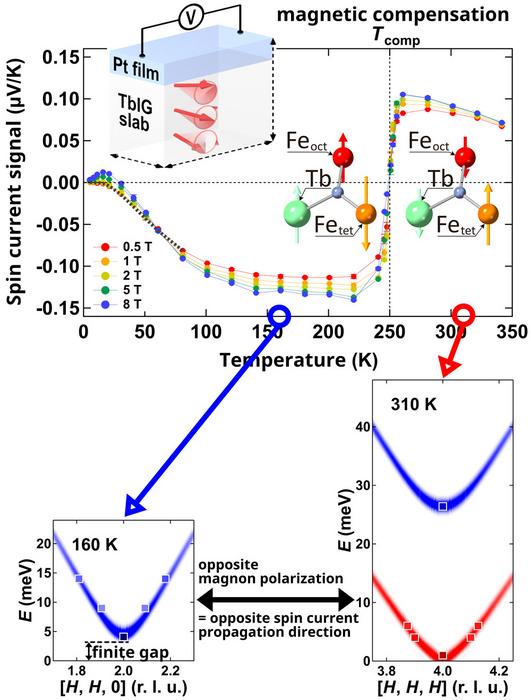
“Using neutron scattering and voltage measurements, we demonstrated that the magnetic properties of the material can predict how a spin current changes with temperature,” points out Yusuke Nambu, co-author of the paper and an associate professor at Tohoku University’s Institute for Materials Research (IMR).”
Nambu and his colleagues discovered that the spin current signal changes direction at a specific magnetic temperature and decreases at low temperatures. Additionally, they found that the spin direction, or magnon polarization, flips both above and below this critical magnetic temperature. This change in magnon polarization correlates with the spin current’s reversal, shedding light on its propagation direction.
Furthermore, the material studied displayed magnetic behaviors with distinct gap energies. This suggests that below the temperature linked to this gap energy, spin current carriers are absent, leading to the observed decrease in the spin current signal at lower temperatures. Remarkably, the spin current’s temperature dependence follows an exponential decay, mirroring the neutron scattering results.
Nambu emphasizes that their findings underscore the significance of understanding microscopic details in spintronics research. “By clarifying the magnetic behaviors and their temperature variations, we can gain a comprehensive understanding of spin currents in insulating magnets, paving the way for predicting spin currents more accurately and potentially developing advanced materials with enhanced performance.”
Cite Scienmag News
Denise Maddox. (April 23, 2024). Unlocking spin current secrets: a new milestone in spintronics. Scienmag. https://scienmag.com/unlocking-spin-current-secrets-a-new-milestone-in-spintronics/
Denise Maddox. "Unlocking spin current secrets: a new milestone in spintronics." Scienmag, 23 April 2024, https://scienmag.com/unlocking-spin-current-secrets-a-new-milestone-in-spintronics/. Accessed 4 September 2026.
Denise Maddox. "Unlocking spin current secrets: a new milestone in spintronics." Scienmag. April 23, 2024. https://scienmag.com/unlocking-spin-current-secrets-a-new-milestone-in-spintronics/

