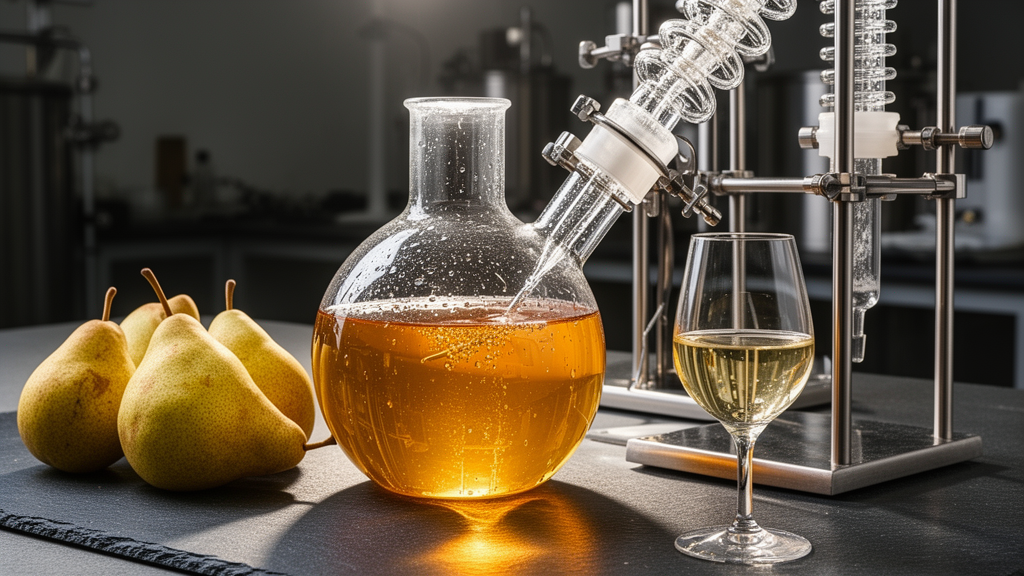
The team found that a Brix level of 35° represented the optimal concentration for producing high-quality pear wine, offering a viable alternative to the common practice of adding sugar to fruit juices.
Pears are highly perishable and prone to rapid spoilage during ambient-temperature storage, while low-temperature storage requires significant energy consumption and cost. These limitations make it difficult to address the seasonal overproduction of pears. Processing pears into novel products, such as fruit wine, represents an effective way to solve these issues while significantly enhancing their economic value. However, the quality of pear wine is heavily influenced by the initial Brix level of the juice, which determines the ethanol concentration and subsequently impacts the aroma profile.
Previous studies have shown that using non-concentrated pear juice, which typically has a Brix level of about 10.9°, results in pear wine with an alcohol concentration lower than 5% ABV. This low alcohol level leads to severe flavor impairment. While adding sugar to pear juice is a common method to increase alcohol concentration, it can cause flavor imbalance and impair consumer acceptance. Consequently, there is a need for alternative approaches to increase the Brix level of pear juice without introducing external sugars that disrupt the natural flavor profile.
Vacuum concentration is a method that removes water from fruit juice, thereby increasing its Brix level. It is widely employed in the commercial production of concentrated fruit juice. The application of vacuum concentration in fruit wine production has been relatively limited, particularly in pear wine. Theoretical analysis and experimental results suggest that vacuum concentration not only increases the initial Brix level but also enhances nutrient contents, such as polyphenols, betaine, and ascorbic acid, and antioxidant capacity. Additionally, it can reduce the initial microbial load, making it a promising approach for improving pear wine quality.
In this study, researchers used ‘Huangjin’ pear fruits, which were frozen at −40°C for seven days before being peeled, pitted, and pressed to obtain the juice. The juice was concentrated to 40° Brix using a rotary evaporator at 65°C and 50 rpm. Samples with Brix levels of 20°, 25°, 30°, and 35° were prepared by diluting the concentrated juice. A commercialized yeast containing Saccharomyces cerevisiae was used as the fermentation agent. The fermentation process was carried out at 20°C for seven days, with daily stirring to remove gas, followed by filtration to obtain the pear wine.
The physicochemical properties of the pear juice and wine samples were evaluated, including appearance, color, browning index, pH, and total acids. The color of the samples changed from light brown to deep brown as the initial Brix level increased from 20° to 40°. The total color difference (ΔE) of pear juice to the corresponding pear wine differed significantly, particularly from 30° to 40°. The browning index (BI) of pear wine increased from 1.58 to 1.90 as the Brix level rose from 20° to 25°, followed by a plateau, and then decreased from 2.08 to 1.73 when the Brix level increased from 35° to 40°. This suggests that the fermentation process significantly affects the BI levels of pear wine.
The concentrations of fructose, glucose, sucrose, and sorbitol were measured in the pear juice and wine samples. In the 40° Brix pear juice, fructose was the most abundant sugar at 199.38 mg/mL, followed by sorbitol at 124.59 mg/mL. Fructose, glucose, and sucrose were not detected in pear wine samples with initial Brix levels from 20° to 35°, indicating that they were completely metabolized by Saccharomyces cerevisiae. However, at the 40° Brix level, residual concentrations of glucose, fructose, and sucrose were detected at 8.46 mg/mL, 39.56 mg/mL, and 0.19 mg/mL, respectively. Sorbitol was partially consumed by the yeast, with its concentration in wine remaining lower than in the juice.
The antioxidant activity of the pear juice and wine samples was assessed using ABTS+ and DPPH radical scavenging assays. The ABTS+ radical scavenging rate of pear wine rose from 50.80% to 89.00% as the initial Brix level increased from 20° to 40°. The DPPH radical scavenging rate also increased significantly, from 48.30% to 72.79% for the corresponding wine samples. These results indicate that increasing the Brix level of pear juice significantly enhances the antioxidant activity of the pear wine. The concentrations of individual antioxidant compounds, such as quinic acid, arbutin, and vanillic acid, were also analyzed. Quinic acid was the most common compound in the 40° pear juice, and its concentration in the corresponding wine was significantly higher than in the juice.
The alcohol and methanol concentrations in the pear wine were determined to evaluate safety and quality. The concentration of alcohol increased from 7.0% ABV to 15.0% ABV as the Brix level of pear juice increased from 20° to 35°. The methanol concentration increased from 0.095 g/100 mL to 0.182 g/100 mL as the Brix level rose from 20° to 40°. These levels did not exceed the safety standards set by the National Food Safety Standard of the People’s Republic of China, the U.S. Food and Drug Administration, or the European Union. This demonstrates that using the vacuum concentration method to increase the initial Brix level does not increase the safety risk of methanol in pear wine.
Electronic tongue analysis and volatile flavor compound analysis were conducted to evaluate the taste and aroma of the pear wine. The E-tongue results showed that as the Brix level rose from 20° to 40°, the values of sourness, bitterness, astringency, and aftertaste decreased significantly, while umami, richness, and saltiness increased. Volatile flavor compounds were analyzed using headspace solid phase microextraction coupled with gas chromatography-mass spectrometry. Sixty volatile compounds were identified, categorized into six classes. The number of volatile compounds was greater at 35° and 40° Brix levels than at 20° and 25° Brix levels. The concentrations of key odor compounds, such as methionol, phenylethyl alcohol, and benzeneacetaldehyde, varied with the Brix level, with some showing higher concentrations at the 40° Brix level.
Sensory evaluation was performed by eighteen trained evaluators to assess the overall quality of the pear wine samples. The initial Brix level significantly affected all sensory parameters, including color, luster, clarity, aroma, harmony, sourness and sweetness, alcoholic taste, and characteristics. The total sensory scores of the pear wine samples were 39.46, 58.22, 69.68, 75.76, and 73.10 for 20°, 25°, 30°, 35°, and 40° Brix, respectively. The pear wine had the highest sensory score when the initial Brix level was 35°. This finding suggests that 35° Brix is the optimal concentration for producing high-quality pear wine using the vacuum concentration method.
The study concludes that vacuum concentration is an effective approach for improving the overall quality of pear wines and alleviating the seasonal oversupply of pear fruits. However, the study was limited to one pear cultivar (‘Huangjin’) and one commercial yeast strain. Different pear cultivars and yeast strains may differ in sugar composition, nitrogen sources, and ester-synthesizing capacity, potentially affecting the optimal Brix level and flavor compounds in pear wine. Therefore, additional studies are needed to verify these findings with different pear cultivars and yeast strains to fully understand the impact of vacuum concentration on pear wine quality.
Subject of Research: Vacuum concentration of pear juice for improving wine quality
Article Title: Vacuum concentration of pear juice for improving wine quality
Article References: Zhao, B., Fan, C., Chen, Q., Yang, X., Xu, Z., & Yi, X. (2026). Vacuum concentration of pear juice for improving wine quality. Journal of Agriculture and Food Research, 32, Article 103422. https://doi.org/10.1016/j.jafr.2026.103422
Image Credits: AI Generated
DOI: 10.1016/j.jafr.2026.103422
Keywords: Vacuum, concentration, pear, juice, improving, wine, quality, scientific research
Cite Scienmag News
Alan Morgan. (November 9, 2026). Vacuum Concentration Improves Pear Wine Quality. Scienmag. https://scienmag.com/vacuum-concentration-improves-pear-wine-quality/
Alan Morgan. "Vacuum Concentration Improves Pear Wine Quality." Scienmag, 9 November 2026, https://scienmag.com/vacuum-concentration-improves-pear-wine-quality/. Accessed 9 November 2026.
Alan Morgan. "Vacuum Concentration Improves Pear Wine Quality." Scienmag. November 9, 2026. https://scienmag.com/vacuum-concentration-improves-pear-wine-quality/