


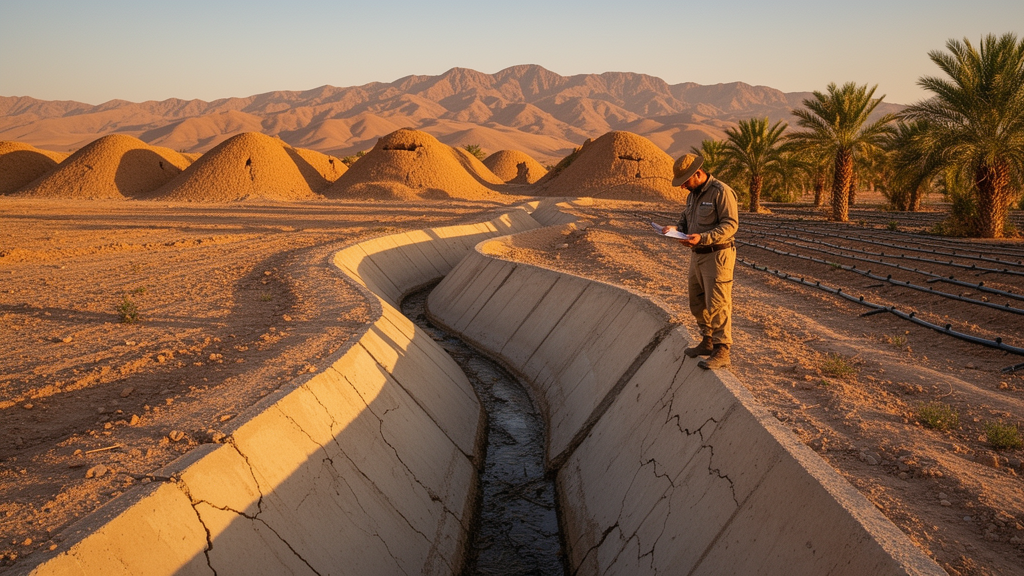
Researchers have published a comprehensive assessment of drinking water resource management and distribution networks in Bajestan, a hyper-arid city in northeastern Iran. The study, appearing in Applied Water Science, focuses on the specific challenges associated with groundwater desalination and the logistical burdens imposed on local residents. By integrating social, managerial, and technical dimensions, the research provides a detailed analysis of the current drinking water distribution network (DWDN) and drinking water resources (DWR) in the region. The primary objective was to evaluate the performance of these systems and identify critical areas for improvement to ensure long-term sustainability and public health safety.
Bajestan faces severe limitations in the availability of high-quality water resources due to its hot and arid climate, with an average annual rainfall of only 150 millimeters. The urban population of the catchment area is estimated at approximately 14,032 residents. In this environment, high-quality groundwater is predominantly allocated to agricultural use due to ownership restrictions, which exacerbates the limitations in urban drinking water supply. Consequently, the city relies heavily on saline groundwater extracted from nearby playas, which requires costly desalination processes to become suitable for human consumption.
The current water supply system involves transporting saline groundwater with electrical conductivity levels ranging between 5,000 and 10,000 microsiemens per centimeter. This water is pumped over a pipeline distance of 24 kilometers and an elevation difference of 400 meters to a specialized desalination facility. After treatment, the salinity is reduced to approximately 500 microsiemens per centimeter, making it safe for drinking. However, this process incurs significant energy costs and financial burdens, raising concerns about the long-term economic and environmental sustainability of the system.
To assess the social and managerial aspects of the water system, the study employed a multi-criteria decision-making approach involving three distinct stakeholder groups: the general public, water-sector experts, and academic professionals. The public survey was conducted through door-to-door visits in three urban textures: traditional neighborhoods, new villa developments, and apartment complexes. A total of 102 valid questionnaires were collected and analyzed using the Technique for Order Preference by Similarity to Ideal Solution (TOPSIS) to prioritize areas for network improvement.
The TOPSIS analysis revealed that apartment complexes had the highest relative priority for the implementation of new or revised DWDN solutions, followed by new villa areas and traditional neighborhoods. This ranking suggests that apartment residents may be more receptive to infrastructure changes, potentially due to younger demographics and greater familiarity with digital tools such as smart-card-based water access. In contrast, traditional neighborhoods showed the lowest priority, possibly reflecting older population profiles and stronger reliance on established water-supply practices.
Expert opinions were gathered through the Analytic Hierarchy Process (AHP), which evaluated eight main criteria and 36 sub-criteria related to DWDN performance. The results highlighted electrical conductivity as the most critical factor within the water quality criterion, underscoring the importance of controlling salinity. Additionally, kidney diseases were identified as the most significant health concern within the disease reduction criterion. Experts also emphasized the need to reduce water loss and improve physical accessibility, noting that the current method of collecting water from withdrawal stations imposes a considerable logistical burden on households.
The academic survey utilized a SWOT analysis to evaluate the strategic and managerial aspects of both the DWDN and DWR. The analysis identified substantial internal weaknesses and external threats for both systems. For the DWDN, the internal weakness score was 3.83 and the external threat score was 3.52, placing the system in the “Reserved Strategy” zone of the SWOT matrix. Similarly, the DWR assessment yielded weakness and threat scores of 3.55 and 3.66, respectively, also indicating a Reserved Strategy position. This strategic placement suggests that immediate planning should focus on stabilization, vulnerability reduction, and gradual improvement rather than large-scale expansion.
Based on the integrated findings from the public, expert, and academic assessments, the study proposes a conceptual framework known as the Home Dual Drinking Water Distribution Network (HD-DWDN). This model aims to separate potable and sanitary water supplies at the household level through dedicated distribution lines. By doing so, it seeks to reduce reliance on centralized Drinking Water Withdrawal Stations and manual barrel-based water collection. The HD-DWDN is presented as a context-specific management recommendation derived from the identified deficiencies and stakeholder priorities, rather than a tested intervention.
The study also recommends reallocating high-quality Qanat-derived water currently used in agriculture to urban drinking water supply. This suggestion addresses the legal and ownership constraints that currently limit access to safer water sources for domestic use. The researchers emphasize that improving water governance and planning in hyper-arid settings requires a coordinated approach that considers technical, economic, social, and institutional factors. Strengthening infrastructure management, improving monitoring systems, and enhancing inter-organizational coordination are identified as key steps toward achieving this goal.
The findings of this study provide a conceptual foundation for enhancing water management in similarly arid and resource-constrained regions. By highlighting the interconnected challenges of water quality, accessibility, and infrastructure condition, the research offers valuable insights for policymakers and water managers. The proposed HD-DWDN framework and the emphasis on stakeholder engagement offer potential pathways for improving the resilience and sustainability of drinking water systems in hyper-arid environments. Future research should focus on testing the technical and economic feasibility of these alternative configurations to ensure their effective implementation.
The study’s statistical analysis of the public survey data examined the relationships between five specific dimensions of household drinking-water management and the optimization of drinking-water consumption. These dimensions included economic factors, social dimensions, service accessibility, sanitary and quality factors, and cultural norms. The researchers employed five separate bivariate linear regression models to evaluate these relationships, rather than a single multiple regression model. This methodological choice means that the reported coefficients represent unstandardized associations between each individual dimension and the optimization score, without controlling for the influence of the other variables. Consequently, the findings should be interpreted as bivariate associations rather than causal effects or mutually adjusted partial effects. The analysis revealed that all five dimensions had statistically significant positive associations with drinking-water optimization. Service accessibility demonstrated the strongest association, explaining approximately 80.7% of the variance in the optimization score. This was followed by sanitary and quality factors, which explained about 67.3% of the variance, and cultural norms, which accounted for roughly 53.8%. Social dimensions explained approximately 51.3% of the variance, while economic factors explained about 34.5%. These results suggest that physical access to water and perceived water quality are particularly strongly linked to household drinking-water optimization in the surveyed population.
The expert survey, analyzed using the Analytic Hierarchy Process, provided detailed insights into the relative importance of various factors influencing the drinking water distribution network. Among the eight main criteria evaluated, water quality was a dominant concern, with electrical conductivity receiving the highest local weight of 0.59112. This finding is particularly relevant to Bajestan, where groundwater salinity is a major challenge. The high weight assigned to electrical conductivity underscores the critical importance of controlling salinity and improving the physicochemical quality of the supplied water. In the disease reduction criterion, kidney diseases were identified as the most significant health concern, with a local weight of 0.5941, substantially higher than digestive, skin, or ocular diseases. This highlights the public health implications of ensuring access to high-quality drinking water in arid regions. Regarding accessibility, the sub-criterion of moving gallons received the highest weight, reflecting the practical burden residents face when transporting water from withdrawal stations to their homes. For water conservation, reducing water loss was the dominant sub-criterion, with a local weight of 0.64081, indicating that experts view minimizing losses within the supply system as a crucial component of conservation efforts.
The academic survey’s SWOT analysis identified specific internal weaknesses and external threats that constrain the current water systems. For the drinking water resources, internal weaknesses included poor management of water resources, reduction in the quality of water transferred to the plain, and adverse environmental effects. Other significant weaknesses involved insufficient knowledge of groundwater conditions, poor management of agricultural water consumption, and a lack of an integrated organizational structure for water-resource management. External threats included drought and climate change, changes in investment costs for water-transfer projects, and the vulnerability of water resources to floods and earthquakes. The analysis also noted the inadequacy and lack of sustainability of available water resources as a major external threat. These findings suggest that the current drinking-water resource system is affected by substantial internal limitations while simultaneously facing significant external pressures. The Reserved Strategy position derived from the SWOT matrix indicates that the system does not currently possess sufficient internal strengths to offset these identified weaknesses.
The study’s recommendations emphasize a coordinated and gradual approach to improving drinking-water security in Bajestan. The researchers suggest that the physical condition of the distribution network and withdrawal stations should be systematically assessed, with regular inspection, maintenance, and rehabilitation programs established to reduce leakage and service interruptions. Strengthening monitoring and information systems through digital and smart-monitoring technologies is also recommended to improve the detection of system losses and water-quality conditions. Accessibility should be improved by reducing the physical and logistical burden associated with transporting water from withdrawal stations to households. Water-quality management should remain a central priority, particularly regarding salinity and other physicochemical characteristics. Institutional coordination and public participation need to be strengthened to improve trust and support water-conservation behavior. Financial and planning mechanisms should be enhanced to support the long-term sustainability of the system, ensuring that future interventions are evaluated for technical performance, economic feasibility, environmental implications, and social equity. The conceptual HD-DWDN framework and alternative supply configurations should be regarded as potential future management options requiring further technical, economic, environmental, and institutional feasibility assessment before implementation.
Subject of Research: Assessment of drinking water resource management and distribution networks in hyper-arid Iran
Article Title: Assessing drinking water resource management and distribution networks in hyper-arid Iran: a focus on groundwater desalination
Article References: Mohammadzadeh, F., Adam, E., Ekhtesasi, M. R., & Hashemi, H. (2026). Assessing drinking water resource management and distribution networks in hyper-arid Iran: a focus on groundwater desalination. Applied Water Science, 16(10), Article 289. https://doi.org/10.1007/s13201-026-02979-8
Image Credits: AI Generated
DOI: 10.1007/s13201-026-02979-8
Keywords: drinking water, hyper-arid regions, groundwater desalination, water management, Iran, public health, infrastructure, SWOT analysis, AHP, TOPSIS, Assessing, drinking
Cite Scienmag News
Violet Maxwell. (November 9, 2026). Study Evaluates Water Management Challenges in Hyper-Arid Iran. Scienmag. https://scienmag.com/study-evaluates-water-management-challenges-in-hyper-arid-iran/
Violet Maxwell. "Study Evaluates Water Management Challenges in Hyper-Arid Iran." Scienmag, 9 November 2026, https://scienmag.com/study-evaluates-water-management-challenges-in-hyper-arid-iran/. Accessed 18 November 2026.
Violet Maxwell. "Study Evaluates Water Management Challenges in Hyper-Arid Iran." Scienmag. November 9, 2026. https://scienmag.com/study-evaluates-water-management-challenges-in-hyper-arid-iran/




