This finding addresses a significant bottleneck in the use of microalgae as sustainable platforms for producing high-value recombinant proteins, particularly those requiring glycosylation for therapeutic applications. The study, published in Current Genetics, shows that when the 8xHis affinity tag is internalized rather than exposed at the C-terminus, the proteins can be successfully captured using Ni-NTA chromatography.
The challenge of purifying secreted proteins from Chlamydomonas has persisted despite the theoretical advantage of the low protein complexity in the culture medium. Previous attempts to purify recombinant proteins, such as the SARS-CoV-2 spike protein ectodomain, using C-terminal poly-histidine tags have often proven inefficient. The authors hypothesized that this difficulty might stem from proteolytic activity that truncates C-terminally exposed affinity tags, a phenomenon previously observed in the protist Leishmania tarentulae.
To test this hypothesis, the research team generated three distinct genetic constructs for the production of the methionine-rich 2S albumin from Bertholletia excelsa. These constructs featured the 8xHis affinity tag at different positions relative to the SP20 glycomodule and the HA epitope. One variant placed the tag at the C-terminus (SP20-HA-8xHis), while the other two internalized the tag (8His-SP20-HA and SP20-8His-HA). All constructs included the synthetic SP20 module, consisting of 20 serine/proline repeats, which has been shown to enhance the yield of secreted proteins in Chlamydomonas severalfold.
The team transformed these constructs into the Chlamydomonas strain UVM4, which had been previously modified to enable growth on nitrate. They screened twelve spectinomycin-resistant transformants for each construct by precipitating proteins from the culture medium and detecting the secreted 2S albumin via immunoblotting using an antibody against the HA epitope. Eight to eleven of the twelve transformants per construct tested positive, confirming successful secretion of the recombinant protein. The best-expressing transformants were then grown in 100 ml of TAP medium to stationary phase, a stage when secretion of recombinant proteins is typically highest.
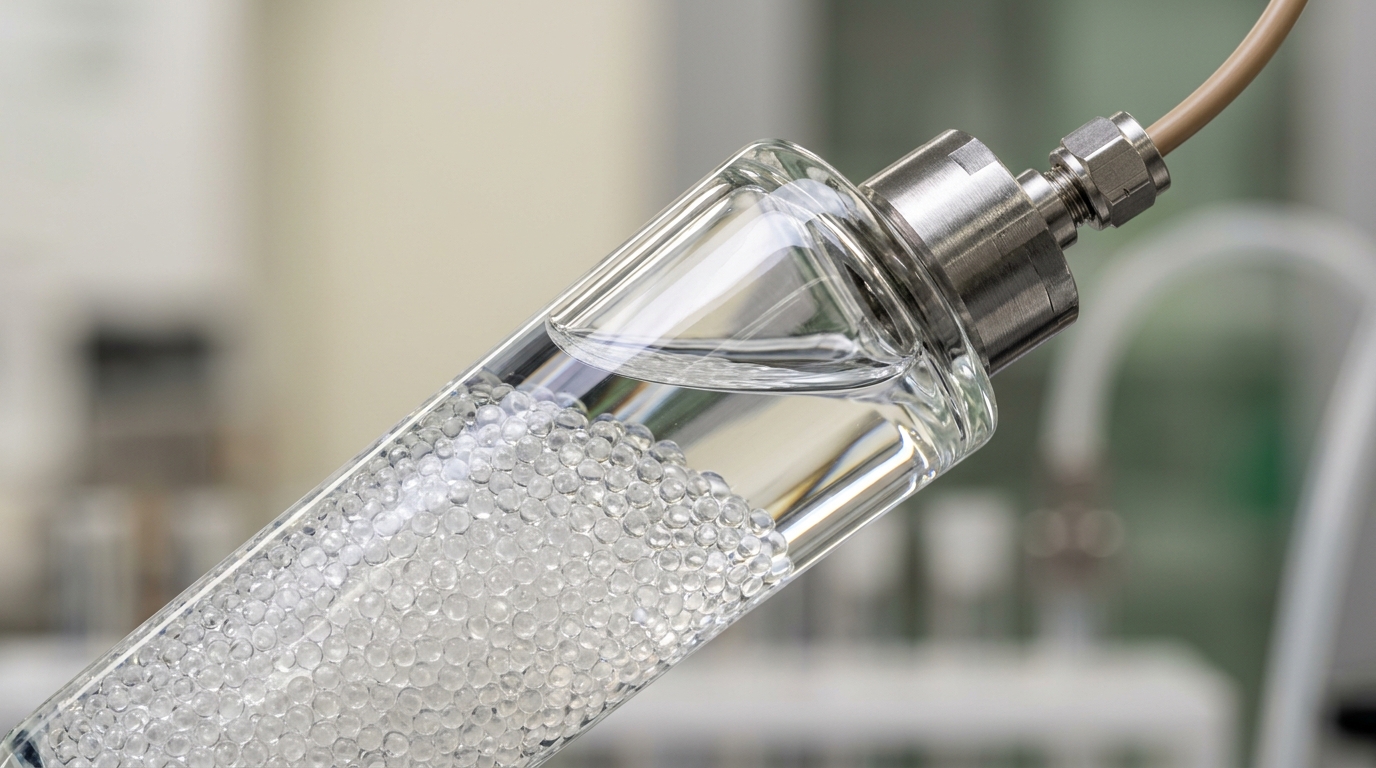
When the cell-free culture medium was subjected to Ni-NTA affinity chromatography, the results clearly distinguished between the tag positions. The 2S albumin variant with the C-terminally exposed 8xHis tag was not depleted in the column flow-through and was absent from the eluates. This indicated that the exposed tag was unsuitable for affinity purification, likely due to the hypothesized proteolytic cleavage. In contrast, the variants with the internalized 8xHis tag were efficiently depleted from the flow-through and enriched in the eluates, demonstrating that internalization enables effective purification.
To estimate the yield and purity of the purified protein, the researchers performed Ni-NTA affinity purification using 100 ml of culture medium from the 2S albumin variant containing the 8His-SP20-HA sequence. After separating 85% of the total eluted protein by SDS-PAGE and staining with Coomassie Blue, the purified 2S albumin migrated with an apparent molecular mass of approximately 40 kDa. This is significantly larger than the calculated mass of 21.2 kDa after signal peptide cleavage, a discrepancy attributed to glycosylation of the SP20 glycomodule. The gel showed few impurities and no degradation products, indicating high purity.
Densitometric quantification of the Coomassie-stained bands, using bovine serum albumin as a standard in three independent replicates, estimated a yield of 31 ± 10.9 µg of recombinant protein per liter of culture. While this yield is promising for visualizing the protein, the authors note that it remains low for commercial purposes. They suggest that an improvement of at least 100-fold is necessary for industrial applications, which could be achieved through cultivation in high-density media and further optimization of secretion rates.
To validate the general applicability of this approach, the team also tested the internalized tag with the SARS-CoV-2 spike protein ectodomain. They assembled the coding sequence for the spike protein with the 8His-SP20-HA motifs and transformed the construct into Chlamydomonas. Six out of 26 transformants produced detectable levels of the recombinant spike protein. Similar to the 2S albumin results, the internalized 8xHis tag enabled successful purification of the spike protein from the culture medium via Ni-NTA affinity chromatography.
The purified spike protein migrated with an apparent molecular mass of approximately 200 kDa, which is much larger than the calculated mass of 139 kDa. This increase is likely due to the glycosylation of the SP20 glycomodule and the realization of N-linked glycans in the spike protein. The spike protein exhibited several degradation products, most prominently at approximately 96, 85, and 48 kDa, reflecting its known instability. Densitometric estimation yielded 23.3 ± 3.7 µg of recombinant spike protein per liter of culture.
The authors suggest that the successful purification of these proteins indicates that unassembled cell wall proteins, which can accumulate and aggregate in extracellular space, do not pose a significant problem for affinity purification. The efficient depletion of the tagged proteins from the culture medium supports the hypothesis that proteolytic removal of exposed tags is the primary cause of purification failure. This finding opens the door for the use of Chlamydomonas as a viable platform for producing human therapeutic proteins that require glycosylation.
However, the study highlights that the low yield of recombinant protein remains a critical challenge. The authors propose several strategies to boost production, including the cultivation of transgenic lines in medium supporting high cell densities, the selection of more efficient signal peptides, and the enhancement of protein folding capacity in the endoplasmic reticulum. They also suggest fusing target proteins with easily detectable reporters, such as luciferase or fluorescent proteins, to facilitate the screening of high-expressing transformants.
Furthermore, the degradation of unstructured C-termini in secreted recombinant proteins could lead to protein heterogeneity, which is a concern for therapeutic applications. The authors propose incorporating cleavage sites for highly specific proteases, such as tobacco etch virus or PreScission protease, upstream of the affinity tag. This would allow for precise tag removal and the elimination of other undesired sequences, such as the SP20 glycomodule, upon elution of the target protein.
This study represents an important step toward establishing Chlamydomonas as a sustainable host for the production of high-value recombinant proteins. By overcoming the technical hurdle of affinity purification through tag internalization, the research provides a practical solution for a long-standing problem in microalgal biotechnology. While further improvements in yield are needed for commercial viability, the ability to efficiently purify secreted proteins is a crucial milestone for the development of this platform.
Subject of Research: Optimization of recombinant protein purification in Chlamydomonas reinhardtii through affinity tag internalization
Article Title: Internalization of affinity tags enables the purification of secreted Chlamydomonas proteins
Article References: Probst, A., Knochenhauer, D., Niemeyer, J., Fischer, L., & Schroda, M. (2025). Internalization of affinity tags enables the purification of secreted Chlamydomonas proteins. Current Genetics, 71(1), Article 7. https://doi.org/10.1007/s00294-025-01311-2
Image Credits: AI Generated
DOI: 10.1007/s00294-025-01311-2
Keywords: Chlamydomonas reinhardtii, affinity purification, recombinant proteins, microalgae biotechnology, Ni-NTA chromatography, secretory pathway, glycosylation, SARS-CoV-2 spike protein, 2S albumin, protein engineering, Internalization, affinity
Cite Scienmag News
Drew Townsend. (November 8, 2026). Moving Affinity Tags Inside Proteins Fixes Purification Issues. Scienmag. https://scienmag.com/moving-affinity-tags-inside-proteins-fixes-purification-issues/
Drew Townsend. "Moving Affinity Tags Inside Proteins Fixes Purification Issues." Scienmag, 8 November 2026, https://scienmag.com/moving-affinity-tags-inside-proteins-fixes-purification-issues/. Accessed 8 November 2026.
Drew Townsend. "Moving Affinity Tags Inside Proteins Fixes Purification Issues." Scienmag. November 8, 2026. https://scienmag.com/moving-affinity-tags-inside-proteins-fixes-purification-issues/