Aligning messenger RNA or protein sequences to a genome sounds like a solved problem, but the hardest part often comes down to two letters. In humans, more than 98 percent of introns begin with the dinucleotide GT and more than 99 percent end with AG, yet the genome contains hundreds of millions of GT and AG pairs, of which only about 0.1 percent are real splice sites. Picking the true junctions from this sea of decoys is a low signal-to-noise problem, and it is exactly where a new tool called minisplice claims a decisive improvement. In a study published in Algorithms for Molecular Biology, Siying Yang, Neng Huang and Heng Li describe a compact one-dimensional convolutional neural network with just 7,026 parameters that learns splice signals and, when plugged into the widely used aligners minimap2 and miniprot, substantially improves the accuracy of predicted splice junctions.
Spliced alignment, the task of mapping an mRNA or protein sequence onto a eukaryotic genome while accounting for introns, underpins gene annotation and the study of gene function. The difficulty is that the residue alignment around a splice site can be genuinely ambiguous: the same genome-mRNA pair can sometimes be aligned in several ways with no mismatches or gaps at all. Only the splice signals break the tie. Classical aligners model these signals with simple rules, most commonly a position weight matrix, which scores each position independently. The authors note that such matrices cannot capture dependencies between positions or regulatory motifs like branch points that lack fixed positions, and this weakness matters most when the sequences being aligned are dissimilar, because the aligner must then choose among many similarly scored candidate alignments.
Minisplice takes a different route. It is a command-line tool written in C, with zlib as its only external dependency, and it uses a small deep-learning library the team had previously built for identifying human centromeric repeats. The default model has two 1D-CNN layers with 16 features each. For every candidate splice site it examines a 202-base-pair window: 100 bases on each side of the GT or AG dinucleotide. Training data come from gene annotations supplied in BED12 format, with a script provided to convert GTF or GFF3 files. Annotated GT donors and AG acceptors are labeled positive; unannotated GT or AG sites on the opposite strand of a known gene serve as negatives, a trick that mitigates the problem of incomplete annotation in non-model organisms. Negatives are downsampled to a one-to-three positive-to-negative ratio.
A key design decision is that the model scores each donor or acceptor site independently, mirroring how minimap2 and miniprot evaluate candidate sites during dynamic-programming alignment. The raw model output, a number between zero and one, is not directly usable as a probability, so the authors calibrate it. They bin the raw scores, count annotated versus unannotated sites in each bin, and convert each bin into an empirical probability of being a real splice site. The transformed score is a log-odds against a null model in which every GT or AG is equally likely to be real, scaled by a factor of two to match the BLOSUM scoring matrices that miniprot uses. This calibration step is what allows the neural network’s output to slot cleanly into the aligners’ probability-based scoring system.
The authors found that mixing donor and acceptor training data into one joint model cost almost nothing in accuracy, simplifying the pipeline. They also tested window sizes: shrinking to 102 bases hurt accuracy, while expanding to 302 bases gave only a minor benefit. Visualization of the network’s internal activations showed why. Some features focus on the short-range signals right at the splice sites, while others capture the broader composition of exons and introns, with intronic sequence around acceptors providing more signal than around donors, possibly reflecting branch points located tens of bases upstream. The activation differences fade beyond 100 bases, explaining why a larger window adds little.
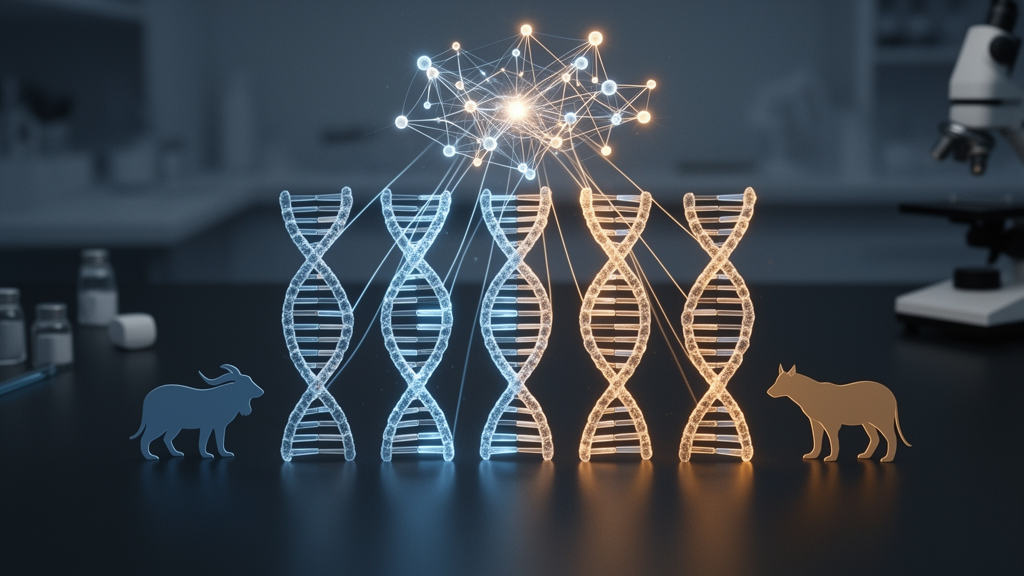
Cross-species behavior was a central question. When models trained on one species were applied to another, accuracy fell with evolutionary distance: a mouse-trained model performed almost as well on human as a human-trained model, while a mosquito-trained model dropped sharply on human but only modestly on fruitfly. The pooled vi2 model was not as accurate as species-specific models on their own genomes, but it outperformed applying an insect model to human, and it predicted splice sites accurately even in amphibian and shark genomes it had never seen during training. The authors interpret this as the network capturing conserved splice signals across large evolutionary distances while avoiding overfitting to individual species. They also trained vertebrate-only and insect-only variants, which performed slightly better within their groups, but judged the gain too small to outweigh the convenience of a single model.
An unexpected biological finding emerged from visualizing the trained network with UMAP. The samples separated into three clusters, corresponding to positive acceptors, negative sites and positive donors, but two regions of the map contained splice sites almost exclusively from mammals and birds. Human splice sites in these regions turned out to have GC content reaching 64 percent in the 100 intronic bases following the donor site, far above the human genome average of roughly 40 percent. Follow-up analysis of homologous introns, identified by aligning Swiss-Prot vertebrate proteins to multiple genomes with miniprot, confirmed the pattern: introns reaching 60 percent GC in human have zebrafish homologs below 40 percent GC, birds share the high-GC introns of mammals, and reptiles have them too, which the authors note is unrelated to warm- versus cold-blooded physiology under isochore theory. GC-rich introns are known from earlier work and have been linked to RNA secondary structure, splice site recognition and intron retention.
The practical payoff showed up in alignment benchmarks. When zebrafish proteins were aligned to the human genome with miniprot and aligned junctions were checked against human annotation, 14.01 percent of junctions were unannotated under a minimal GT..AG-only model, a proxy for alignment error. With minisplice scores feeding the aligner, that figure fell to 4.37 percent. Stratifying zebrafish proteins by alignment identity showed that both the fraction of recovered junctions and junction accuracy decline as proteins become more divergent, and the minisplice model delivered higher accuracy in every bin, often halving the error rate relative to default miniprot. The authors note that exon accuracy was 9 to 11 percent lower than junction accuracy for this cross-species test, but attribute much of that gap to incomplete protein sequences and start-codon issues rather than splice modeling, which is why they focused on junction accuracy.
RNA-seq results followed the same trend with a caveat. On direct RNA reads from a Nanopore RNA004 kit run, where 74.6 percent of reads mapped with identity above 98 percent, the overall junction error rate dropped only marginally, from 1.4 percent to 1.0 percent. The authors emphasize that the advantage of advanced splice models will be more noticeable for older, noisier long-read data, genomically diverse regions and cross-species cDNA-to-genome alignment. On the performance side, precomputing splice scores for the entire human genome took 1.4 hours on 16 CPU threads, a step needed only once per genome; the aligners then needed about 13 seconds to load the scores, after which alignment speed was barely affected. The scores are supplied as a simple tab-delimited file, so minimap2 and miniprot do not depend on minisplice directly, and users can in principle substitute scores from other sources.
The authors are candid about limitations. Minisplice models only GT..AG splice sites; although miniprot and minimap2 also consider rarer GC..AG and AT..AC introns, they may still favor well-scored GT..AG sites and misalign introns using noncanonical splicing. The model also reads the reference genome only, so mutations in other samples that alter splice signals are invisible to it, a bias the authors consider minor compared with annotation-guided alignment. And even a very accurate model cannot solve gene finding alone: at a 1 percent false positive rate, the authors calculate that roughly 3.75 million false donor sites would be predicted in a mammalian genome, an order of magnitude more than the real ones. Larger models with wide genomic context, or hybrid approaches combining hidden Markov models with deep learning, may capture more, but for the specific job of scoring candidate splice sites inside an aligner, this study argues that a small, fast, deployable network is enough to make a measurable difference.
Subject of Research: Deep learning model for splice site detection integrated into spliced sequence alignment tools
Article Title: Improving spliced alignment by modeling splice sites with deep learning
Article References: Yang, S., Huang, N., & Li, H. (2026). Improving spliced alignment by modeling splice sites with deep learning. Algorithms for Molecular Biology, 21(1), Article 1. https://doi.org/10.1186/s13015-025-00293-7
Image Credits: AI Generated
DOI: 10.1186/s13015-025-00293-7
Keywords: spliced alignment, splice sites, deep learning, convolutional neural network, minimap2, miniprot, gene annotation, RNA-seq, bioinformatics, genomics, introns, cross-species
Cite Scienmag News
Juliet Wilcox. (October 30, 2026). Small neural network sharpens gene alignment across species. Scienmag. https://scienmag.com/small-neural-network-sharpens-gene-alignment-across-species/
Juliet Wilcox. "Small neural network sharpens gene alignment across species." Scienmag, 30 October 2026, https://scienmag.com/small-neural-network-sharpens-gene-alignment-across-species/. Accessed 30 October 2026.
Juliet Wilcox. "Small neural network sharpens gene alignment across species." Scienmag. October 30, 2026. https://scienmag.com/small-neural-network-sharpens-gene-alignment-across-species/