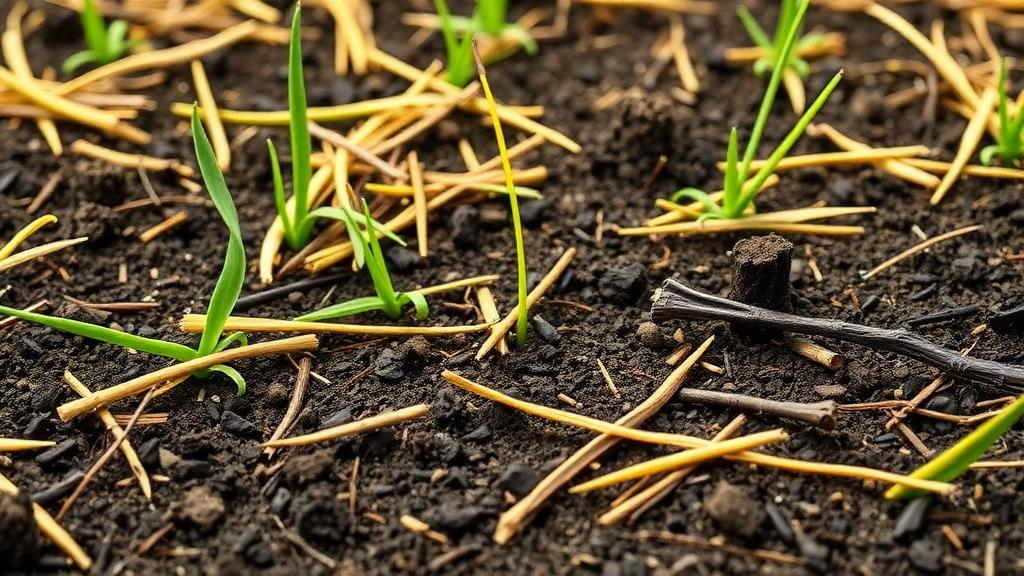
Biochar has long been prized as a stable form of carbon that farmers and climate planners can bury in soils, but a new laboratory study suggests the material does far more than simply sit in the ground as a passive reservoir. Researchers report that persistent free radicals on biochar surfaces, long-lived unpaired-electron species generated during pyrolysis, actively redirect the fate of fresh crop-residue carbon. Rather than merely speeding up decomposition, these radicals appear to steer straw-derived carbon toward mineral-associated organic matter, a soil fraction widely regarded as a long-term carbon repository. The work, published as an open-access original research article in the journal Biochar, offers one of the most direct experimental tests to date of how biochar’s surface redox chemistry shapes the transformation of plant carbon in soil.
The central question the team addressed is a stubborn puzzle in soil science. Returning crop residues to fields is the most widely practiced strategy for building soil organic carbon, yet residue carbon is notoriously ephemeral; more than half of it can be lost as carbon dioxide within the first year after incorporation. Biochar co-application has been proposed as a way to slow those losses, but studies of its effects have produced seemingly contradictory outcomes. Some experiments found that biochar accelerates the mineralization of residue-derived or native soil carbon, while others reported enhanced stabilization through increased formation of mineral-associated organic matter. A key complication is that previous comparisons typically used biochars that differed simultaneously in surface area, mineral composition, oxygen-containing functional groups, and radical abundance, making it nearly impossible to isolate the specific contribution of persistent free radicals.
To break that confounding, the researchers used a chemical quenching approach. They produced a single base biochar from maize straw pyrolyzed at 500 degrees Celsius under nitrogen, then treated it with graded concentrations of L-ascorbic acid, a radical scavenger, to create a continuous series of biochars designated BC-Q0 through BC-Q100. Electron paramagnetic resonance spectroscopy confirmed that the most strongly quenched material retained only about twelve percent of the radical signal of the unquenched biochar. Crucially, specific surface area and elemental composition did not differ significantly across treatments, meaning the quenching procedure selectively altered radical abundance without disturbing the bulk structure or chemistry of the material. This design allowed the team to attribute any differences in soil carbon behavior to radical activity rather than to other biochar properties.
The incubation experiment combined these graded biochars with isotopically labeled straw in two contrasting agricultural soils from northern China. Maize plants were grown in a controlled chamber continuously supplied with carbon-13 dioxide, producing straw with a delta carbon-13 value of plus 450 per mil, a signature distinct enough to trace residue carbon through the soil system. The soils were a black soil from Heilongjiang Province, classified as a Pachic Haploboroll, with high organic carbon content of 28.5 grams per kilogram and a pH of 6.8, and a fluvo-aquic soil from Hebei Province, a Haplic Cambisol with lower organic carbon of 12.3 grams per kilogram and a pH of 8.1. Soils received carbon-13-labeled straw at one percent by weight and biochar at two percent, then were incubated in sealed jars at 25 degrees Celsius for 84 days, with destructive sampling on days 1, 3, 7, 14, 28, 56, and 84.
The first major finding concerns hydroxyl radical production. Biochar-associated persistent free radicals are known to activate molecular oxygen and generate reactive oxygen species, and the experiment showed this happens in a dose-dependent manner in soil. The highest-PFR treatment generated 6.1-fold higher hydroxyl radical levels than the straw-only control in black soil and 18.1-fold higher levels in fluvo-aquic soil. Hydroxyl radical production rates correlated positively with radical spin concentrations measured by electron paramagnetic resonance, with correlation coefficients of 0.89 in black soil and 0.96 in fluvo-aquic soil. This abiotic oxidation accelerated the early-stage mineralization of straw carbon: relative to the straw-only control, first-order mineralization rate constants under the unquenched biochar increased by 49.8 percent in black soil and 47.5 percent in fluvo-aquic soil during the first two weeks.
That acceleration, however, did not translate into greater net carbon loss. Instead, the oxidation redirected straw-derived carbon along a different chemical trajectory. Dissolved organic matter aromaticity, indexed by the specific ultraviolet absorbance at 254 nanometers, rose most rapidly within the first 14 days in the high-radical treatments, coinciding with elevated hydroxyl radical production. By the end of the incubation, fractionation of the soils revealed that increasing biochar radical activity significantly raised the proportion of straw-derived carbon incorporated into mineral-associated organic matter. Under the highest radical treatment, straw-derived carbon accounted for 64.2 plus or minus 2.1 percent of total mineral-associated organic matter carbon in black soil and 60.0 plus or minus 1.4 percent in fluvo-aquic soil, compared with 59.4 plus or minus 1.9 percent and 53.8 plus or minus 2.1 percent in the corresponding straw-only controls. Solid-state carbon-13 nuclear magnetic resonance spectroscopy showed that the mineral-associated fraction formed under high-radical treatments also contained a higher proportion of aromatic carbon derived from straw.
To quantify how these pieces fit together, the researchers built a structural equation model integrating radical activity, hydroxyl radical production, chemical transformation indicators, microbial functional measures, and mineral-associated carbon accumulation. The model showed good fit, with a goodness-of-fit statistic of 0.83, and explained 48 percent of the variance in chemical transformation, 98 percent in microbial functional indicators, and 94 percent in mineral-associated accumulation. Persistent free radicals exerted a strong direct effect on hydroxyl radical production, with a path coefficient of 0.61, which in turn strongly influenced chemical transformation indicators, with a coefficient of 0.70. Chemical transformation showed a dominant effect on microbial functional responses, at 0.95, and a strong total effect on straw-derived mineral-associated accumulation. Overall, indirect effects accounted for the majority of the total influence of the radicals on stabilization, with pathways mediated primarily through hydroxyl-driven chemical transformation rather than direct microbial effects.
The microbial data reinforce that interpretation. Along the radical gradient, bacterial taxa linked to aromatic compound degradation and oxidative stress tolerance, including members of Sphingomonadaceae, Burkholderiaceae, and Comamonadaceae, became more abundant, while taxa associated with rapid decomposition of labile polysaccharides, such as Streptomycetaceae and Micromonosporaceae, declined. Fungal communities shifted in parallel: Fusarium, Mortierella, and Penicillium decreased in relative abundance with increasing radical activity, whereas Chaetomium and members of Agaricomycetes increased. Polyphenol oxidase activity, a functional marker of oxidative carbon processing, rose significantly under high-radical treatments and correlated positively with the proportion of straw-derived carbon stabilized in the mineral-associated fraction. In the authors’ framing, microbes acted mainly as secondary responders to chemically transformed substrates rather than as the initiators of straw carbon transformation.
The magnitude of the effect differed between the two soils, and the authors attribute that to soil properties. The black soil, with its near-neutral pH and higher native organic carbon, showed greater hydroxyl radical production and mineral-associated formation than the alkaline, carbon-poor fluvo-aquic soil. Near-neutral conditions generally favor hydroxyl radical generation over alkaline environments, and soils richer in native organic carbon contain larger pools of dissolved, redox-active compounds that can facilitate oxidative transformation. The authors therefore suggest the mechanism is broadly applicable across contrasting agricultural soils, while its efficiency is modulated by intrinsic soil physicochemical properties, particularly pH and native soil organic carbon.
Important limitations temper these findings, and the authors are explicit about them. The work was conducted under controlled laboratory conditions with a single biochar made from one feedstock at one pyrolysis temperature, over an 84-day incubation with four replicates per treatment. Chemical transformation was inferred from reactive oxygen species production, dissolved organic matter characteristics, and nuclear magnetic resonance analyses rather than direct molecular identification of intermediates; the relative contributions of biochar-derived, background soil, and incubation-generated radicals were not resolved, and individual straw components such as cellulose, hemicellulose, and lignin were not separately tracked. Microbial functional responses were assessed through community composition and enzyme activity rather than gene expression. The authors call for component-specific analyses, high-resolution molecular characterization, multi-omics approaches, diverse biochar materials, and validation under field-realistic conditions, including drying-rewetting cycles and fluctuating temperatures, before the mechanism can be generalized. Even so, the study reframes biochar as a chemically active regulator of soil carbon pathways and offers a mechanistic basis for designing biochars that enhance the persistence of residue-derived carbon in soil.
Subject of Research: Biochar persistent free radicals and the stabilization of straw-derived carbon in soil
Article Title: Persistent free radicals on biochar surfaces redirect straw-derived carbon toward mineral-associated organic matter
Article References: Yuan, D., Yuan, J., Hao, X., Dong, X., Wu, P., Zhang, Y., Yu, Z., & Qin, S. (2026). Persistent free radicals on biochar surfaces redirect straw-derived carbon toward mineral-associated organic matter. Biochar, 8(1), Article 147. https://doi.org/10.1007/s42773-026-00658-0
Image Credits: AI Generated
DOI: 10.1007/s42773-026-00658-0
Keywords: biochar, persistent free radicals, soil organic carbon, mineral-associated organic matter, hydroxyl radical, carbon sequestration, straw decomposition, 13C labeling, soil incubation, structural equation modeling, microbial communities, redox chemistry
Cite Scienmag News
Alan Morgan. (October 30, 2026). Biochar surface radicals steer straw carbon into stable soil pools. Scienmag. https://scienmag.com/biochar-surface-radicals-steer-straw-carbon-into-stable-soil-pools/
Alan Morgan. "Biochar surface radicals steer straw carbon into stable soil pools." Scienmag, 30 October 2026, https://scienmag.com/biochar-surface-radicals-steer-straw-carbon-into-stable-soil-pools/. Accessed 30 October 2026.
Alan Morgan. "Biochar surface radicals steer straw carbon into stable soil pools." Scienmag. October 30, 2026. https://scienmag.com/biochar-surface-radicals-steer-straw-carbon-into-stable-soil-pools/