


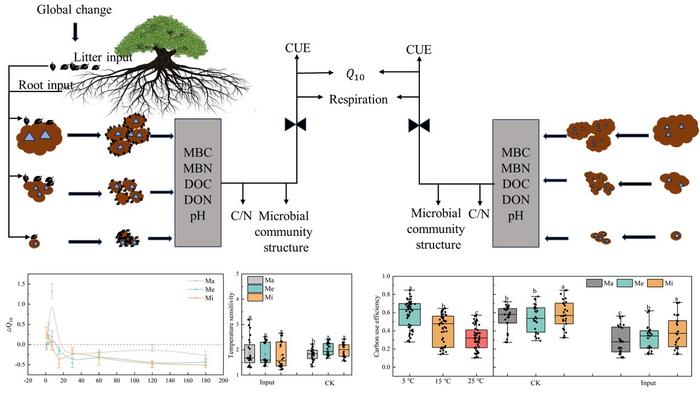
The Qinghai-Tibet Plateau is one of the most dramatically affected regions by global warming. For a long time, the region has been exposed by low temperature and soil moisture, which led to the severe inhibition of the soil biological activities and decomposition enzyme systems. As a result, the soil organic matter in this region decomposes slowly and accumulates in large quantities, underscoring its substantial potential for carbon release. In the face of climate warming, the low-temperature limiting effect of soil ecological processes will be weakened or eliminated, thereby affecting the soil carbon cycling in the regional ecosystem. However, the increased input of organic matter in soil caused by warming would strongly affect soil C cycling and microbial activities. Researchers conducted exogenous organic matter addition experiments to explore the effects of organic matter input and warming coupling on soil aggregate-scale respiration and microbial activities. The researchers’ finding appeared January 19, 2024 in Soil Ecology Letters.

Credit: Yi Liu Lab
The Qinghai-Tibet Plateau is one of the most dramatically affected regions by global warming. For a long time, the region has been exposed by low temperature and soil moisture, which led to the severe inhibition of the soil biological activities and decomposition enzyme systems. As a result, the soil organic matter in this region decomposes slowly and accumulates in large quantities, underscoring its substantial potential for carbon release. In the face of climate warming, the low-temperature limiting effect of soil ecological processes will be weakened or eliminated, thereby affecting the soil carbon cycling in the regional ecosystem. However, the increased input of organic matter in soil caused by warming would strongly affect soil C cycling and microbial activities. Researchers conducted exogenous organic matter addition experiments to explore the effects of organic matter input and warming coupling on soil aggregate-scale respiration and microbial activities. The researchers’ finding appeared January 19, 2024 in Soil Ecology Letters.
They found that exogenous organic matter input increased the respiration rate and accumulation of aggregates, and changed the respiration rate pattern among aggregates with different particle sizes. The temperature sensitivity of soil aggregate respiration increased at the beginning of incubation due to exogenous organic matter and decreased thereafter. Microbial carbon use efficiency was negatively correlated with exogenous organic matter input, incubation temperature, and aggregate size.
They thought that the relationship between temperature sensitivity of soil aggregate respiration and soil quality index (SQI) supported the Carbon Quality Temperature hypothesis, highlighting the effect of SQI on Q10. However, this relationship was not so obvious at the early stage of exogenous organic matter input. Their findings highlighted the complexity of the interaction between climate change and exogenous organic matter inputs and their importance in soil carbon dynamics. Their results also emphasised the importance of considering the effects of exogenous organic matter and soil aggregates when modeling soil C cycling.
“As the largest carbon pool in terrestrial ecosystems, soil should fully utilize its carbon sequestration potential and increase its carbon content, which is of great significance for addressing global change,” said Professor Liu.
Soil is closely related to our lives. It is essential for food security, water security and overall ecosystem health. Today in the Anthropocene, it is more important than ever to monitor and enhance soil organic carbon content.
Journal
Soil Ecology Letters
Method of Research
Experimental study
Subject of Research
Not applicable
Article Title
Influence of organic matter input and temperature change on soil aggregate-associated respiration and microbial carbon use efficiency in alpine agricultural soils
Article Publication Date
19-Jan-2024
Cite Scienmag News
Morgan Morrow. (April 18, 2024). Warming and exogenous organic matter input affected temperature sensitivity and microbial carbon use efficiency of agricultural soil respiration on the Qinghai-Tibet Plateau. Scienmag. https://scienmag.com/warming-and-exogenous-organic-matter-input-affected-temperature-sensitivity-and-microbial-carbon-use-efficiency-of-agricultural-soil-respiration-on-the-qinghai-tibet-plateau/
Morgan Morrow. "Warming and exogenous organic matter input affected temperature sensitivity and microbial carbon use efficiency of agricultural soil respiration on the Qinghai-Tibet Plateau." Scienmag, 18 April 2024, https://scienmag.com/warming-and-exogenous-organic-matter-input-affected-temperature-sensitivity-and-microbial-carbon-use-efficiency-of-agricultural-soil-respiration-on-the-qinghai-tibet-plateau/. Accessed 4 September 2026.
Morgan Morrow. "Warming and exogenous organic matter input affected temperature sensitivity and microbial carbon use efficiency of agricultural soil respiration on the Qinghai-Tibet Plateau." Scienmag. April 18, 2024. https://scienmag.com/warming-and-exogenous-organic-matter-input-affected-temperature-sensitivity-and-microbial-carbon-use-efficiency-of-agricultural-soil-respiration-on-the-qinghai-tibet-plateau/

